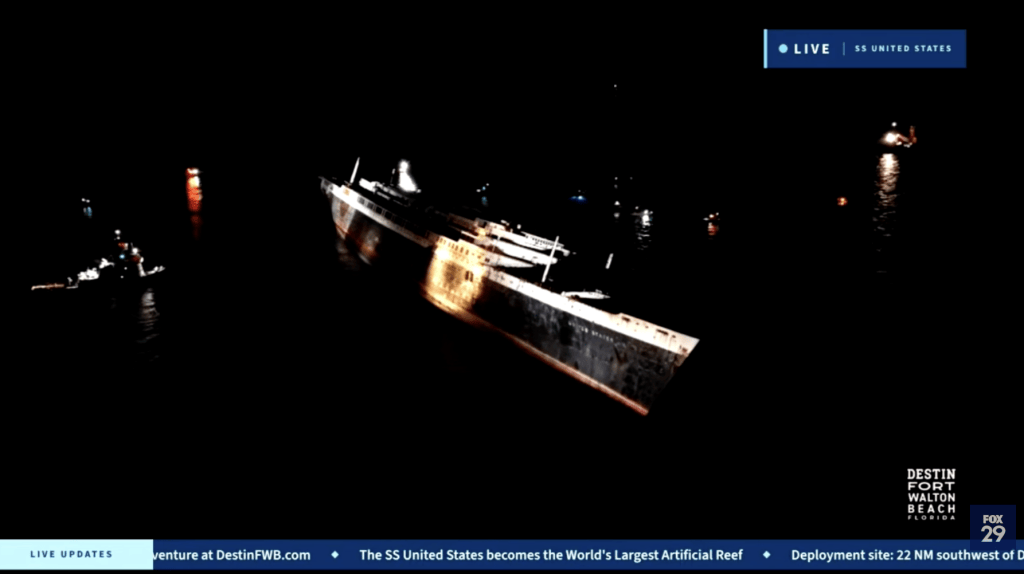
The renowned SS United States, once the fastest ocean liner, embarked on its final aquatic voyage on Wednesday. This legendary ship, longer than the Titanic and having crossed the Atlantic over 800 times, was purposefully sunk to the Gulf of Mexico’s floor. It now begins a new chapter as the world’s largest artificial reef.
Despite predictions of a swift submersion, the massive vessel’s descent took longer than anticipated. By nightfall, remnants of the ship were still visible off Florida’s coastline. The controlled sinking, planned meticulously over years at a cost of $13.5 million, aims to attract divers and fishing enthusiasts while providing a habitat for marine life.
Coleen O’Malley, president of Coleen Marine, remarked on the ship’s resilience, comparing its strength to the nation it represents. The process was prolonged due to the task of filling 128 tanks to ensure even placement on the ocean floor. Nick Tomecek of Okaloosa County, involved in organizing the event, explained the complexity, stating, “She’s a big ship.”
A Vessel with a Storied Past
The SS United States launched in 1952 as a technological marvel, avoiding reduction to scrap metal through this project. Esteemed passengers over the years included Hollywood’s Grace Kelly and Elizabeth Taylor, and leaders such as Presidents Harry Truman and John F. Kennedy. In preparation for its transformation, crews removed its smokestacks to feature in a new museum dedicated to the liner’s history.
One significant restriction involved prohibiting explosives due to federal regulations. The removal of pipes and additional modifications, like creating openings in the hull, facilitated the flooding needed for the ship’s descent. Situated in 180 feet of water, its top deck remains reachable for novice divers.
The Legacy of the Record-Holder
Built by over 3,000 workers between 1950 and 1951, the SS United States set a transatlantic speed record outperforming the RMS Queen Mary in 1952. Susan Gibbs, granddaughter of the ship’s designer, highlighted the ship’s embodiment of pride and resilience.
With its new resting place among over 500 artificial reefs near Pensacola, the site is positioned to enhance the area’s prestige as a diving destination. The largest prior artificial reef derived from the USS Oriskany establishes this region’s underwater appeal. Tomecek expressed aspirations to elevate the Gulf into a premier diving location. Though decommissioned in 1969, the ship’s legacy prevails, partially preserved by its smokestacks destined for museum display.
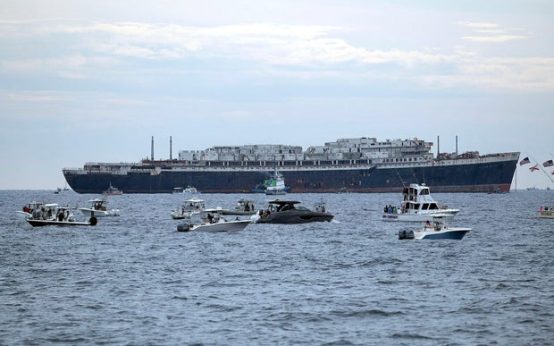 Historic Ocean Liner SS United States Transformed into Artificial Reef
 Pumpkin Smash Event Combines Fun and Environmental Benefits
 Grizzly Bears Identified in Fatal Canada Attack
 Governor Newsom to Attend UN Climate Conference in Turkey
 Aspen Fire Crews Embrace Drone Technology
 The Cycle of Life in Butterfly Milkweed and Seed Dispersal