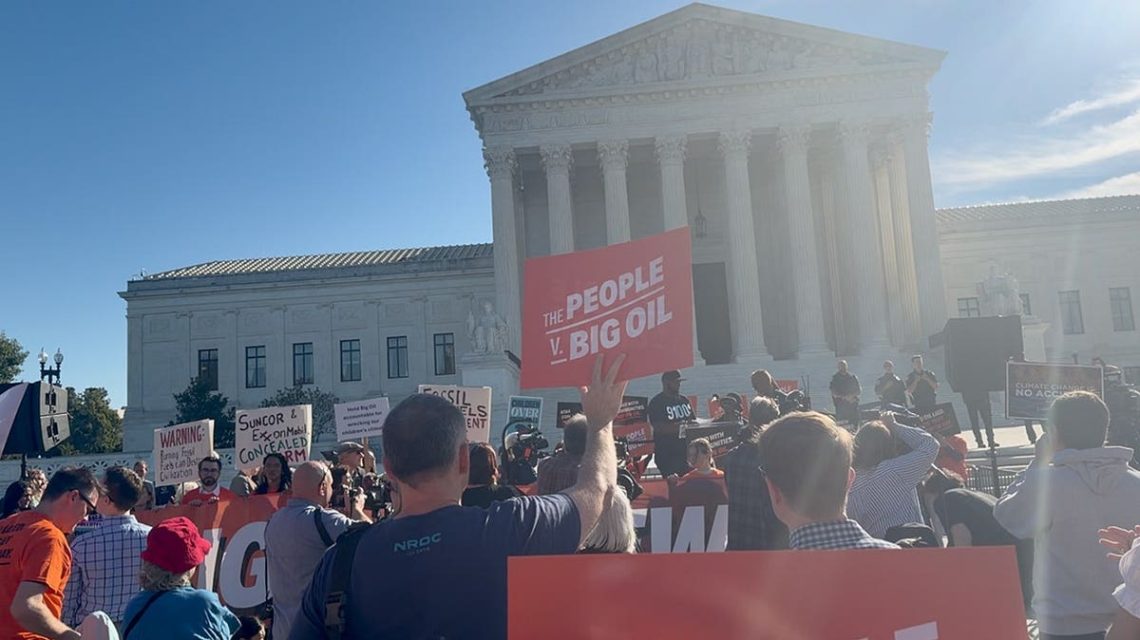
A Supreme Court case, Suncor v. Boulder, sharpens focus on potential financial consequences for oil companies and consumers. Energy policy experts express concern over the possibility of cities and states seeking billions in damages from the fossil fuel industry.
“Mass exodus would create more scarcity with fuel, higher prices,” Jason Isaac, CEO of American Energy Institute, shared with Fox News Digital, emphasizing the control over hydrocarbon use.
The legal dispute examines if federal law prohibits state-level lawsuits against oil companies for climate harm attributed to cross-border emissions. Justice Clarence Thomas questioned Boulder attorney Kevin Russell about potential litigation reaching beyond oil producers, possibly implicating large retailers.
During oral arguments, Justice Brett Kavanaugh discussed the financial impact of widespread lawsuits on oil companies, suggesting possible bankruptcy signs, and noted the risk of similar claims extending to various manufacturers or businesses.
“Nothing in our theory prevents that,” Russell affirmed, acknowledging state tort law might limit these lawsuits.
Boulder, Colorado, initiated a lawsuit against ExxonMobil and Suncor Energy in 2018. The lawsuit claims the companies contributed to climate change, while misleading the public on fossil fuel dangers. Boulder seeks restitution for escalating climate-related costs, with similar legal actions in several cities, including Portland and Baltimore.
The lawsuit accuses ExxonMobil of concealing climate risks since the 1970s, referencing a 1977 internal memo acknowledging fossil fuels’ impact on CO2 emissions rise.
David Bookbinder, previous counsel for Boulder, described the legal strategy as an “indirect carbon tax.” Boulder argues state laws empower Colorado to address harm from company activities, supported by Russell’s statement emphasizing state torts to provide remedies.
O.H. Skinner, of the Alliance for Consumers, commented on the lawsuits as judicial attempts to realize policy objectives Congress has not achieved, focusing on a “backdoor carbon tax” or bankrupting the energy sector.
Justice Samuel Alito abstained from the case without elaboration. Experts warn a Supreme Court decision supporting Boulder could lead to multiple jurisdictions pursuing similar claims, thereby raising energy costs for consumers.
Isaac noted, “Over 90,000 governmental entities in the U.S. could begin lawsuits against energy companies, driving up the cost to consumers due to defense expenses.”
Mentioning broader economic risks, Skinner discussed lawsuits potentially targeting entities beyond oil producers, including gas stations and utility firms.
Skinner explained, “From Boulder’s perspective, any entity contributing to climate change could be accountable.”
Isaac drew distinctions between climate lawsuits and past tobacco or opioid cases, emphasizing greenhouse gas emissions’ broader, global nature.
ExxonMobil and Suncor base their defense on the argument that emissions travel globally, limiting state law’s power to impose liability for externally-originating emissions. They assert federal oversight is warranted in such matters.
Some states, including Utah, counter such pursuits, blocking related tort claims.
Utah Attorney General Derek Brown stressed potential national implications, “If Colorado’s stance prevails, gas prices could spike universally, with such decisions reserved for Congress.”
Elaine Mallon reports for Fox News Digital and Fox Business, covering national politics.
 Southern California Braces as Tropical Storm Rachel Approaches
  Hurricane Isaias Causes Widespread Disruption Along Gulf Coast
  Hurricane Isaias Brings Devastation and Uncertainty to the Southeast
  Hurricane Developments: Simon’s Intensification and Isaias’ Threat
  Trump Administration Moves to Expedite Arctic Oil Exploration
  Renewed Volcanic Activity At Kīlauea Prompts Trail Closures