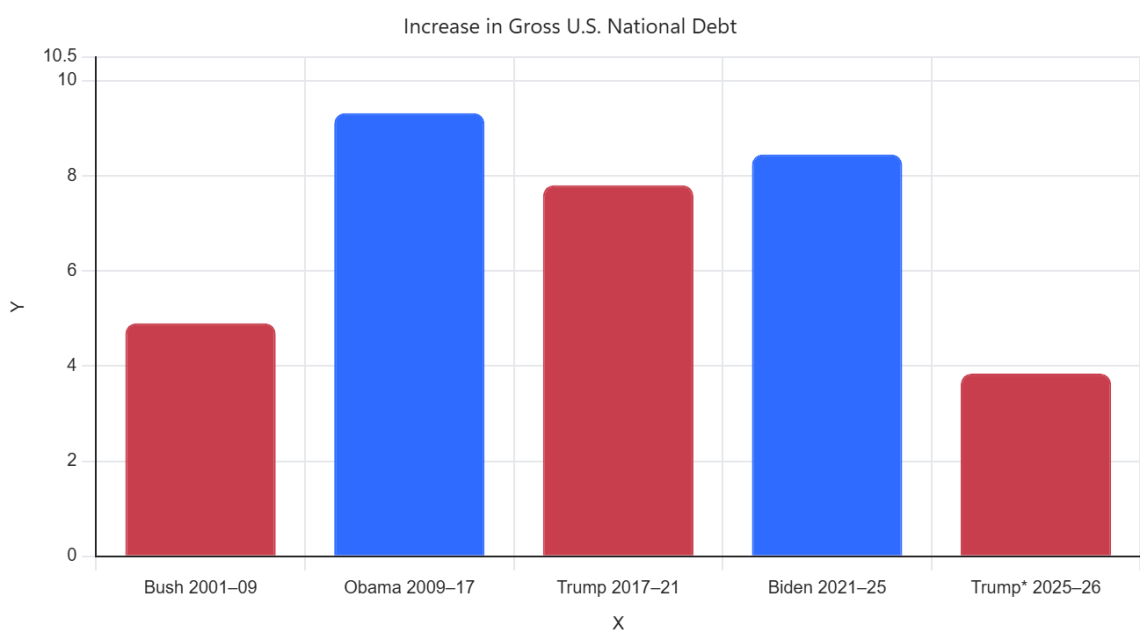
The United States recently crossed a historic threshold as its gross national debt reached approximately $40.05 trillion, per data from the Treasury Department. This is more than twice the $19.95 trillion recorded when Donald Trump entered office in January 2017. Federal borrowing has surged under both Republican and Democratic administrations due to wars, economic downturns, tax cuts, and emergency spending.
Understanding Gross Federal Debt
The $40 trillion debt represents total public outstanding debt, commonly referred to as gross federal debt. This includes about $32.27 trillion held by investors and $7.78 trillion in intragovernmental holdings such as Treasury securities. This milestone is crucial because the government has to pay interest on these obligations while continuing essential services like Social Security, Medicare, Medicaid, and defense.
Cost of Interest
In fiscal year 2026, interest costs totaled nearly $1.2 trillion, making it one of the largest categories of federal spending. The Congressional Budget Office (CBO) projects that debt held by the public will grow from around 101% of gross domestic product (GDP) in 2026 to 120% by 2036.
Debt Growth Under Different Presidencies
During Trump’s two nonconsecutive terms, national debt increased by approximately $11.6 trillion. This includes $7.8 trillion during his first term and $3.84 trillion since returning to office in January 2025. Comparatively, debt rose $8.4 trillion under Joe Biden, $9.3 trillion during Barack Obama’s eight years, and $4.9 trillion during George W. Bush’s presidency.
Kevin Thompson of 9i Capital Group highlights that various external factors also influence federal borrowing: “Crisis spending, whether it was bailouts during the GFC or COVID-era spending, increased deficits significantly.” Therefore, multiple administrations are often faced with crises that prevent meaningful fiscal austerity.
Growth Under Each President
Biden oversaw the largest increase in dollar terms over four years at $8.45 trillion, though the percentage increase was smaller than those under Bush, Obama, and Trump’s first term. According to financial experts, rising debt results from borrowing exceeding revenue and low GDP growth.
Obama saw an increase of $9.32 trillion or 87.7% over his presidency. In contrast, Bush’s presidency saw an 85.5% rise, from $5.73 trillion to $10.63 trillion, mostly due to foreign policy decisions and the financial crisis.
Alex Beene from the University of Tennessee underscores the need for future budgets to manage the current debt effectively rather than pointing fingers at past administrations.
Debt During Bush’s Presidency
Bush’s tenure included wars in Afghanistan and Iraq, tax reductions, and the financial crisis beginning around 2007. Emergency measures continued into Obama’s presidency, adding to the fiscal burden.
Beene notes the stark increase in per capita debt: “Two decades ago, the cost per American to eliminate the national debt was in the thousands. Today, it barely covers interest expenses.”
Debt During Obama’s Presidency
Obama inherited the worst financial downturn since the Great Depression. His administration took measures to stabilize the economy and tackle unemployment, compounded by declining federal revenue. During his terms, debt increased from about $10.63 trillion to $16.43 trillion and $19.94 trillion respectively.
Financial expert Michael Ryan stresses the significance of interest debts: “At $40 trillion, the danger lies in the interest bills, limiting room for future financial priorities.”
Debt Under Trump’s First Term
Trump’s first term saw a debt increase from roughly $19.95 trillion to $27.75 trillion, driven by the 2017 Tax Cuts and Jobs Act and COVID-19 pandemic borrowing.
Ryan outlines fiscal responsibility concerns regarding Bush and Trump, highlighting inherited budget surpluses and deficits prior to COVID-19.
Debt Increase Under Biden
During Biden’s presidency, debt rose from $27.75 trillion to $36.21 trillion, influenced by recovery spending and increased costs of mandatory federal programs. Rising debt correlates with declining dollar buying power and a growing wealth gap, warns Beene.
Trump’s Second Term
Trump’s return to office in 2025 commenced with gross debt at $36.21 trillion, escalating to $40.05 trillion by this week. Legislation extending the 2017 tax law and raising the debt ceiling significantly contributed to this increase.
White House spokesperson Kush Desai emphasizes focusing on reducing unnecessary spending, while Treasury Secretary Scott Bessent claims growth strategies can mitigate the impact, stating “There’s nothing magical about the $40 trillion number. We can grow our way out of it.”
Future Debt Projections
The national debt is expected to rise unless spending aligns more closely with revenue. The Peter G. Peterson Foundation projects debt reaching $50 trillion in six years without fiscal reforms, and the CBO estimates public-held debt could hit 120% of GDP by 2036.
Kevin Thompson states the responsibility lies with Congress: “They pass legislation that directs federal spending and taxation. Congress, not just the president, must get our fiscal house in order.”