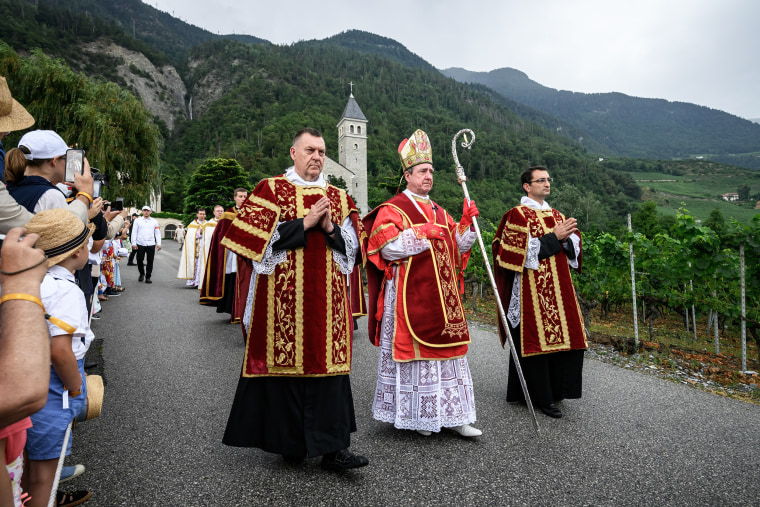
The small Swiss town, surrounded by vineyards and mountains, witnessed a significant event that unsettled the Catholic Church. An ultraconservative Catholic group, the Society of St. Pius X (SSPX), consecrated four new bishops. This act directly contravened the church’s canon law and ignored Pope Leo XIV’s calls for unity.
Thousands of people, including hundreds of robed priests, attended the five-hour ceremony. It was broadcast globally, bringing attention to the split within the church. Following the event, the Vatican excommunicated SSPX’s six bishops.
Event Details
The SSPX held the ceremony on Wednesday, appointing Pascal Schreiber, Michael Goldade, Michel Poinsinet de Sivry, and Marc Hanappier as bishops. Bishop Alfonso de Galarreta, himself consecrated without papal approval in 1988, performed the ancient ritual. This act violates canon law, leading to automatic excommunication.
Pope Leo XIV had previously expressed concern, writing to the society’s superior, Rev. Davide Pagliarani, to postpone the event for the church’s unity. Leo warned that the ceremony would deny followers valid sacraments.
Background of the Society of St. Pius X
The Society of St. Pius X, named after Pope Pius X, began in 1970 by Archbishop Marcel Lefebvre. It opposed the modernizing reforms of the Second Vatican Council (Vatican II). Vatican II aimed to improve relations between the church and other religions and introduced Mass in local languages, which SSPX opposes. The society favors the traditional Latin Mass, asserting it maintains mystery and formality.
After Lefebvre consecrated four bishops without consent in 1988, he and those bishops were excommunicated. Despite this, the SSPX continues to grow, operating in numerous countries with a significant following.
Response and Consequences
Gemma Simmonds, a Catholic nun, explained that SSPX’s actions indicate a preference for old church rules over new ones. SSPX chose to stand against church teachings, knowing it would provoke serious consequences.
Pope Benedict XVI once attempted reconciliation, permitting the Latin Mass and lifting excommunications. However, this effort faced challenges, notably due to controversial statements by Bishop Richard Williamson. Pope Francis also sought to ease tensions, allowing SSPX priests to perform certain sacraments, but recent events led to the Vatican reversing these concessions.
Pope Leo made efforts to bridge the divide, yet the SSPX’s decision resulted in the recognition of their choice and its repercussions.
Historical Schisms
The Catholic Church experienced other significant splits, such as the East-West Schism in 1054, where the Western and Eastern churches excommunicated each other. The Reformation in the 16th century, led by Martin Luther and John Calvin, further divided Christianity and led to Protestantism’s emergence.
 Ontario Synagogue Shooting During Yom Kippur Leaves One Officer and Shooter Injured
  Pope Leo XIV’s Upcoming Visit to Latin America: An Overview
  Ukraine Deploys Ground Robots in ‘Operation Vivaldi’
  Understanding AI’s Impact Compared to Historical Threats
  State Department Alerts on Middle East Travel Amid Rising Tensions
  Iran’s Attacks on Bahrain: The Impact on Military Families