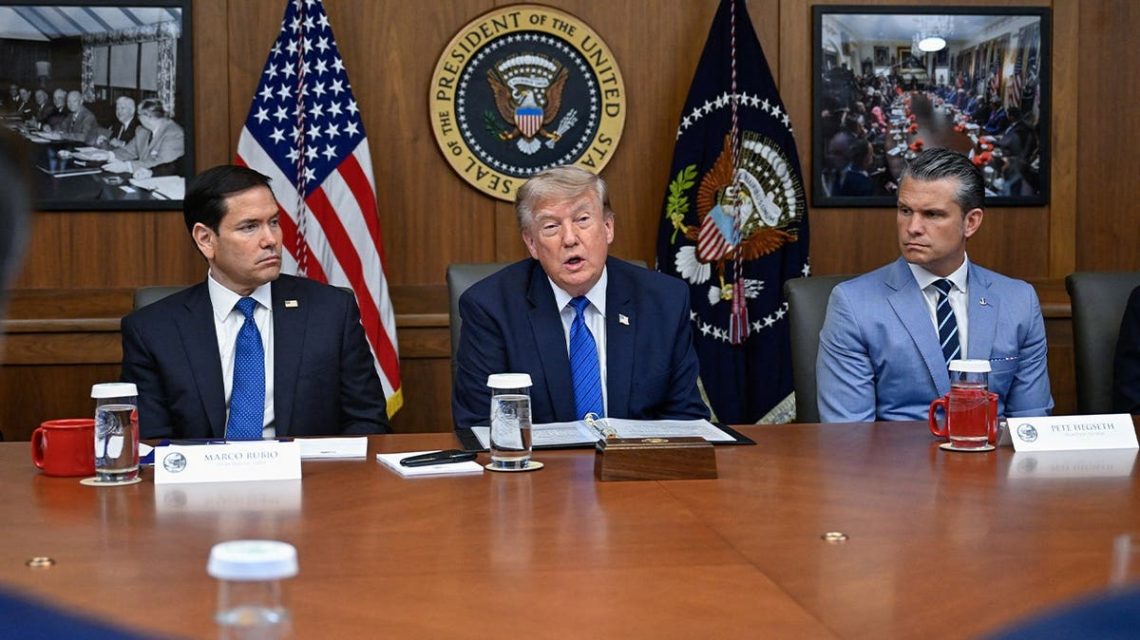
President Donald Trump expressed on Friday that Americans should brace for continued conflict with Iran. He predicted Tehran would eventually weaken due to ongoing U.S. strikes, which are diminishing its ability to retaliate.
Preparedness for Prolonged Conflict
When questioned if the hostilities might persist until Iran loses its striking capability, Trump confirmed, “Yeah, sure, I think so. I’d be foolish to say no. You know, you always have to keep your guard up.” He reflected that although Iran may regain some strength, it will eventually diminish.
“They’ll get weaker. They’ll get a little stronger, maybe. But they’ll get weaker, and then they peter out,”
he said during a Cabinet meeting at Camp David, Maryland.
Recent U.S. Military Actions
Despite Trump’s assertions that U.S. forces had severely weakened Iran, the conflict seemed poised to continue. Trump highlighted Iran’s lack of naval, air, and anti-aircraft capabilities, yet acknowledged they retain some limited strength.
The White House had previously declared in April that Operation Epic Fury’s goals were met, including the destruction of Iran’s naval forces and certain missile capabilities. Despite these claims, Iran continued to launch missiles and drones at U.S. targets.
Failed Negotiations and Renewed Attacks
Trump also conveyed skepticism regarding a peace deal with Iran, accusing them of dishonesty in negotiations.
“They do lie, and they do misrepresent,”
he stated, describing his growing frustration.
The situation complicates as the U.S. nears the November midterm elections, increasing pressure on Trump to clarify the conflict’s resolution.
On two occasions, U.S. Central Command executed attacks on Iranian sites as retaliation for assaults on U.S. forces. These strikes targeted Islamic Revolutionary Guard Corps locations, including command centers and missile sites.
Failed Peace Efforts
A peace agreement reached in June aimed to halt hostilities and resume commercial activity through the Strait of Hormuz. However, hostilities rekindled in July following Iran’s aggression against vessels in the vital waterway.
Despite attempts by Oman, Qatar, Pakistan, and Egypt to revive the previous agreement, disputes over the strait, sanctions, and nuclear concerns have stalled negotiations. New conflicts have further diminished the likelihood of a deal, marking a notable shift from Trump’s earlier optimism about resolving the conflict.
 Venezuelan Leadership at the United Nations
  Ontario Synagogue Shooting During Yom Kippur Leaves One Officer and Shooter Injured
  Pope Leo XIV’s Upcoming Visit to Latin America: An Overview
  Ukraine Deploys Ground Robots in ‘Operation Vivaldi’
  Understanding AI’s Impact Compared to Historical Threats
  State Department Alerts on Middle East Travel Amid Rising Tensions