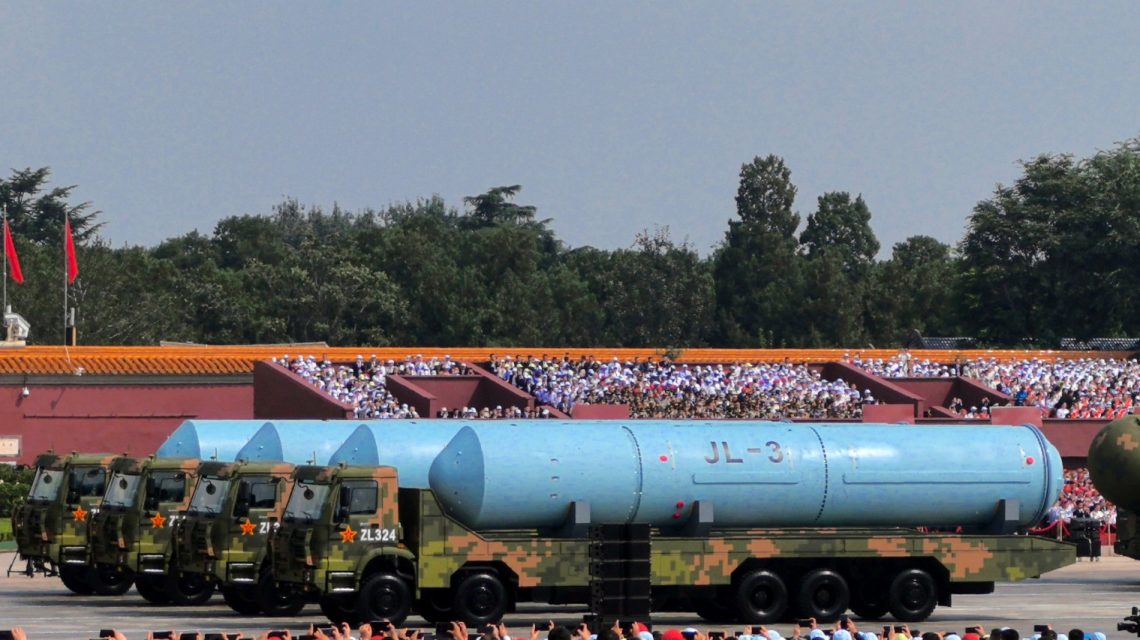
The United States, along with 40 other countries, has called for advance notice of missile launches following China’s recent test of a nuclear-capable missile. Last month, China test-fired a missile believed to be a Julang-2 or Julang-3 intercontinental ballistic missile (ICBM) from a submarine. Although the missile was equipped with a dummy warhead, it traveled approximately 4,500 miles over the Pacific Ocean, causing concern among nations in the region.
Treaty allies such as Japan and Australia condemned the launch, labeling it destabilizing. They highlighted that Beijing provided only two hours’ notice before the launch. The Marshall Islands and Palau, two U.S.-aligned Pacific nations that signed the joint statement, also lodged official protests.
The joint statement released on Tuesday noted, “Recent missile testing activity in the Pacific area did not follow the standard practices adopted by most states to notify and deconflict ICBMs, submarine-launched ballistic missiles, and space launch vehicles.” It warned that unannounced tests involving nuclear-capable missiles are “dangerous” and “increase the risk of miscalculation.” The statement urged “all countries, particularly nuclear-weapon states” to provide a minimum of 24 hours’ notice.
China Responds to U.S. Criticism
In response, China dismissed the U.S.’s accusations of destabilization as “double standards”. During a United Nations-linked disarmament conference in Geneva, Chinese Ambassador for Disarmament Affairs Li Chijiang stated that China has always conducted ICBM tests safely and responsibly. He accused the U.S. of “political manipulation” and noted that while China has conducted only three ICBM test launches, the U.S. has carried out over 300.
However, experts argue that the recent Chinese test was fundamentally different from typical U.S. tests. The missile’s path traversed island states in a manner that U.S. tests do not, as emphasized by Robert Underwood, former congressman and director of the Pacific Center for Island Security.
“This test is about China demonstrating the viability of its nuclear triad and a strategic counter-strike capability,” Underwood explained.
Concerns Over China’s Expanding Arsenal
U.S. officials remain concerned about China’s rapidly growing nuclear arsenal. The Stockholm International Peace Research Institute estimated that China’s stockpile could reach at least 600 warheads by early 2025, up from about 350 in 2020. Despite calls from the U.S. to join nuclear arms-limitation talks, Beijing insists its stockpile is at the minimum level needed for defense and remains significantly smaller than those of the U.S. and Russia.
The Pentagon and Chinese Foreign Ministry declined to comment on the issue when contacted by Newsweek.
 Wisconsin Governor’s Race: Prediction Market Shifts Favor Democrats
  Alexandria Ocasio-Cortez: Personal Developments and Political Implications
  Kremlin’s Actions Against Anti-War Party Expose Propaganda
  Chicago’s Struggle with Education and Governance
  Large Solar Eclipse to be Visible Across Parts of Europe and Asia
  Nixon’s “Saturday Night Massacre” and Its Echoes in Modern Politics