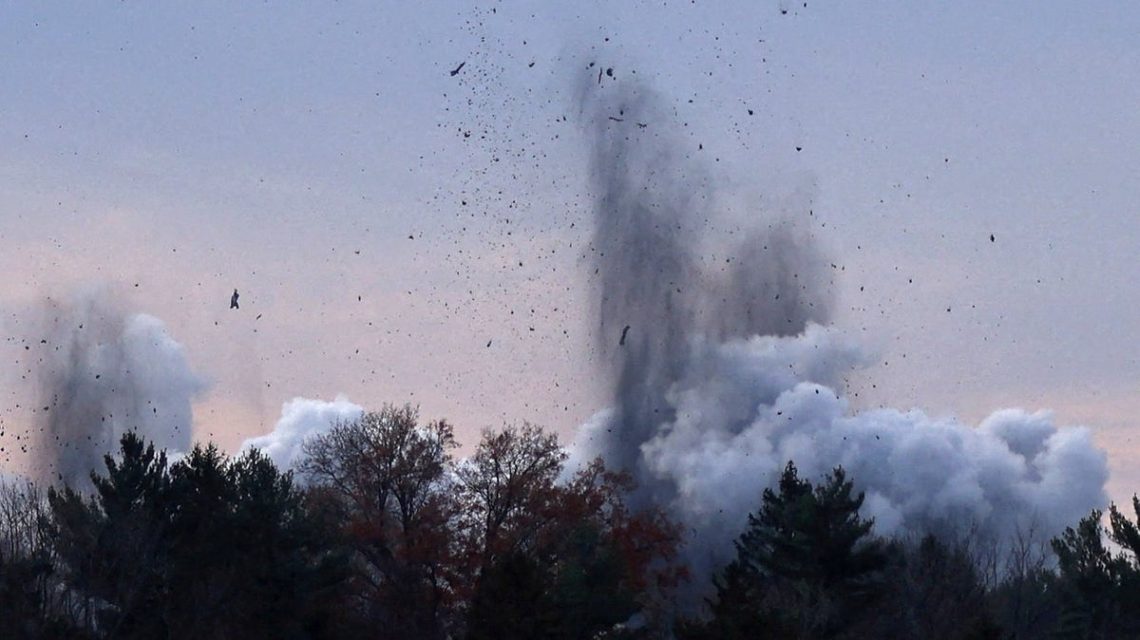
The U.S. Army has conducted a planned detonation of nearly 5 tons of degraded lead azide at its ammunition facility in Middletown, Iowa, after multiple postponements and a federal court directive. The detonation resulted in two audible explosions near the site, as confirmed by video footage.
A high-ranking official from the Trump administration mentioned that the explosion “exceeded all expectations,” achieving “maximum mitigation.” President Donald Trump supported this view via a brief social media post, indicating initial reports showed the mitigation efforts were effective.
Missouri Governor Mike Kehoe verified the explosion occurred approximately 15 minutes after it was heard. Updated Army maps had suggested that the blast’s residue could drift southwest toward Missouri’s northeastern area.
The Army initiated the detonation on November 25, 2026, at the Iowa Army Ammunition Plant. According to Kehoe’s social media post, early assessments from federal partners and Iowa Homeland Security and Emergency Management indicate that the mitigation strategies successfully contained the explosion.
Before the detonation, there were concerns from local residents and environmental advocates about the risk of toxic lead dust affecting nearby communities. To address these concerns, the Army used extensive barriers and specialized gels to capture potential fallout.
Following the explosion, FEMA advised residents within a 20-mile radius who had not evacuated to continue sheltering in place and adhere to EPA safety recommendations. FEMA Administrator Cameron Hamilton mentioned a “sigh of relief” within the Army’s command center, noting that containment efforts appeared successful in preventing a significant lead plume.
In the weeks ahead, federal agencies plan to conduct air and soil sampling. The Department of Agriculture will also assess nearby farms to evaluate any potential impact.
Officials universally agreed that a controlled detonation of the 68 barrels of lead azide was safer compared to the risk of a spontaneous explosion. Lead azide, already crystallized, was highly unstable, making it sensitive to heat, shock, and friction. The cold temperatures in Middletown could have exacerbated this instability, increasing the likelihood of an unplanned explosion.
 Thanksgiving Reflections on America’s Agricultural Heritage
 Trump Considers Pardoning Nvidia CEO Jensen Huang Amidst Allegations
 Bystanders Stop Alleged Attack in Women’s Restroom at In-N-Out Burger
 Plane Crash off Mississippi Coast Initiates Search and Rescue
 FBI Special Agent Discusses Investigation of Peoria Explosive Device
 Presidential Turkey Pardon: A Look at the Tradition and the Arrival of Gobble and Waddle