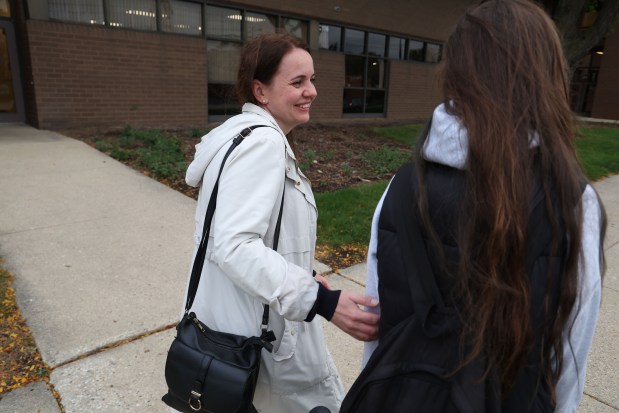
Yaryna Levchuk, a Ukrainian native, has dedicated her life to working tirelessly. When war erupted in Ukraine four and a half years ago, she, a seasoned pharmacist, began volunteering to handle medical aid while maintaining her regular job. Forced to flee Ukraine, she and her family resettled in the Chicago area of the United States. Levchuk quickly sought employment upon authorization to work and vigilantly adhered to immigration deadlines to safeguard her work eligibility—a crucial factor for her family’s survival and personal pride.
Currently, inconsistent policies and processing delays are obstructing Levchuk’s ability to work; her husband may soon face similar difficulties. This has left the family questioning their future in the U.S. Levchuk said, “We’re just friendly asking, if it’s possible, please help us. Just give us permission to work and we will work.”
A tense situation loomed for over 100,000 Ukrainian refugees in the U.S. Protected under Temporary Protected Status (TPS), their circumstances were uncertain as protections seemed set to expire on a Monday. With the war continuing in Ukraine, refugees like Levchuk worry about what comes next—if they can continue working, pursue education, or risk deportation.
The Trump administration’s recent announcement of maintaining TPS for now—without a formal declaration—has placed Ukrainians in a state of limbo. This uncertainty, fostered by lack of acknowledgment from federal officials, raises fears among refugees trying to navigate their legal status amid the war back home.
Meanwhile, those seeking other protection pathways face delays due to slowed processing times. Complicating matters further are deteriorating relations between Ukraine and the U.S., potentially affecting U.S. assistance to Ukraine and related policies like TPS.
Levchuk’s work authorization expired, resulting in job loss as a pharmacy technician. “I don’t know what to do,” she expressed, concerned about her husband’s employment status. Five years ago, Levchuk lived near Ukraine’s Polish border with her family. When warned of impending war, she and her husband cautiously prepared for their children’s safety. As the conflict erupted in February 2022, her husband joined Ukraine’s army, while Levchuk stayed behind sorting aid supplies for the frontline. However, separation from her children proved too difficult, prompting her to reunite with them in Poland.
With her husband’s declining health and her sister’s insistence, Levchuk eventually moved to the U.S. through the Uniting for Ukraine (U4U) program—a “humanitarian parole” initiative launched by President Biden in 2022. It allowed Ukrainians to temporarily stay and work in the U.S. as long as they found a willing American sponsor. Arriving in Buffalo Grove in late September 2022, Levchuk immediately sought employment, overcoming limited English skills and transportation challenges to secure pharmacy technician roles for both herself and her husband.
As they adapted, Levchuk pursued credentials to practice as a pharmacist. Her first parole period expired in 2024, prompting timely reapplication for parole and TPS. According to Nicole Hallett, Director of the Immigrants’ Rights Clinic at the University of Chicago Law School, U4U and TPS intentionally complement each other. TPS, granted at the Secretary of Homeland Security’s discretion, allows legal residence and work for people fleeing unsafe homelands, renewed for set durations.
The Biden administration expanded TPS eligibility in August 2023, under which Levchuk and her husband applied. Yet, delayed TPS processing poses additional challenges as work authorization depends on case approval. While her husband remains eligible for interim work, Levchuk depends on temporary authorization through humanitarian parole, subject to suspension by a Trump-led freeze order on parole renewals.
Despite past system restarts, delays in TPS adjudication make navigating work status precarious. Alongside concerns over TPS expiration, a university professor highlights that technical statutes should theoretically extend TPS protections for at least six months until formal decisions, though recent experiences suggest unpredictability and challenges for Ukrainians.
The diversity in handling such matters, especially in current political climates, leaves experts and locally based refugee organizations preparing for potential disruptions in support. Advocacy efforts continue with U.S. senators calling for TPS extension, though future resolutions remain uncertain given Congressional schedules.
Organizations aiding refugees like RefugeeOne report increasing inquiries from families worrying over program expirations, with many losing work authorization amidst looming deadlines without clear guidance.
Levchuk’s own parole expired on September 27, resulting in work authorization loss. Her son, now approaching high school graduation, hopes to attend college but faces barriers tied to their legal status. In dire circumstances, Levchuk and her husband discuss options, feeling trapped by the challenges posed both abroad and within the United States.
Although grateful for the stability granted thus far, Levchuk hopes for resolution to work status. As per USCIS communication on query responses, demand, heightened by procedural volume, has delayed responses to applicants like Levchuk seeking faster processing amid uncertain future prospects.
 Signs of Strain in Trump Administration as Fox News Criticism Surges
 Trump Launches Initiatives for Women’s Health Research
 Addressing the Housing Crisis in Rural Ohio
 Ohio’s Working Class Poised for Midterms
 Chicago Area Events on October 19
 Lessons from a Storied Press Secretary