Thanksgiving often marks one of the most hectic travel periods, yet for many young adults, the journey back home means merely walking from one room to another in their parents’ house. A report from Realtor.com highlights that areas traditionally seen as affordable are witnessing a surge in young adults moving back in with their parents.
Regional Shifts in Living Arrangements
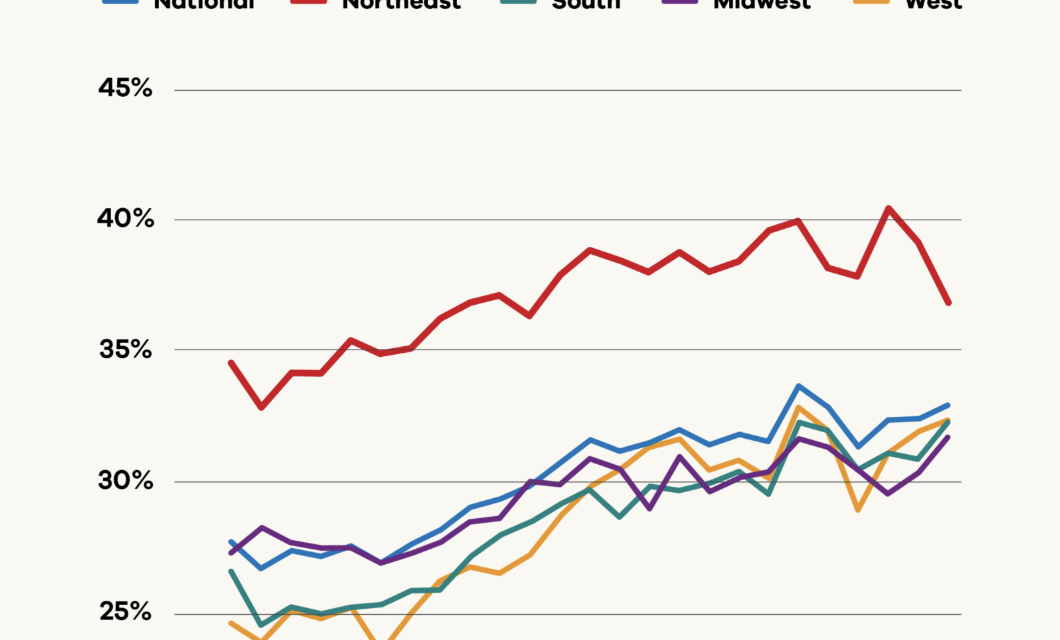
The report notes an increase among 18- to 34-year-olds living with parents in the South and Midwest, rising by 1.4 percentage points to 32.3% and 31.7% respectively in 2025. Conversely, in the Northeast, where such living arrangements have been more common, there was a decrease of 2.3 points to 36.9%, reaching its lowest since 2010.
“This is not a coastal problem that has stayed coastal; it has spread to even the more-accessible parts of the country,”
stated Hannah Jones, a senior economist at Realtor.com.
National Trends in Multigenerational Living
A record 25.2 million young adults lived with their parents in the past year, representing about one-third of that age group. This trend is not limited to youth; older adults are also moving in. Geoffrey Sanzenbacher from Boston College observed that the proportion of 25- to 34-year-olds living with parents increased from 1.6% in 1996 to 4% in 2025.
A Pew Research Center survey revealed that the primary reason for shared households is financial stress, noted by 40% of respondents. The National Association of Realtors added that 14% of homebuyers in the last year purchased multigenerational homes, with reasons including caring for aging parents (30%) and saving money (23%).
Market Preferences and Housing Demand
Some buyers are strategically planning for long-term family cohabitation. Tim Yee from RE/MAX Gold noticed more interest in homes with accessory dwelling units in the Bay Area. These structures allow young adults to stay close to their parents while retaining independence.
In San Antonio, homes designed for multigenerational living received 65.2% more page views than typical listings in 2025, yet their prices, with a median of $573,105, were nearly 69% higher. Despite an increase in available homes, local young adults often face challenges meeting housing costs due to rising prices and interest rates.
Hannah Jones emphasized that the increase in housing supply primarily targets mid-to-upper tiers, leaving entry-level households struggling.
 Newly Built Homes Are Now Cheaper Than Existing Ones
 Navigating Life Next to a Golf Course
 Rustic Tiny Home with Customization Options for $21K
 Controversy Surrounding North Texas Development with Mosque at Its Center
 Silicon Valley’s Luxurious Growth Amid Anthropic’s IPO
 Swanky Hotel to Transform Historic Minneapolis Building