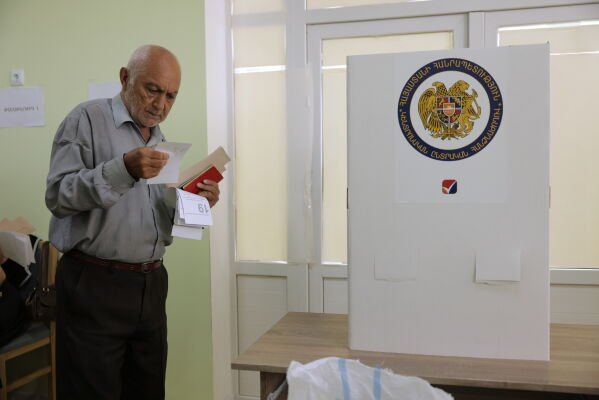
Armenian Prime Minister Nikol Pashinyan declared victory in the recent general election, which many viewed as a test of Russia’s influence in this South Caucasus country. Preliminary results showed Pashinyan’s governing party leading with over double the votes of its nearest competitor. Pashinyan aims to pursue a geopolitical strategy that distances Armenia from Moscow and strengthens ties with the West. “The European Union is our main partner in implementing democratic reforms, and we will continue on that path,” stated Pashinyan as he cast his vote.
European election monitors described the process as divisive but “well-run,” while acknowledging concerns about Russia’s attempts to influence the outcome through economic pressure. Observers noted Pashinyan’s administration sought to suppress the largely pro-Russian opposition. According to Monday’s preliminary results, Pashinyan’s Civil Contract party secured 49.82% of the vote. The main challenger, billionaire Samvel Karapetyan, under house arrest for allegedly plotting against the government, led the Strong Armenia bloc, collecting 23.28% of votes. Karapetyan rejects charges as politically contrived.
Armenian investigators issued arrest warrants for six Strong Armenia members before the election, accusing them of vote-buying. The party aims to deepen business relations with Moscow and claims Pashinyan instigated hostility with the Kremlin. Despite the Central Election Commission counting ballots, final outcomes will be delayed to allow for grievances on irregularities.
‘Referendum on the Future of the Country’
Richard Giragosian, head of the Regional Studies Center think tank in Yerevan, argued the election acted as a “genuine referendum” on Armenia’s future, despite Russian interference attempts. He stated Russia’s meddling efforts were largely unsuccessful. Moscow has warned Armenia of potential economic repercussions for leaning toward the EU. Russia wields control over a crucial segment of Armenia’s energy and infrastructure, asserting this in discussions between President Vladimir Putin and Pashinyan. Recent Russian measures include banning Armenian products, which the European Commission labels “economic coercion.” Moscow’s remarks likening Armenia’s direction to Ukraine’s situation evoke past Russian aggression.
Pashinyan’s party appears poised for a parliamentary majority, potentially governing independently within Armenia’s 101-member National Assembly. Election commission estimates grant Pashinyan’s party 61 seats, though they lack enough for constitutional changes without voter approval.
Controversy surrounds Pashinyan’s peace process initiatives with Azerbaijan, sharply criticized by opposition parties. Notably, Pashinyan and Azerbaijani President Ilham Aliyev agreed to a peace framework in Washington, witnessed by President Donald Trump. The long-standing conflict centered on Karabakh saw Azerbaijan reclaim the region during a swift offensive in 2023. On Monday, Pashinyan emphasized plans to “institutionalize” a peace agreement, envisioning a transit route through Armenia named after Trump, projecting Armenia as a global intersection.
International observers from the OSCE, PACE, and the European Parliament confirmed the election provided “genuine choice,” balanced by pressure from Russia. Observers recognized the domestic campaign as “highly confrontational,” including allegations of electoral violations and judicial bias against opposition figures. Concerns emerged about public sector employee involvement in ruling party events, raising questions about campaign fairness.
Reactions in Brussels and Moscow reveal different perspectives. EU officials plan economic support for Armenia and applauded Pashinyan’s win. European Commission President Ursula von der Leyen expressed a “deeply valued” partnership with Armenia. Conversely, Russia criticized the election, citing Western interference, yet avoided examples of its claims. Russian Foreign Ministry spokesperson Maria Zakharova described the societal polarization, emphasizing Moscow’s future engagement will hinge on Armenian leadership’s tangible actions.
According to Giragosian, Russia’s reserved stance suggests readiness to continue dialog with Pashinyan’s regime while maintaining strategic pressure.
Additional contributions came from AP writers Sam McNeil in Brussels and Menelaos Hadjicostis in Nicosia, Cyprus. A previous error in reported election turnout figures corrected the faulty announcement suggesting a 97% figure. The accurate turnout recorded was 59.97%
 Michigan Senate Candidate Faces Scrutiny Over Family Ties
  Trump’s Diesel-Deal Feud with Zelensky Obscures a More Important Effort
  Democratic Endorsement Shift in Montana Senate Race
  Ukraine Requests Stronger U.S. Action as Energy Hostilities Continue
  Arizona Voters Prioritize Water Concerns in Upcoming Midterms
  Trump Links High Energy Costs to Ukraine, Suspends Russia Sanctions