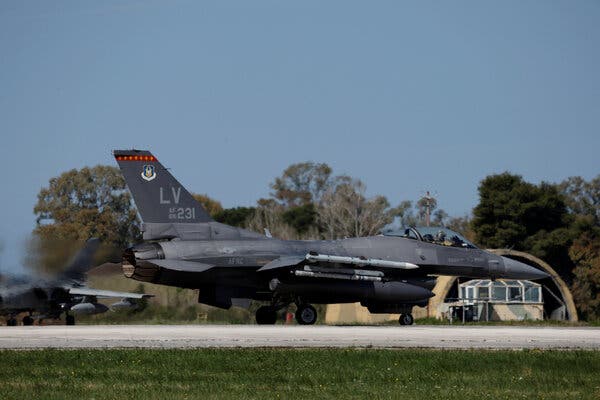
The United States plans to significantly reduce the number of aircraft and warships available for NATO operations in Europe. This move signals an acceleration in America’s effort to scale down its protection of European allies, a relationship maintained for eight decades.
This decision, outlined by officials in a written document, limits NATO’s ability to launch long-range strikes and conduct surveillance. Two senior European officials, who were briefed on the plan, shared these details under conditions of anonymity due to the sensitivity of military discussions. According to the document, the changes were communicated to allies in early June and parts were reviewed by The New York Times.
The planned reductions include:
- Decreasing F-16 and F-15E fighter jets from about 150 to 100.
- Reducing maritime reconnaissance aircraft from 26 to 15, and removing all eight aerial refueling tanker jets previously available to Europe.
- Reallocating a missile-launching submarine and an aircraft carrier, along with several warships and jets that participate in carrier missions.
- Reassigning one of two bomber groups previously designated for Europe’s defense.
The Pentagon has not commented specifically on the numbers in the document. However, a statement by its European Command last week generally referred to the intention to lessen commitments in Europe. The German news outlet Die Welt was among the first to report these details, providing a clearer picture of the Trump administration’s plans to decrease its NATO involvement.
NATO, established after World War II, aimed primarily to protect American allies in Europe from external threats, particularly from the Soviet Union. European members still view NATO as crucial for deterring Russia. However, the U.S. drawdown could weaken NATO’s ability to monitor Russian submarine activities or to launch long-range Tomahawk missiles into Russian territory.
Though European nations possess similar missile-launching capabilities, the presence of U.S. missiles is seen as a stronger deterrent to Russia. Europeans might hesitate more to deploy these weapons.
American officials have indicated that the reduction will take effect shortly, far sooner than European counterparts had anticipated, which could impact the alliance’s response readiness in addressing Russian threats.
 Israeli Prime Minister’s Visit to the U.N. Amid Controversy
  U.S. Secures Strategic Arctic Agreement
  Trump Administration’s Plan to Resettle Afrikaners as Refugees
  Trump’s Vision on Iran, AI, and Global Security at the UN
  Lithuanian Leader Seeks U.S. Military Commitment Amid Rising Russian Threats
  Italian PM Giorgia Meloni Skips UN General Assembly Amid Growing Tensions