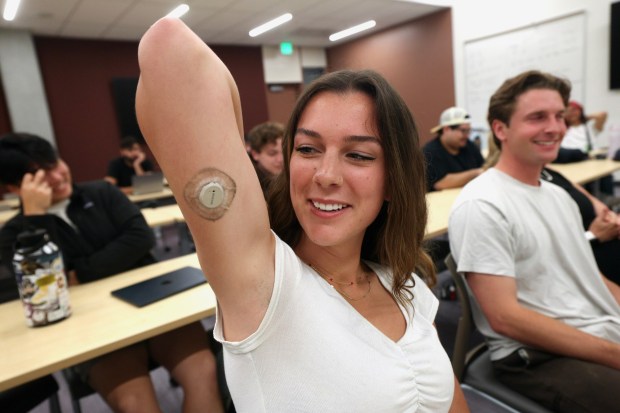
Adam Van Voorhees used to frequently consume orange chicken until a white patch on his arm led him to reconsider his diet. The alarm from his continuous glucose monitor notified him that his blood sugar had reached prediabetic levels after a meal at Panda Express. As a result, he started bringing his own lunch. Though not diabetic, Van Voorhees used the monitor as part of a class project at UC San Diego.
Continuous glucose monitors (CGMs) were traditionally for those with Type 1 diabetes, but are gaining interest among the health-conscious after becoming available over-the-counter. Mary Boyle, a cognitive science professor, recognized CGMs’ potential in helping individuals understand their bodies better. With a collaboration with Dexcom, Boyle involved her students in a study to assess CGMs’ impact on promoting healthier habits.
Through these devices, users receive real-time feedback on how their bodies respond to lifestyle choices such as eating and exercise. For example, blood sugar spikes after sugary foods can be seen immediately on the monitors. For diabetics, the stakes are high, with various health risks prompting behavior changes. Boyle’s class, Metabolic Health Analytics, aims to determine if this holds true for healthy individuals as well.
Some interesting discoveries came from the students’ experiences. Katie Lam, a student, monitored how stress influenced her glucose levels, resulting in significant spikes during high-stress events like exams. This tangible feedback encouraged relaxation techniques.
Professor Boyle emphasized the importance of understanding hormonal impacts on blood sugar, such as morning cortisol surges that increase glucose. To explore this further, she has expanded her research to include women in different stages of menopause.
Students like Jaidy Leyva provided insights into different food effects on glucose levels. While homemade and store-bought cakes did not cause spikes, a restaurant dessert led to a significant increase. Such observations inform lifestyle changes and understanding of personal health metrics.
The class’s experiment has shown that while some students revert to old habits, many make lasting positive changes. The real-time feedback from CGMs seems more effective in altering behavior than external dietary advice.
However, potential downsides exist. Some students find the constant alerts to be a source of anxiety, what Dr. Robert Thomas calls “device burden.” He advises moderation in CGM use, suggesting their use for targeted periods rather than continuously.
One student, scrolling through social media, noted how access to a CGM provided clearer insights than the flood of generic health advice online. The instant feedback on personal choices offered a more direct understanding of how one’s body responds.
 President Trump Proposes ‘Super Intelligence’ as New AI Term
  Potential Changes in Medicare Reimbursement for Lab Tests
  First Lady Melania Trump’s AI Education Push Amid Concerns
  Expansion of Data Centers Fueled by AI Development
  Understanding and Addressing the Complexity of Suicide
  Recall of Meat Products from Star Meat Delivery Inc.