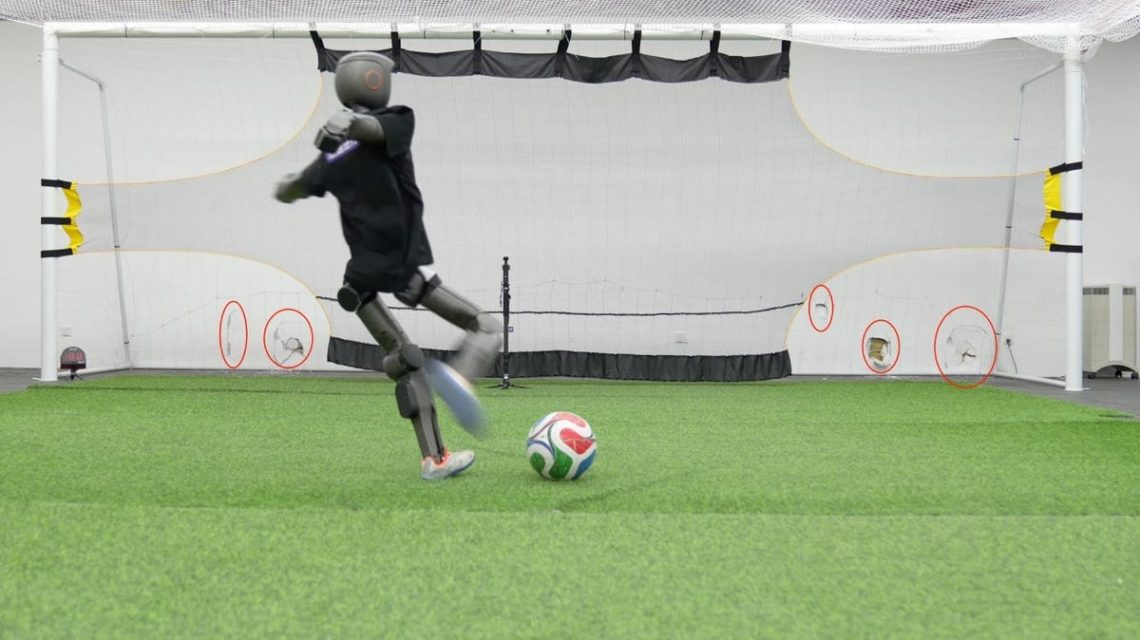
A recent demonstration by Booster Robotics has stirred conversations about the potential of humanoid robotics. Their T1 robot, capable of powerful soccer kicks, showcased its ability to dent walls, causing onlookers to consider both its prowess and safety implications.
Understanding the Booster T1 Humanoid Robot
The Booster T1 is a product of Beijing-based Booster Robotics. It stands approximately 3 feet and 10 inches tall and weighs around 66 pounds. Depending on its configuration, the T1 offers 23 to 41 degrees of freedom. This capability allows the robot to walk, turn, balance, and perform athletic tasks.
The T1 can walk for about two hours and stand for around four hours per charge. It accommodates open-source tools, software frameworks, and APIs, making it accessible for developers to train and innovate new functionalities. Notably, over 50 robotics teams and research institutes employ the T1 platform for development.
Robot Soccer: More Than Entertainment
Testing robots through soccer provides valuable insight. The dynamic nature of soccer challenges humanoid robots to adjust their movement, balance, and decisions dynamically. These lessons serve beyond the field, proving useful for robots that could function in warehouses, labs, or disaster zones.
Robotic Training and Development
The T1 serves as a developmental tool for schools, laboratories, and teams. It supports software testing, motion modeling, and behavior development. The company’s tools include a reinforcement learning framework and a demo system for robot matches, enhancing robot capabilities in perception and decision-making.
The Issue of Safety
The powerful abilities of the T1 robot raise critical safety questions. A robot capable of denting walls could pose risks if a system malfunction occurs. Hence, it’s vital to establish strong safety protocols before these machines integrate into public domains or workplaces.
Regulations about force limits, emergency stops, and operational environments are crucial. While a robot operates safely in a controlled lab environment, public interaction demands stricter safety standards.
RoboCup and the Future of Robotics
The Booster T1 is part of RoboCup, an international robot soccer competition. The long-term aspiration of RoboCup is for humanoid robots to outperform human teams under standard soccer rules.
This isn’t merely a futuristic notion. The research directed toward improving the robots’ balance, perception, and decision-making is foundational for progress in robotics, potentially extending their application beyond sports into more practical fields.
Implications for Everyday Robotics
Demo videos like the T1’s highlight the strides in humanoid robots’ mobility and force application, which could benefit sectors like warehouse operations, elder care, or emergency responses. However, their increased strength also demands thorough checks on safety and responsibility.
The T1 demonstration underscores the importance of transparency and accountability as robotics technology progresses. As these machines become capable of performing complex tasks, establishing who ensures their safety and who holds responsibility becomes paramount.
 Virginia’s Data Center Plan Sparks Tensions Over Energy and Environmental Goals
  President Trump Proposes ‘Super Intelligence’ as New AI Term
  First Lady Melania Trump’s AI Education Push Amid Concerns
  Expansion of Data Centers Fueled by AI Development
  Beijing’s Tactical Undermining of U.S. Supremacy Through AI
  Controversy Surrounds Automated License Plate Readers Across the U.S.