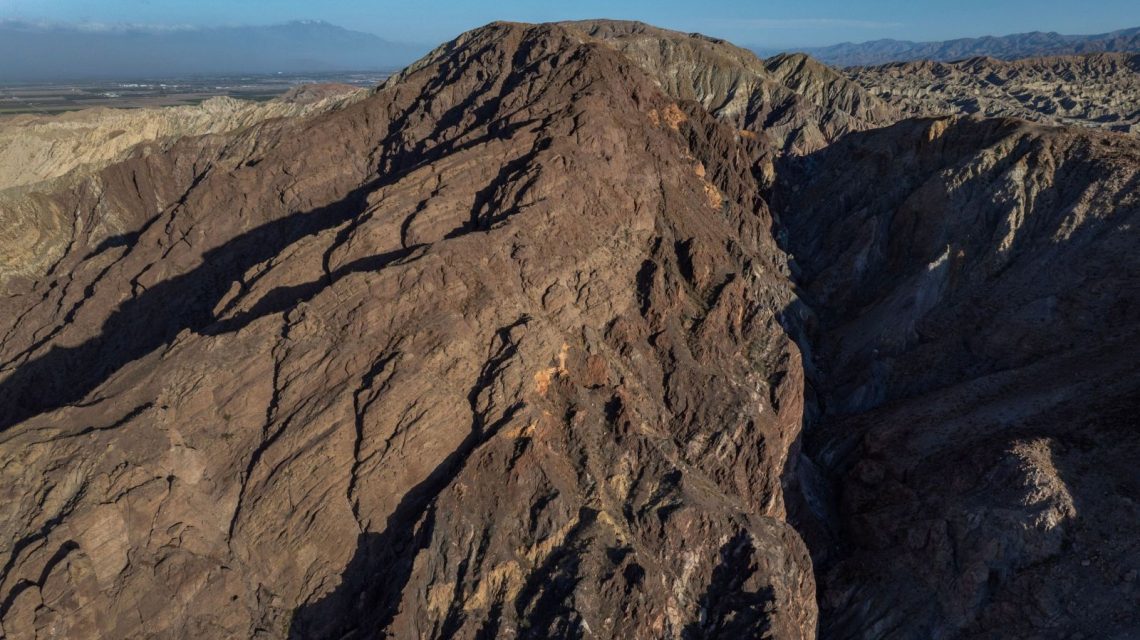
Tectonic Stress Levels on the Rise
Research from the University of Hawaiʻi at Mānoa indicates that tectonic stress along the San Andreas and San Jacinto fault systems in Southern California has reached unprecedented levels. This study highlights an increased seismic risk in the area.
Why Stress Levels Matter
The study suggests many fault segments are experiencing stress levels unseen in over 1,000 years. This puts the system in a “critically loaded state.” This finding is crucial for seismic risk analysis in a densely populated region.
Notably, Cajon Pass, a key junction between these faults, may serve as an “earthquake gate.” It occasionally halts ruptures but can also allow them to progress between both networks. This could result in a joint rupture, affecting areas like Los Angeles and San Bernardino more severely than if one fault ruptures alone.
Detailed Findings
Published in the Journal of Geophysical Research: Solid Earth, the study employed a physics-based model. Researchers simulated stress accumulation and release along the southern San Andreas and San Jacinto systems over the last millennium. Geological records, such as radiocarbon-dated sediments and tree rings, informed this model.
Lead researcher Liliane Burkhard stated that stress levels across multiple fault segments are now the highest recorded in a thousand years. This situates the region for a potential large rupture involving both systems. The “earthquake gate” at Cajon Pass might block or permit ruptures, depending on concurrent stress levels.
Preparedness is Key
Burkhard emphasized the non-theoretical nature of these findings. Stress has been building since 1857, surpassing previous historical records. While predicting exact earthquakes is impossible, current conditions mandate serious preparedness among residents.
For anyone in Southern California, readiness involves knowing evacuation routes, creating a communication plan, and maintaining an emergency kit with essentials like water, food, and medications.
Future Implications
The University of Hawaiʻi asserts that physics-based stress models can refine hazard evaluations, influencing infrastructure design, emergency plans, and building standards. This modeling approach could also benefit other global fault intersections, aiding in comprehensive seismic risk assessments.
 This Week In Science: Spiders, TV Pixels, and Storytelling
  Rare Antler Encounter Captured in Viral Video
  How Little Brown Bat Genes Are Outsmarting a Fungal Killer
  The Growing Threat of Glacial Lake Outbursts and the Urgent Need for Mitigation
  SpaceX Falcon 9 Delivers Crew to International Space Station
  California to Vote on $7.5 Billion Scientific Research Fund