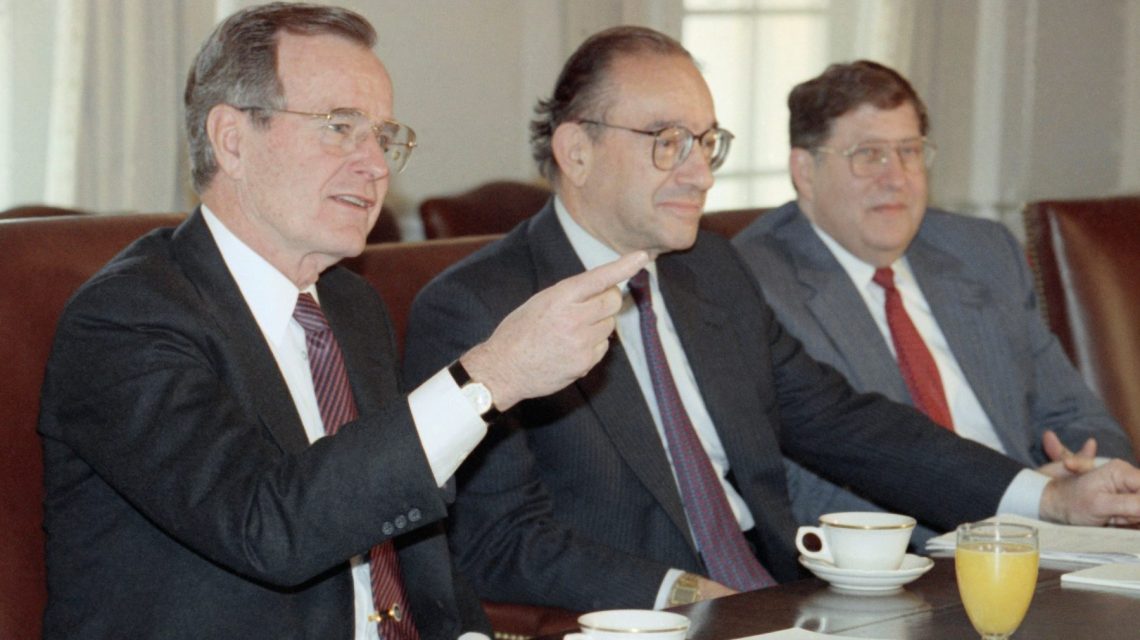
Alan Greenspan, the former U.S. Federal Reserve Chair, passed away at the age of 100 from complications related to Parkinson’s disease. His wife, Andrea Mitchell, an NBC News correspondent, shared that he was a beloved husband and an influential figure in her life. Greenspan was deeply fond of baseball, the Washington Commanders, and music, especially jazz.
Greenspan’s Tenure as Fed Chair
Serving for over 18 years, Greenspan’s leadership at the Federal Reserve is marked by a period of American economic growth. Known as the “Oracle” and “Maestro,” he led a remarkable economic boom, beginning in 1991. His decisions were closely watched for insights into future economic trends.
“He brought rigorous analytical discipline to monetary policymaking and helped establish the credibility that remains one of the Federal Reserve’s most important assets.” – Federal Reserve statement
Despite his acclaim, the positive era would eventually conclude in 2008, after Greenspan’s departure, leading to severe financial turmoil.
The 2008 Financial Crisis
By 2006, Greenspan stepped down, but soon after, the American housing market collapsed. This event triggered a global financial crisis and a severe recession. Many critics blamed Greenspan’s policies and reliance on lightly supervised financial markets for the collapse. He later admitted, “I made a mistake” regarding the assumption that banks could self-regulate.
The crisis led to severe economic repercussions in the U.S. and abroad. Europe’s debt crisis and significant government interventions by China were part of the aftermath.
Greenspan’s Influence and Early Life
During Greenspan’s era, his economic statements impacted global markets. One notable instance was in December 1996 when his comment on “irrational exuberance” caused market fluctuations.
Born in Manhattan’s Washington Heights, Greenspan excelled in mathematics early on. Despite being a Juilliard School dropout, he had a brief career in music. He later pursued economics at New York University and became a recognized economic consultant.
Under President Ronald Reagan, Greenspan was appointed Fed Chair in 1987. An early challenge was “Black Monday,” which saw historic stock market losses. His actions helped restore market stability, earning him credit for crisis management.
Post-Fed Years
After leaving the Fed in 2006, Greenspan continued to explore economics through his consulting firm, writing, and public speaking. He was active in defending the Federal Reserve’s independence, especially during challenges from the Trump administration.
Greenspan’s tenure from 1987 to 2006 made him one of the longest-serving Fed Chairmen. While critics assigned blame for the 2008 crisis, Greenspan defended his foresight in his writings and interviews.