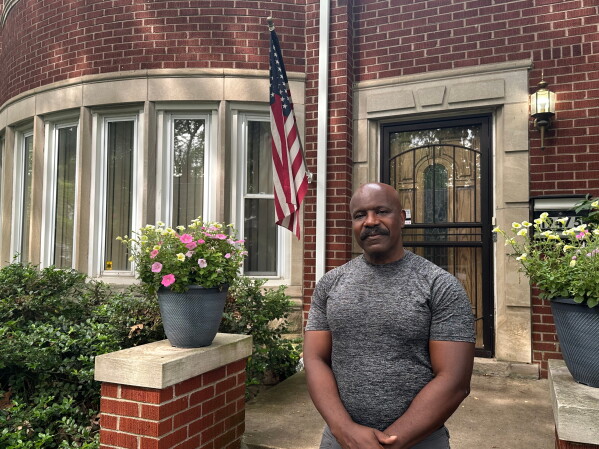
In Detroit, Jerry Esters exhibits the American flag daily at his home. However, Yvonne Pistochini, living not far from Esters’ residence, maintains that she would never permit the flag to be displayed where she lives. Both individuals are Black, yet their perspectives on the flag differ significantly.
For Esters, the American flag symbolizes the opportunities that allowed his family, descendants of slaves, to prosper. Pistochini, 79, perceives a disconnect between the America represented by the flag and the country she witnessed growing up.
According to a survey by The Associated Press-NORC Center for Public Affairs Research, conducted before the United States’ 250th anniversary, opinions about the flag vary widely across political, age, and racial lines. The survey underlines how the American flag serves as both a unifying and divisive emblem, mirroring other divisions in societal views.
This study included 2,596 adults, and it reveals that Republicans and older white adults often display the flag. In contrast, younger Democrats and Black adults are less likely to do so. Professor Matthew Delmont from Dartmouth College explains that Black Americans see the flag as a symbol of both inclusion and exclusion, with some using it to enforce a version of patriotism based on exclusion.
“A lot of Black Americans see the flag as a symbol of both inclusion and exclusion,” Delmont remarks. “More than white Americans, they understand the flag can be used to justify a version of patriotism that is rooted in exclusion, with the flag being used to say ‘you don’t belong here.’”
The survey further suggests that older white Americans, especially Republicans, view the flag as a unifying force. About half of U.S. adults report flying the flag at home, with greater frequencies around holidays. Approximately 70% of Republicans and 60% of Americans aged 60 and older display the flag during holidays at the minimum.
On the opposing end, about 60% of Democrats and independents say they never fly the U.S. flag, with this sentiment prevalent among 75% of Democrats under 45.
Opportunities Worth Fighting For
Jerry Esters, a 64-year-old retired clay sculptor, proudly flies three American flags outside his home in Detroit’s Sherwood Forest area. He associates his capacity to live there with hard-won progress, as Black individuals like him were once unable to own such properties.
Esters feels he is living out the dreams of his great-great-grandmother, Moriah Martin, born into slavery. He sees the ability to own a business and a home as quintessentially American, encompassing goals worth fighting for.
Despite Esters’ pride, only about 30% of Black adults report displaying the American flag, as opposed to around 50% of white and Hispanic adults.
The Flag as a Symbol of Freedom
Ben Gaskins from Lewis & Clark College has noted that the flag holds significant patriotic value for many Americans, alongside being central to the identity of older, more conservative whites.
Nancy Hansen, a retired Customs and Border Protection clerk in Montana, believes the flag signifies freedom. She cherishes the freedom it represents, which encompasses living, traveling, and raising children wherever desired.
In Pontiac, Michigan, Linda and Greg Cunningham associate the flag with freedom, disassociating it from political connotations. They emphasize their love for the flag and the liberty it symbolizes.
The Flag as a ‘Painful Reminder’
Survey results reveal mixed views. While 47% recognize the flag as a unifier, 16% view it as divisive, with 36% deeming it neither. Among Black adults, just 22% see the flag as unifying, compared to 55% of white adults and 42% of Hispanic adults.
Allison Wiltz, a Black author, perceives the flag as a painful symbol, reflecting the gulf between potential and reality for marginalized communities.
Paul Walthour, a white retired creative director, sometimes flies the flag on special occasions. While he regards it as an American pride symbol, he concedes it often divides rather than unites, contrasting attitudes from across the political spectrum.
Survey particulars: Conducted by AP-NORC, from April 16-20. It utilized a representative U.S. sample via NORC’s AmeriSpeak Panel, with a 2.6% margin of error.
 Orland Park Plans New Traffic and Emergency Measures
  Texas Man Charged with Capital Murder in Shooting of 5-Year-Old
  Far-Left Groups Allegedly Organize Protests in Austin
  Austin Police Release Footage of Arrest After ICE-Involved Shooting
  Himalayan Pilgrimage: A Couple’s Narrow Escape and Lingering Questions
  Religious Trends: Decline in Affiliation with LDS Church