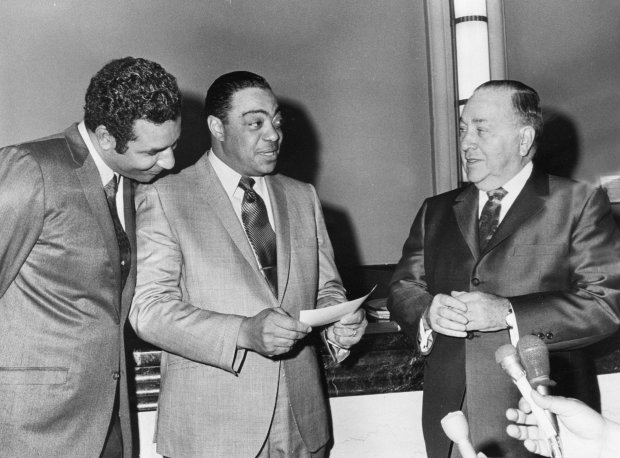
George E. Johnson Sr., a prominent figure in the Black business community, passed away at his home in Chicago. His family confirmed the news. Johnson was a longtime resident of Water Tower Place in the Gold Coast and previously lived in Glencoe.
Johnson made a lasting impact on post-World War II Black America. Through his company, Johnson Products Co., he provided popular haircare products like Afro Sheen and Gentle Treatment. His sponsorship of ‘Soul Train’ further cemented his influence.
Founded in 1954, Johnson Products became the largest producer of cosmetics for African Americans. The company’s success demonstrated the potential for Black business leaders to build powerful enterprises. In 1993, the business was sold to a Miami-based firm, but its legacy as a pioneering enterprise remained strong.
Early Life and Entrepreneurial Journey
Born in Richton, Mississippi in 1927, Johnson’s family moved to Chicago when he was two. He grew up in Bronzeville, displaying an entrepreneurial spirit from a young age by working various jobs like collecting milk bottles and delivering newspapers.
Johnson attended Wendell Phillips High School but left to work with his brother as a door-to-door salesman for Fuller Products. His tenure at Fuller, where he became a head production chemist, equipped him with valuable skills.
Inspired by his achievements at Fuller, Johnson decided to start his own venture. He developed a hair-straightening formula and began his business with a $250 loan, launching Johnson Products from the back room of a friend’s store.
Growth of Johnson Products Co.
The company rapidly expanded, initially focusing on men’s products but expanding to women’s products by 1958. The firm occupied significant space on the South Side of Chicago and generated $1 million in revenue by 1964.
Johnson Products went public in 1971, becoming the first Black-owned company to list on the American Stock Exchange. The business flourished, with revenue reaching $37 million by 1975. Sponsorship of ‘Soul Train’ boosted the company’s profile significantly.
Challenges and Continued Influence
In 1975, the Federal Trade Commission mandated expanded warning labels on one product, creating challenges for the company. Despite this, Johnson Products remained a key player in the market. In the late 1980s, it secured endorsement deals with Michael Jordan and his mother, Deloris.
In 1989, Johnson stepped down as CEO. The company eventually sold in 1993, a move Johnson lamented as separating the business from the Black community. Yet, it returned to Black ownership in 2009.
Other Ventures and Legacy
Beyond his own company, Johnson co-founded Independence Bank in 1964 and served on various boards, including the U.S. Postal Service’s Board of Governors and the Chicago Urban League.
He married several times and is survived by wife Madeline Murphy Rabb, three sons, a daughter, ten grandchildren, and seven great-grandchildren. Plans for his services have not yet been announced.
This article was compiled by freelance reporter Bob Goldsborough.
 Steve Lotysz: From Medinah’s Gates to Presidents Cup Artistry
  A Family’s Journey Through Cancer and Loss
  The Unlikely Intrigue of a 1990 NBA Trading Card
  Celebrating Day of the Dead: Students Craft Calaveras in Pilsen
  Family Conflict over Sentimental Necklace
  Cindy Crawford’s Son Presley Gerber Dies at 27