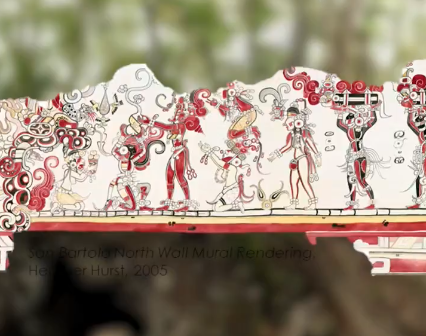
Archaeologists have successfully transcribed mural symbols from Mayan ruins to reveal the name of an ancient astronomer and mathematician for the first time, according to Guatemala’s Ministry of Culture. The name “White-chested Fox” was discovered in drawings at the San Bartolo-Xultun archaeological site near the Mexican border, dating from 400 BC to 900 AD.
Culture Minister Luis Mendez shared with reporters that researchers at Xultun uncovered a “complete mathematical and astronomical formula” authored by Sak Tahn Waax, translating to White-chested Fox. According to Mendez, this is the only known work attributed to a mathematician from the Maya Classic period, considered the peak of Mesoamerican civilization.
The ministry explained that the discovery was facilitated by epigraphic analysis of over 50 mathematical and astronomical microtexts inscribed on the wall. These inscriptions not only revealed the astronomer’s name but also identified calculations and tables using astronomical and calendrical units of time.
Researchers utilized drawings, photographs, and scans of the inscriptions, which were digitally enhanced to decode 11 hieroglyphs. Mendez stated that these glyphs appeared in a setting where art blended with science, mathematics, astronomy, and daily life.
The Maya civilization began to decline around 900 AD, with its eventual collapse occurring with the arrival of Spanish conquistadors in the early 16th century. In recent years, notable discoveries have emerged, such as the remnants of a nearly 3,000-year-old Mayan city in northern Guatemala, featuring pyramids and monuments.
In 2024, an American doctoral student discovered a vast Maya city hidden within the Mexican jungle. Advanced technology enabled scientists and archaeologists to find ruins by shooting lasers down from planes, effectively penetrating the dense vegetation.
 Hurricane Formation and Strengthening
  Ancient Mastodon Tooth Unearthed in California Creek
  The Tiny World of the Pumpkin Toadlet
  Chimps and Self-Medication: Insights from Gombe Stream
  Rovelli Challenges Physics with Relational View
  Legal Waiver for Sharing UAP Information Announced