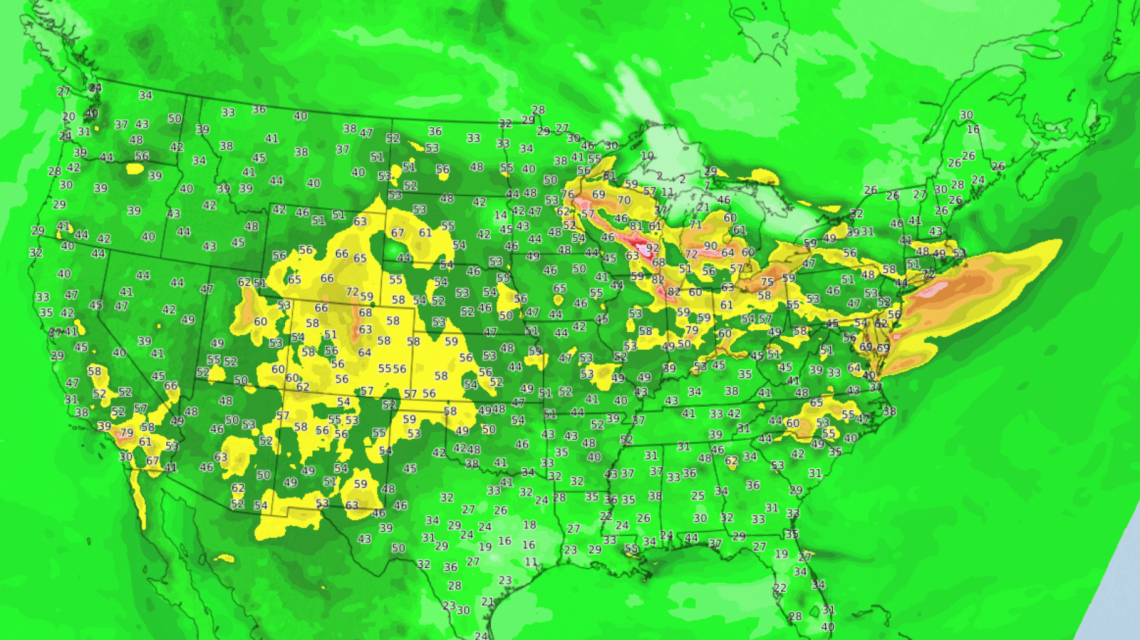
Smoke from hundreds of active wildfires burning across Canada is spreading into the United States. This has triggered air quality alerts across multiple states, shrouding parts of New York in a visible haze.
Air Quality Advisories
Advisories were issued across New York State and portions of neighboring states. Smoke from more than 800 Canadian wildfires drifted southward, reducing visibility and increasing concentrations of harmful fine particulate pollution. Officials warned that the smoke could create unhealthy conditions, particularly for children, older adults, and people with respiratory or cardiovascular conditions.
The latest episode marks another significant cross-border smoke event during the 2026 wildfire season. This season has repeatedly affected air quality across large sections of the U.S. Northeast and Great Lakes regions.
New York’s Emergency Measures
New York City expanded emergency measures as smoky conditions coincided with summer heat. Mayor Zohran Mamdani urged residents to spend time in air-conditioned spaces, limit outdoor activity, stay hydrated, and check on vulnerable neighbors. Free KN95 masks were distributed throughout the city as forecasters predicted air quality could reach the “Unhealthy” category.
The New York State Department of Environmental Conservation (DEC) and Department of Health (DOH) extended a statewide Air Quality Health Advisory. This was due to wildfire smoke and elevated pollution levels. Governor Kathy Hochul encouraged residents to monitor air quality conditions and take precautions, saying, “We are now closely tracking these conditions, and I strongly encourage New Yorkers to stay informed and take appropriate precautions to stay safe. Sensitive groups should take particular caution.”
New York Under Air Quality Alerts
New York is heavily affected by the Canadian wildfire smoke. Air quality health advisories cover large portions of the state, including New York City, Long Island, the Hudson Valley, the Capital Region, Central New York, the North Country, and western New York.
The agency also warned that elevated concentrations of fine particulate pollution were expected to push AQI levels above 100 across many areas.
Other Areas Affected by Canadian Wildfire Smoke
Apart from New York, air quality alerts tied to smoke from ongoing Canadian wildfires stretched across a broad swath of the United States. Affected parts include the Midwest, Great Lakes, and the Northeast.
The National Weather Service (NWS) and state environmental agencies issued air quality alerts for portions of:
- Minnesota
- Michigan
- Illinois
- Indiana
- Ohio
- Pennsylvania
- West Virginia
In Minnesota, the Minnesota Pollution Control Agency warned that the AQI could reach the “Maroon” or Hazardous category.
Michigan reported widespread smoke impacts, with authorities warning of pollutant levels reaching “unhealthy” or “very unhealthy” levels.
In Pennsylvania, the Department of Environmental Protection issued Code Red air quality alerts for multiple regions.
Ohio’s Environmental Protection Agency issued a statewide advisory, warning of air quality being “unhealthy for sensitive groups.”
Health Risks From Wildfire Smoke
Health officials state that wildfire smoke contains microscopic particles known as PM2.5. These can penetrate deep into the lungs and enter the bloodstream. Exposure can lead to coughing, shortness of breath, chest tightness, dizziness, and fatigue. It can also worsen asthma, COPD, heart issues, and other existing health conditions.
Authorities recommend that residents in affected areas reduce strenuous outdoor activity. Keeping windows and doors closed, using air conditioning or filtration systems, and wearing high-quality masks like N95 or KN95 respirators are advised.
The event shows how wildfires can affect communities far from the fire zones, turning skies hazy and creating public health concerns.
What Happens Next?
Meteorologists and air quality experts continue to monitor smoke movement across the Northeast. Residents should check local air quality forecasts and advisories. Changing wind patterns can cause smoke concentrations to fluctuate rapidly.
For New Yorkers dealing with summer heat, elevated temperatures and poor air quality remain a concern until cleaner air arrives in the region.
 Fat Bear Week 2026: A Look at the Contest and Its Competitors
  California Governor Declares Statewide Emergency Ahead of El Niño Storms
  EPA Rollbacks and the Impact on Indiana Communities
  The Impact of Battery Innovations on Renewable Energy
  Challenges in California’s Home Insurance Market
  Race Against Time: Preserving Quinhagak’s Archaeological Heritage