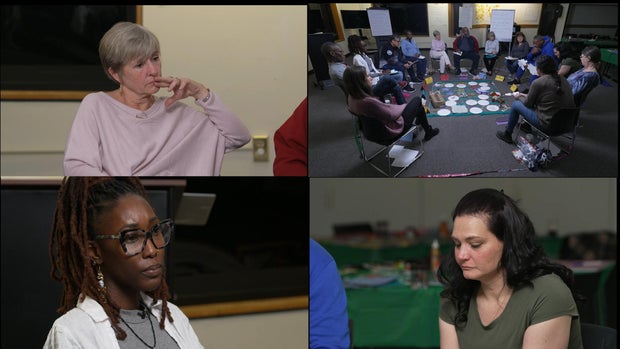
This week, 60 Minutes correspondent Lesley Stahl and her team reported on Healing Justice, a nonprofit organization that creates a supportive environment for survivors of crime, wrongfully convicted individuals, and their families. These groups, while diverse, share common experiences and meet for a three-day retreat aimed at facilitating healing after encountering injustices.
>The retreat’s activities include writing exercises, group discussions, and art therapy. These sessions provide a safe space for participants to openly express feelings of bitterness, guilt, and sadness. Stahl expressed that while a mere weekend may not bring complete transformation, she witnessed a significant initiation of change.
“It’s hard to know whether one weekend can change you that much. But the beginning of a change certainly happens. We were there and watched it. We saw it.”
With permission, 60 Minutes filmed the participants’ emotional journeys. The program’s founder, Jennifer Thompson, a wrongful conviction victim and rape survivor, offered her unique insight into the profound impact of such experiences.
Eyewitness Misidentifications
The broadcast revisited Thompson’s tragic story. As a 22-year-old student, she experienced assault by an intruder in her home. Her determination to remember the attacker’s features led to identifying Ronald Cotton in a police lineup, resulting in his wrongful conviction.
After 11 years, DNA evidence revealed Bobby Poole as the true perpetrator. Thompson, devastated by the realization, sought Cotton’s forgiveness, leading to immense personal healing.
“The minute he forgave me, it’s like my heart physically started to heal,” Thompson shared.
Producer Shari Finkelstein explained the frequent occurrence of misidentifications during police lineups, highlighting that if the real assailant is absent, victims often choose a person closely matching their memory.
Documenting “Healing Justice”
Finkelstein maintained communication with Thompson over the years. When Healing Justice began its retreats, she recognized the story’s potential for 60 Minutes. Ensuring participants’ comfort with filmmaking was paramount.
The complex, emotional nature of trauma necessitated thoughtful consideration in filming. Finkelstein, along with Stahl, interviewed participants before and after the retreat, capturing the transformative effect on individuals.
The technical setup included unobtrusive camera placement around participants during group sessions. Editor Dan Glucksman compiled footage with a four-camera grid, enabling observation of nuanced reactions as events unfolded.
Loretta Zilinger White and Raymond Towler exemplified the retreat’s impact. Zilinger White, a rape survivor, struggled with wrongful conviction memories, while Towler faced societal disbelief despite DNA evidence proving his innocence.
An intense late-night conversation between Zilinger White and Towler, filmed with their consent, illustrated the retreat’s emotional core.
Concluding interviews revealed positive changes. Zilinger White, observed during the final interview session, appeared significantly transformed, transitioning from deep anguish to emotional relief.
“The pain that she had been exhibiting seemed to have been lifted… I was able to see, and feel, and experience with her a person who went from misery to joy,” Stahl reported.
While Thompson emphasized the absence of a “magic fix” in short retreats, the process offers substantial support and leads to ongoing healing.
 A Family’s Journey Through Cancer and Loss
  The Unlikely Intrigue of a 1990 NBA Trading Card
  Celebrating Day of the Dead: Students Craft Calaveras in Pilsen
  Family Conflict over Sentimental Necklace
  Cindy Crawford’s Son Presley Gerber Dies at 27
  Navy Veteran Generald Wilson Reflects on Emotional National Anthem Performance