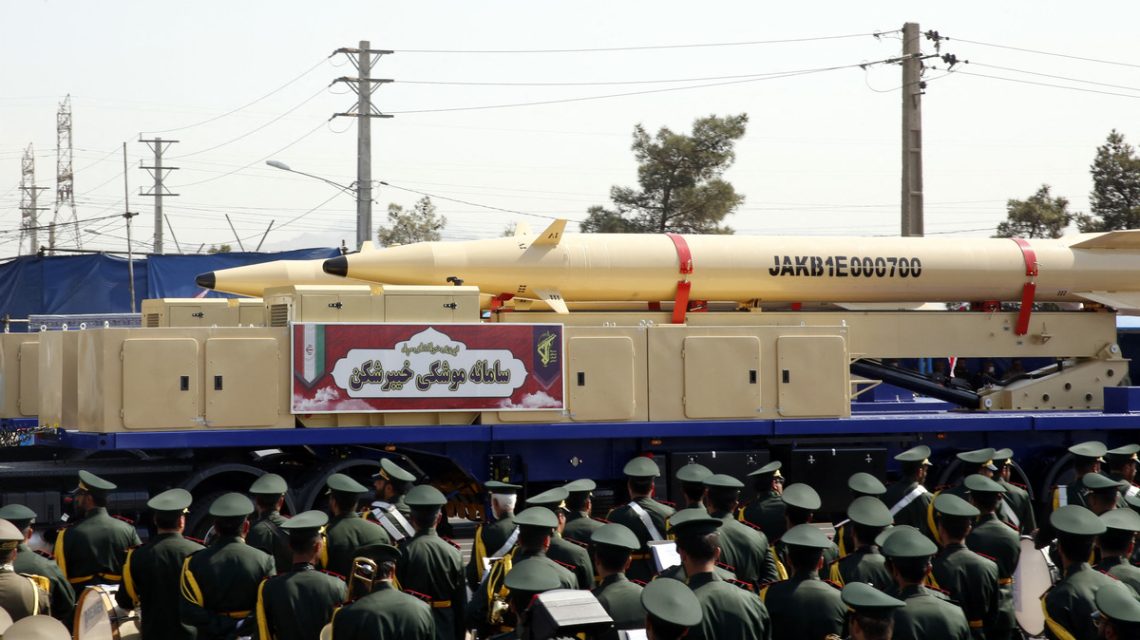
Iran has adjusted its military tactics by employing Kheibar Shekan ballistic missiles to target U.S. bases in the Middle East. According to unnamed U.S. officials in an article by The Wall Street Journal, these missiles are used by altering their flight paths, speeds, and in-air maneuvers to overcome American air defenses.
Missile Attacks and Ceasefires
Tehran has launched multiple missile attacks on American facilities in at least five Middle Eastern countries since early July. This action challenges a fragile ceasefire arranged in June. A sequence of missile exchanges resulted in several nights of attacks before a temporary pause occurred.
President Donald Trump noted last Friday that the U.S. is negotiating with Iran while maintaining the option for military strikes. The U.S. paused its attacks on Iran for the second day on Sunday. A spokesperson for Iran’s army confirmed through state TV that they have also paused their attacks.
Recent Escalations
Among the recent escalations was a strike on the Muwaffaq Salti Air Base in Jordan, which resulted in the deaths of three U.S. service members: 1st Lieutenant Tyler James Feehan, Private Isabella Gonzales, and Sergeant Angel Rampersad. Another U.S. soldier, Sergeant Michael Emmanuel Swinton, died in a drone detonation at Erbil Air Base in Iraq. This raises the number of U.S. personnel killed to 18. Iran has also targeted facilities in Kuwait, Bahrain, and Qatar in recent weeks.
Understanding the Kheibar Shekan
Debuting in 2022, the Kheibar Shekan is an intermediate-range ballistic missile with a range of about 900 miles. This reach allows it to target the entire Middle East, parts of Russia, India, and NATO member Turkey.
Fired from mobile ground launchers, it uses solid fuel, reducing preparation and launch times compared to liquid-fueled systems. This limits the window for opponents to target the launch sites. The missile’s name references the Battle of Khaybar in 628, where the Prophet Muhammad’s forces captured an oasis held by Arabian Jews.
Designed to maximize travel distance, the Kheibar Shekan joins other Iranian solid-fueled systems, such as the short-range Zolfaghar and medium-range Fattah-1. State media claims Fattah-1 is a hypersonic weapon capable of surpassing five times the speed of sound.
Strategic Significance
Iran has paired Kheibar Shekan missiles with jet-powered drones, signaling a shift in tactical strategy. Although Tehran has not disclosed official cost figures, the missiles are believed to be much cheaper than the U.S. interceptors, which can range from several million to $15 million each.
Defense analysts point out that continuously depleting high-cost interceptor stockpiles against less expensive projectiles poses a long-term sustainability issue. Nicole Grajewski, an expert on Iranian strategy, stated, “The Iranians realized during the war that Kheibar Shekans are advantageous because they are cost-effective, adaptable with launch systems, and quite effective.”
International Involvement
Ukrainian President Volodymyr Zelensky claimed recent actions suggest collaboration between Russia and Iran. He highlighted that Russian satellites conducted reconnaissance of U.S. bases, sharing intelligence with Iran. Zelensky noted Russian satellite observation of airbases in Bahrain, Jordan, and Kuwait took place between July 19 and 20.
Newsweek has reached out to Russia’s foreign ministry for comments.
Effectiveness of Air Defenses
Despite U.S. and allied forces intercepting most launched Kheibar Shekan missiles since February 28, some have breached defenses. Tehran has learned from each launch, adapting maneuvers to improve evasion, says Fabian Hinz, a missile expert.
Ballistic missiles are typically harder to intercept than cruise missiles due to less predictable trajectories and higher speeds. The Kheibar Shekan’s reentry vehicle can maneuver to avoid air defenses. Effective attacks may overwhelm defenses with sheer volume, explained retired General Qasid Mahmoud. Simple missiles can distract radar, allowing more advanced missiles to adjust their targets in the final phase, complicating interception.
 Netanyahu’s Middle East Map and Its Implications
  Ukraine Conducts First Medical Drone Evacuation
  Italy and France Deploy Military Amidst Violent Riots
  Paris Unrest and Its Broader Implications
  Endorsements, Political Contributions, and International Affairs in U.S. Politics
  Department of Justice Launches Extensive Fraud Enforcement Actions