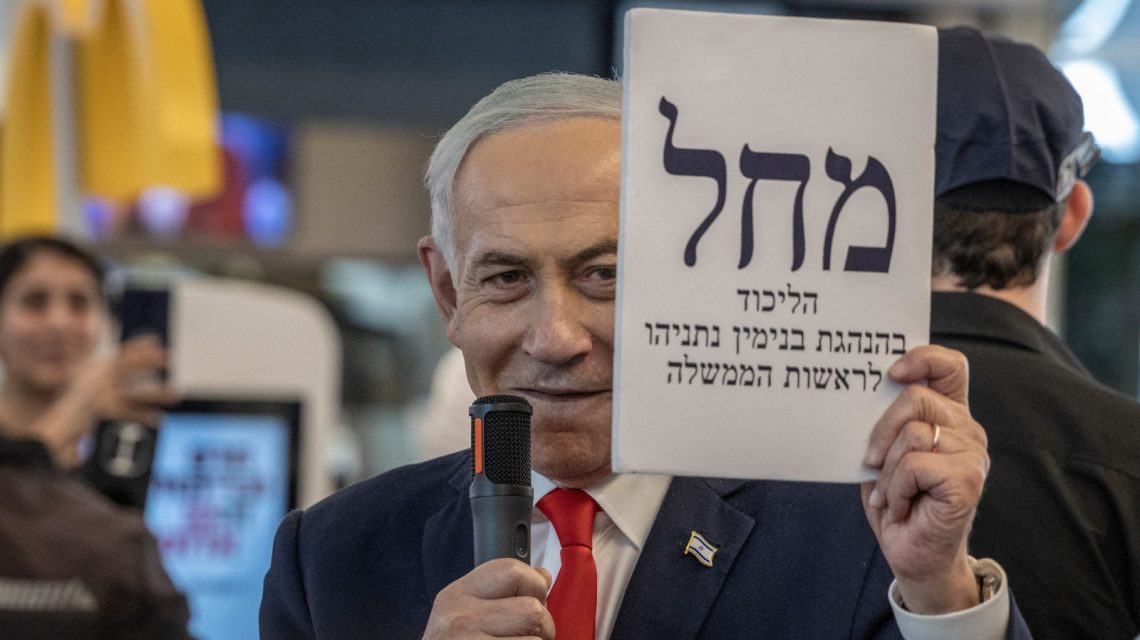
Israel’s Prime Minister, Benjamin Netanyahu, recently presented a map to depict his vision of alliances in the Middle East. This map was showcased during his first media security briefing since the Hamas attacks on October 7, 2023. Originally, the map was developed by the Friedrich-Ebert-Stiftung, a German think tank linked to the SPD party. Released in May, it analyzes emerging regional alliances spanning from Libya to India.
Andreas Krieg, Associate Professor at King’s College London, shared his insights with Newsweek. Krieg suggests that Netanyahu’s map reveals unintended details about Israel’s isolation from major powers in the region. Despite Netanyahu’s aim to display himself as a key player in regional security, the map implies otherwise.
Yoram Meital, Professor Emeritus of Middle East Studies at Ben-Gurion University, commented on Netanyahu’s portrayal of Israel. He pointed out that while Israel is presented as having substantial regional influence and strategic partnerships, this perspective is selective and potentially misleading.
Content of Netanyahu’s Map
Some Israeli media outlets boycotted the briefing, protesting Netanyahu’s limited engagement with the press. Despite this, security officials and aides attended the event, as noted by The Times of Israel. The map, titled “Geopolitical Alliances in the Middle East,” uses colors to indicate alliances.
- The “Israel-UAE Hexagon alliance” is marked in blue. Friendly areas, including Greece, Ethiopia, and Somaliland, are in lighter blue.
- Iran and its “Axis of Resistance” are in purple, covering parts of Yemen amid its civil war.
- Countries Iran considers friendly, such as Russia and portions of Iraq, are in lavender.
- The “Sunni Diamond Alliance,” comprising Turkey, Saudi Arabia, Egypt, and Pakistan, is in dark green. Countries friendly to this alliance, such as Sudan, Syria, and Jordan, are in a lighter green shade.
Netanyahu defended military actions against Iran, citing the need to contain threats following the October 7 attacks. However, Krieg noted resistance building against Israel’s military dominance and questioned the effectiveness of Netanyahu’s alliances.
“Netanyahu can redraw the map of the Middle East, but he cannot redraw the strategic interests of the countries that actually live there,” Krieg stated.
Regional Strategy Under Netanyahu
Netanyahu’s approach is aimed at incorporating the UAE’s “axis of secessionists” into Israel’s security framework. Krieg explained that Netanyahu seeks to reshape the regional order by leveraging fragmented states.
This strategy may pose challenges as countries like Saudi Arabia view it as threatening to sovereignty and stability. Previously, Netanyahu hailed Saudi normalization as a diplomatic success. However, current alignments suggest otherwise.
Netanyahu vowed to bring down the Iranian regime and minimized settler violence in the West Bank. With elections approaching, security remains central to his campaign. He highlights military achievements against Hamas and Hezbollah while dismissing criticisms of security failures from October 7, 2023.
Opposition and Criticism
Gadi Eisenkot, leader of the Yashar party, criticized Netanyahu on social media, pointing out unachieved military goals. He cited the persistent presence of Hamas operatives and Hezbollah’s resurgence. The opposition highlights discrepancies between short-term military successes and long-term security stability.
Meital underscored opposition concerns over Israel’s international standing and the human and economic costs of recent conflicts. These critiques point to a broader disapproval of Netanyahu’s security narrative.
 Putin’s Vision of Global Power Dynamics
 Elections 2026: Key Developments
 Impact of Rising Beef Prices in Texas During the Election Season
 Ukraine Conducts First Medical Drone Evacuation
 Kansas Becomes a Midterm Battleground
 Trump’s Approval Rating and Senate Battlegrounds Ahead of Midterms