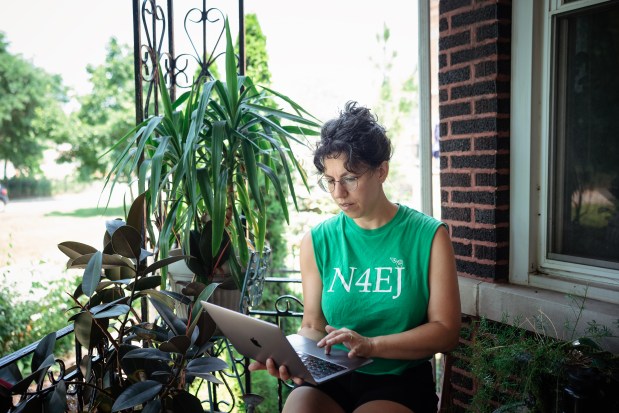
Sonia Monet Saxon often rises early to the scent of burning asphalt. Her home in McKinley Park is near an asphalt plant, making outdoor activities difficult on some days. Even before recent record-breaking PM2.5 levels due to wildfire smoke, pollutants have long been a concern for many. A day before smoke covered the area, Saxon was setting up an air quality sensor at a house in McKinley Park, where she’s installed about 15 sensors over the years. Her aim is to keep an eye on pollution from the nearby plant.
“I love this neighborhood, but some days it reeks of burning asphalt. It can be unbearable,” Saxon noted. Air quality in Chicago gets measured in numerous ways, from inexpensive sensors like those Saxon uses to advanced regulatory monitors. The city of Chicago and the University of Illinois Chicago (UIC) set up a larger network last summer.
UIC professor Serap Erdal highlights that Chicago’s Open Air project is the second-largest of its kind after London. Yet, it measures static points around the city. Researchers suggest that satellites could one day improve coverage in areas lacking monitors. Still, some argue that while air quality tracking is helpful, it doesn’t tackle pollution’s causes.
Anthony Moser, board president of Neighbors for Environmental Justice, said, “We don’t just want to know our air is bad. We want clean air to breathe.”
Neighborhood Air Sensors
Saxon is a community science organizer for the advocacy group Neighbors for Environmental Justice. Her focus is the MAT Asphalt plant in McKinley Park. The plant, criticized since its opening in 2018, is close to a school, a park, and homes. Saxon installs sensors, costing $289 each, in polluted neighborhoods. PurpleAir supplies these sensors, and data is publicly accessible online. They measure PM2.5 particles, which are harmful to human health.
On July 15, Saxon’s sensor initially showed a PM2.5 level of 58, increasing to 71 shortly. Despite being within acceptable ranges, prolonged exposure is risky for sensitive individuals. A day later, the sensor recorded a level of 595 during peak wildfire smoke.
Chicago and UIC finished installing the Open Air Chicago sensors by September. These solar-powered sensors are now found on city light poles. High pollution areas identified by the Chicago Environmental Justice Index received more sensors. Thirteen organizations, including Saxon’s, decided their placement, often near schools and hospitals.
Angela Tovar, Chicago’s chief sustainability officer, explained the sensors provide real-time neighborhood air quality information. They aren’t used for enforcement but to educate the community and possibly inform future strategies.
Erdal mentioned that an educational and data-sharing website for Open Air Chicago will soon launch. It aims to make data more accessible and understandable for the public.
Beyond Legal Limits
Despite the sensors’ importance, groups like Neighbors for Environmental Justice continue installing their own. Moser notes city sensors, while valuable, might be spaced a mile or more apart. The group’s earlier efforts ensured data was available before the city’s installations. Moreover, local data helps residents personally experience pollution impacts. Moser finds it an effective way to highlight air pollution’s reality.
While air pollution from asphalt plants is documented, tackling the underlying issues is complicated by zoning and planning laws. These laws often lead to development in lower-income, predominantly non-white areas.
Industry and Air Quality
MAT Asphalt facility manager Joe Haughey frequently fields odor complaints but maintains their emissions are within legal limits. A 2022 report by CleanAir Engineering showed their emissions at less than 1% of permitted levels.
Besides plants, truck traffic in industrial areas significantly contributes to pollution. Developments in places like Little Village have led to community efforts against increased diesel emissions. A state bill to create buffer zones between warehouses and neighborhoods stalled in legislature, but advocacy continues.
Baltazar Enriquez, from Little Village Community Council, speaks on these efforts, “We want our children to play without developing asthma or lung problems.”
Local groups leverage sensors like PurpleAir, despite their limitations in broad detection and environmental sensitivity. The regulatory monitors are superior but costly and few, making the public, low-cost sensors a popular choice. However, their accuracy is sometimes questionable due to environmental factors.
Kevin Stewart from the American Lung Association highlighted the shortage of comprehensive air monitoring across the U.S. With fewer than 1,000 counties having monitors, many areas remain uncovered. Stewart and researcher Tracey Holloway have explored satellites as a potential solution, as they can collect extensive geographical data.
Yet, viewing from space presents challenges. Holloway compared it to seeing fish in a pond but struggling to judge their depth. Despite complications, such a satellite approach could complement existing systems, adding depth to air quality tracking in Chicago.
 The Growing Threat of Glacial Lake Outbursts and the Urgent Need for Mitigation
  Collapse of Hawaii’s Holei Sea Arch Highlights Nature’s Impact
  Decrease in Atlantic Hurricanes: A 2026 Outlook
  Keurig Dr Pepper Introduces Eco-Friendly Coffee Pods to Cut Waste
  Drought Drives Bears Closer to Human Habitats
  Viral Video Captures Elk Smashing Car Window in Colorado