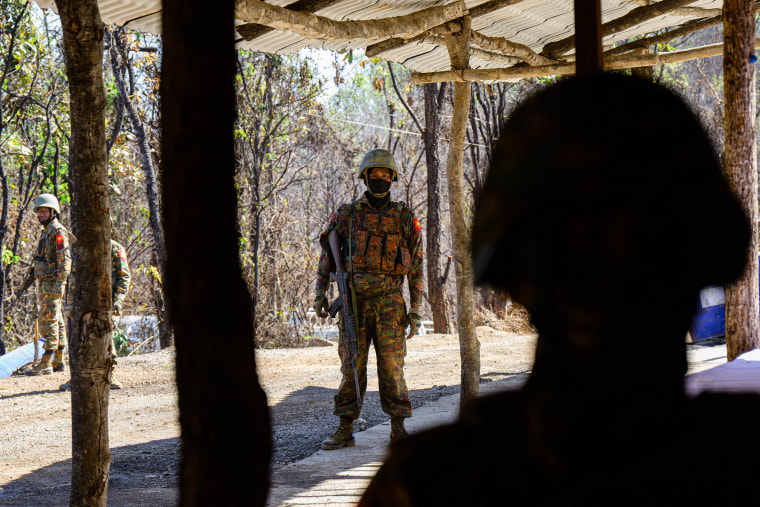
Myanmar’s military has significantly increased its assaults on civilians following the appointment of a new leadership in the conflict-ridden nation. This observation was made by the Armed Conflict Location & Event Data Project (ACLED) on Monday. Despite efforts by regional governments to engage diplomatically, the situation continues to worsen.
According to ACLED, the surge in attacks is linked to new strategies implemented by Myanmar’s military chief, who assumed his role in late March as his predecessor prepared to become the country’s president. ACLED noted that since the junta adjusted its military command structure in March, civilians have experienced intensified repression, including more frequent aerial bombardments.
“These adjustments included the regular deployment of specialized groups of two to five jet fighters executing sustained airstrikes against single targets,” ACLED explained.
A Myanmar government spokesperson did not immediately respond to Reuters’ inquiries.
ACLED collects data on Myanmar’s conflict using media reports, contributions from local partners, as well as information from the U.N., international observers, and local human rights groups.
Myanmar fell into chaos after the military deposed Aung San Suu Kyi’s elected government in February 2021. This led to a civil war that has resulted in about 100,000 deaths and the displacement of millions.
Days before ascending to the presidency following an election that excluded most opposition, Min Aung Hlaing installed Ye Win Oo, a longstanding loyalist and former intelligence chief, as the military’s new commander-in-chief. Under Ye Win Oo’s leadership, the military has renewed attacks in several border regions, including areas with critical rare earth mineral deposits and essential trade routes.
“Reprieve for civilians is unlikely as the junta focuses its efforts on consolidating control following coup leader Min Aung Hlaing’s transition from commander of the military to civilian president in April,” ACLED commented.
In the first half of 2026, ACLED documented more than a dozen mass killings, resulting in over 450 civilian deaths. Around 40% of these fatalities occurred in Myanmar’s central dry zone, known as the Anyar region.
In May, hundreds of junta troops moved through parts of Myit Chay township, located across the river from Bagan’s ancient temples, killing at least 40 people, according to three local residents. “About 700 soldiers came into the town, grabbed the belongings of people here, and then beat and killed them,” reported a resident named Ye Naung, 35.
Reuters could not independently verify the Myit Chay incident reports, which are part of ACLED’s event database and include at least five fatalities as reported by local media.
“The military’s tactics in 2026 thus far show merely shifting modalities of civilian repression rather than any reduction in its severity,” ACLED said.
The political changes in Myanmar have led to increased diplomatic activities, with Min Aung Hlaing visiting neighboring countries like India and China. The junta has also shown tentative steps to re-engage with the 11-member Association of Southeast Asian Nations (ASEAN), which excluded Myanmar’s ruling generals from its summits after the coup. Min Aung Hlaing is scheduled to make an official visit to Thailand from August 6 to 7 as he seeks greater legitimacy.
 Twitch Streamer Hasan Piker Discusses Controversial Commentary
  A Shifting Political Landscape: The Decline of Autocratic Power
  Trump Delivers Warning to Iran, Cuba at UN General Assembly
  Lukashenko and Putin’s Unique Relationship and Belarus’ Strategic Role
  Alan Ritchson Faces Backlash Over Political Remarks
  Himalayan Pilgrimage: A Couple’s Narrow Escape and Lingering Questions