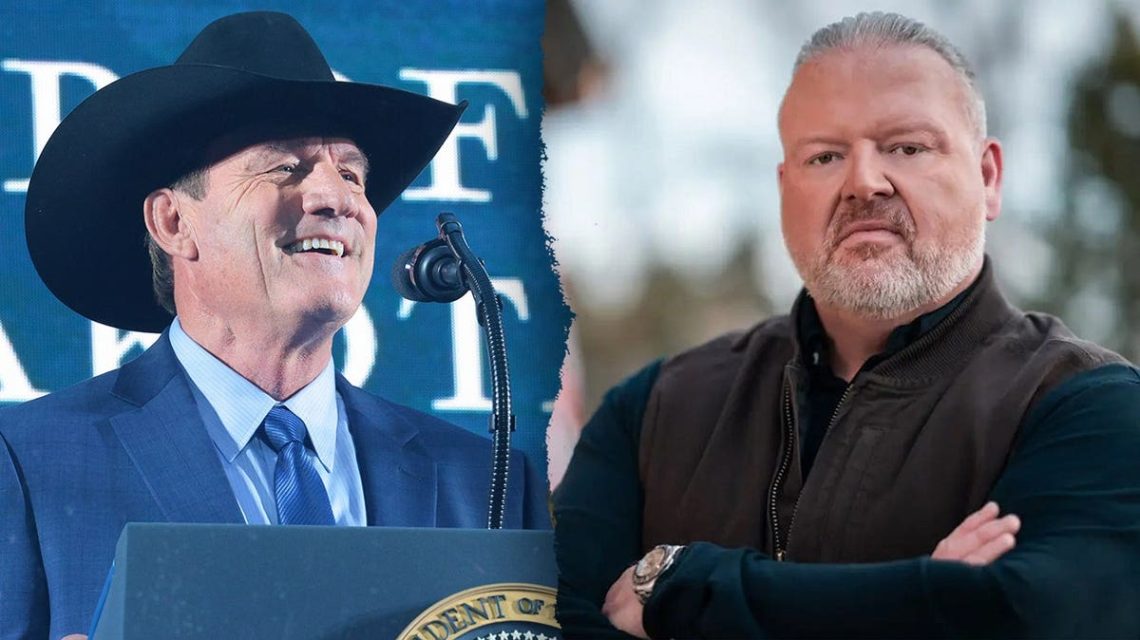
South Dakota Governor Larry Rhoden successfully defended his position against businessman Toby Doeden in a groundbreaking primary runoff, the first in the state’s history. Rhoden secured 70.5% of the vote, as reported by the Associated Press shortly after the polls closed. This decisive victory against Doeden, who garnered 29.5% of the vote, allows Rhoden to advance to the November general election.
This election marked an unprecedented moment for South Dakota voters, who resolved a gubernatorial nomination through a primary runoff. State regulations necessitated a runoff because no candidate achieved the required 35% of the vote in the initial primary. Rhoden and Doeden emerged as the top contenders from a four-way race, with neither acquiring the needed percentage to win outright.
In June’s primary, Doeden led with 30.6% of the vote while Rhoden followed with 25.2%. Despite being new to politics, Doeden campaigned vigorously as a Bitcoin advocate, claiming to have invested significantly in the digital currency since 2020. He even suggested South Dakota should create a state Bitcoin reserve, a proposal that faced opposition from financial officials.
The campaign leading up to the runoff touched on critical issues such as property tax reform. While Doeden advocated for the elimination of property taxes, Rhoden argued that this would jeopardize funding for local governments and schools. Rhoden’s campaign emphasized existing tax relief measures, specifically highlighting what they described as the largest property tax reduction in the state’s history.
The upcoming election will see Rhoden face Democrat Dan Ahlers, a former state senator. South Dakota has not elected a Democratic governor since 1974, emphasizing the challenge Ahlers faces. The last Democratic governor, Harvey Wollman, assumed the role as lieutenant governor following his predecessor’s resignation.
The primary runoff also involved broader political interactions. Doeden campaigned as a strong supporter of former President Donald Trump, aligning himself with Trump’s “America First agenda.” However, Trump did not officially endorse a candidate in the runoff. He acknowledged Rhoden during a recent event but did not explicitly reference the gubernatorial race.
This contest highlighted the classic dichotomy between insider experience and outsider perspectives. Doeden criticized Rhoden’s ties to established political circles, while Rhoden emphasized the benefits of his legislative experience. Rhoden argued that his history in lawmaking provided practical insights essential for governance.
 Federal Appeals Court Decision Against Trump’s ‘Third-Country’ Deportation Policy
  President Trump’s Controversial Ban on Media Outlets Sparks Press Freedom Concerns
  U.S. Security Agreement in Greenland Sparks Optimism and Concerns
  Cook County’s Property Tax Bridge Loans
  A Controversial Stance on Immigration Policies Sparks Debate in South Carolina
  Trump Administration Challenges In-State Tuition for Undocumented Students