A significant low-oxygen “dead zone” has formed again in the Gulf of Mexico along the U.S. coast. The National Oceanic and Atmospheric Administration (NOAA) released new measurements on Wednesday. However, this year, the affected area is much smaller than expected, initially due to a tropical storm altering conditions.
Size of the Annual Hypoxic Zone
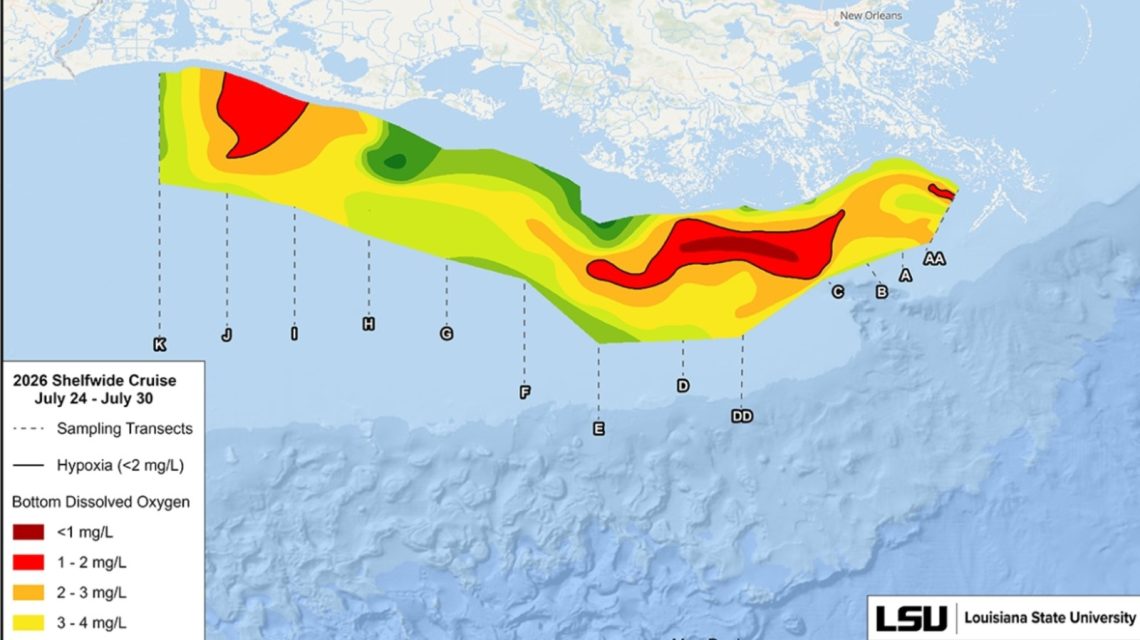
The annual hypoxic zone, a region with dissolved oxygen levels too low to support many marine life forms, measured about 1,332 square miles during a survey conducted in July. This area is roughly the size of Rhode Island and marks the second-smallest dead zone recorded in four decades of monitoring. Such hypoxic areas are often referred to as “dead zones” because fish, shrimp, and other marine life either flee or struggle to survive when oxygen levels drop.
A map from NOAA highlights how the zone stretches across portions of the northern Gulf near Louisiana. Nutrient-rich waters carried by the Mississippi and Atchafalaya rivers contribute to seasonal oxygen depletion. Areas in red on the map show dissolved oxygen levels of 2 milligrams per liter or less, considered hypoxic and not suitable for many bottom-dwelling species.
Causes of Hypoxic Zones
Hypoxic zones typically occur when excess nutrients, especially nitrogen and phosphorus from agricultural runoff, wastewater, and stormwater, enter rivers and coastal waters, leading to large algal blooms. As the algae die and sink, bacteria decompose them, consuming oxygen in the process. This often leaves bottom waters with dangerously low oxygen levels, especially during warm months when the water column is stratified, preventing the mixing of oxygen-rich surface water downward.
Scientists have studied this phenomenon for decades due to its ecological and economic setbacks. Prolonged hypoxia can impact migration patterns, reduce habitat availability, and affect important fisheries. NOAA emphasizes understanding these impacts because they are crucial for the seafood industry, recreational fishing, and coastal tourism economies, all relying on healthy Gulf ecosystems.
Animals at Risk in Hypoxic Zones
Marine species living on or near the seafloor face the hardest hit when oxygen levels plummet. NOAA notes that hypoxic conditions can render crucial habitats unavailable to these bottom-dwelling organisms, forcing them to relocate or suffer stress affecting their growth and reproduction. Vulnerable species include fish, shellfish, coral, and aquatic plants.
While mobile animals, like many fish and shrimp, can escape if oxygen depletion occurs gradually, this often causes crowding in other regions and disrupts feeding and breeding behaviors. Less mobile organisms, particularly those attached to the seafloor or residing within sediments, have fewer options and face greater risks. Ocean-dwelling mammals, such as whales and dolphins, are generally less susceptible to hypoxia since they breathe air and can leave low-oxygen areas. However, dead zones may still affect them indirectly by altering food webs and reducing prey like fish and squid. Such changes may force dolphins to travel further or modify their feeding behavior.
Repeated dead zones can have broader impacts on food webs. Habitat loss and reduced oxygen levels may threaten species supporting major commercial fisheries, leading changes in the living areas of fish and shellfish. NOAA and partner institutions conduct annual surveys and improve predictive models to comprehend these effects better.
This Year’s Hypoxic Zone Size
Despite the smaller measurement of the zone, it does not fully suggest that the Gulf avoided severe hypoxia. Tropical Storm Bertha passed through the northern Gulf prior to the annual survey, mixing the water column and pushing oxygen-rich surface waters downward, temporarily reducing low-oxygen conditions during the measurement cruise.
Earlier, NOAA had forecasted a considerably larger dead zone, approximately 7,027 square miles, surpassing the long-term average and nearing the size of New Jersey. Such discrepancies underline how weather events can significantly impact hypoxic water formation and distribution.
Measuring the hypoxic zone provides more than merely a scorecard of the Gulf’s ocean oxygen levels—it helps us better understand the interconnectivity of our nation’s land, waterways, and ocean,
stated NOAA Assistant Secretary of Commerce for Oceans and Atmosphere Timothy Petty. The extensive data collected over 40 years in the region strives to inform management strategies upstream, aiming to alleviate future impacts in the Gulf.
Other Hypoxic Dead Zones
The Gulf of Mexico’s “dead zone” is not an isolated case. U.S. scientists have documented recurring low-oxygen events in various major waterways, including Chesapeake Bay, Long Island Sound, portions of Lake Erie, and coastal waters off Washington and Oregon. Excess nutrients often drive algal blooms, leading to oxygen depletion as they decompose. However, oceanographic conditions can also cause seasonal hypoxia in some areas. These low-oxygen conditions make survival challenging for marine life.
Chesapeake Bay is one of the most closely watched examples, with researchers issuing annual hypoxia forecasts due to threats to fish, blue crabs, and oysters. Long Island Sound has also faced summertime dead zones historically linked to nitrogen pollution. Similarly, the Pacific Northwest coast and Lake Erie have recorded seasonal hypoxia, underlining that oxygen-depleted waters are a widespread environmental challenge affecting coastal and inland ecosystems across the U.S.
Future Measures
Federal agencies and researchers aim for the Gulf’s dead zone to shrink to 1,900 square miles by 2035 by reducing nutrient runoff across the Mississippi River watershed. Although this year’s measured zone stays below the target, scientists caution that it was heavily influenced by Tropical Storm Bertha and does not imply that the underlying nutrient issue is resolved.
 California Governor Declares Statewide Emergency Ahead of El Niño Storms
  EPA Rollbacks and the Impact on Indiana Communities
  The Impact of Battery Innovations on Renewable Energy
  Challenges in California’s Home Insurance Market
  Race Against Time: Preserving Quinhagak’s Archaeological Heritage
  Managing Drying Rivers: The Need for New Approaches