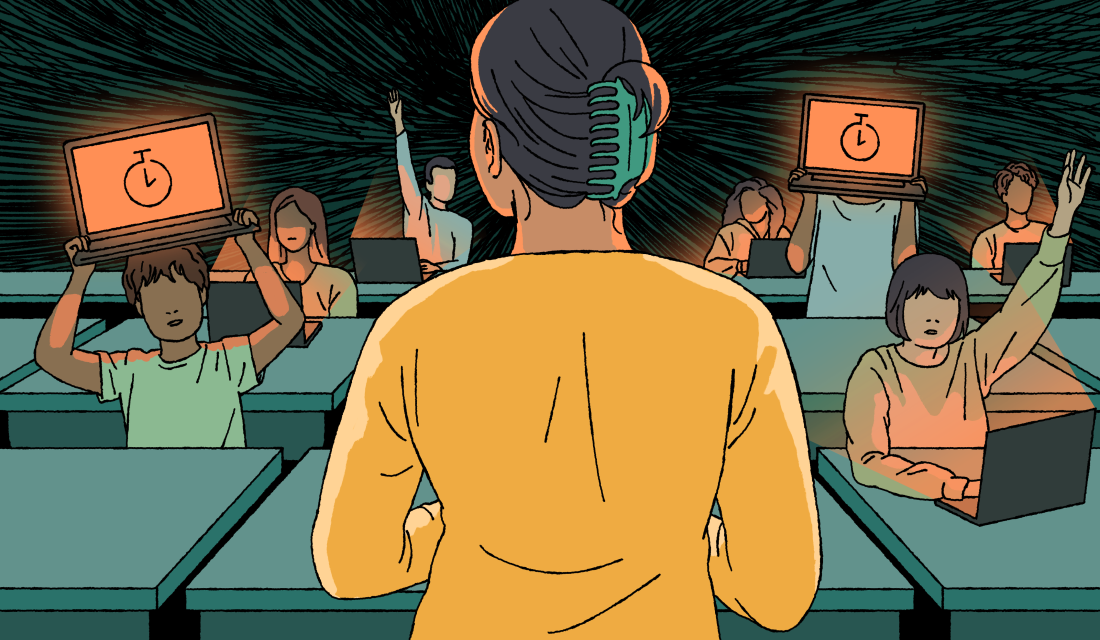
This academic year presents a significant challenge for Armaghan Khan, along with many teachers in the Los Angeles Unified School District (LAUSD), the nation’s second-largest. The district has implemented a policy to ban screen time for younger students and impose stringent limits for older students. “This will greatly impact my teaching methods,” says Khan, who has dedicated his career to LAUSD. “Previously, approximately 75% of our educational activities involved screens.”
Khan, a science teacher at Johnnie L. Cochran Middle School, has relied on technology. His students conduct large experiments on laptops, such as car crash simulations to explore Newtonian forces. “I’m constrained in what I can offer,” Khan explains. “We have a lab space but lack a budget for lab materials.”
The policy shift is part of a national trend, yet the rapid implementation in Los Angeles, affecting over 400,000 students, is distinctive. The school board approved the resolution this spring. Starting immediately, 1st-grade students and younger have no screen time. By November, elementary grades will have restrictions, with middle and high school students affected later.
This marks a change for LAUSD, previously known for its leadership in educational technology. Khan was surprised by the policy’s introduction and the minimal guidance provided. “I don’t feel equipped for success,” he admits.
A Rapid Rollout
Pia Sadaqatmal, the district’s new chief academic officer overseeing the policy, acknowledges the imperfections. “No perfect solution exists for implementing such a policy in a district of our size,” she states. She requests teachers view this year as a transitional phase, stressing that instant results are unrealistic. “We are one of the first districts nationwide to adopt a policy of this scale. We expect to learn with each step,” Sadaqatmal comments.
Students will have software on their personal devices to monitor weekly screen time. This software will not disable the device when limits are reached but will collect data for year-end analysis. The gathered data aims to refine the policy and ascertain its successes and failures. Virtual textbooks are exempt from limits, yet teachers seek clarity on other materials.
Filling the Gaps
“I have more questions than immediate concerns,” says Kirti Baranwal, a teacher librarian at William Jefferson Clinton Middle School, now in her 28th year in the district. “Overall, screen time limits are beneficial.” The district’s previous ban on cell phones, now common in many states, did not curtail extensive screen use. Baranwal reviewed screen addiction with her students, who reported daily usage of 8 to 10 hours, even with restrictions. “I wondered when they found time to sleep,” Baranwal notes.
Research indicates that children lacking access to sports or arts programs may predominantly occupy their time outside school with phones. Both Baranwal and Khan are concerned that simply switching off devices could create educational voids. “We want to reduce phone use,” Baranwal explains. “But we need to decide how we want students to spend their time.”
As the school year begins, LAUSD continues to explore solutions.
 A Controversial Stance on Immigration Policies Sparks Debate in South Carolina
  Politics, Academia, and Their Impact on Standards
  Staying for Progress: A Principal’s Commitment in Missouri
  Life-Changing Experiences: Reflections from Past College Podcast Challenge Winners
  The Unique Education Model of Cristo Rey Jesuit High School
  Civics Education and Student Self-Censorship