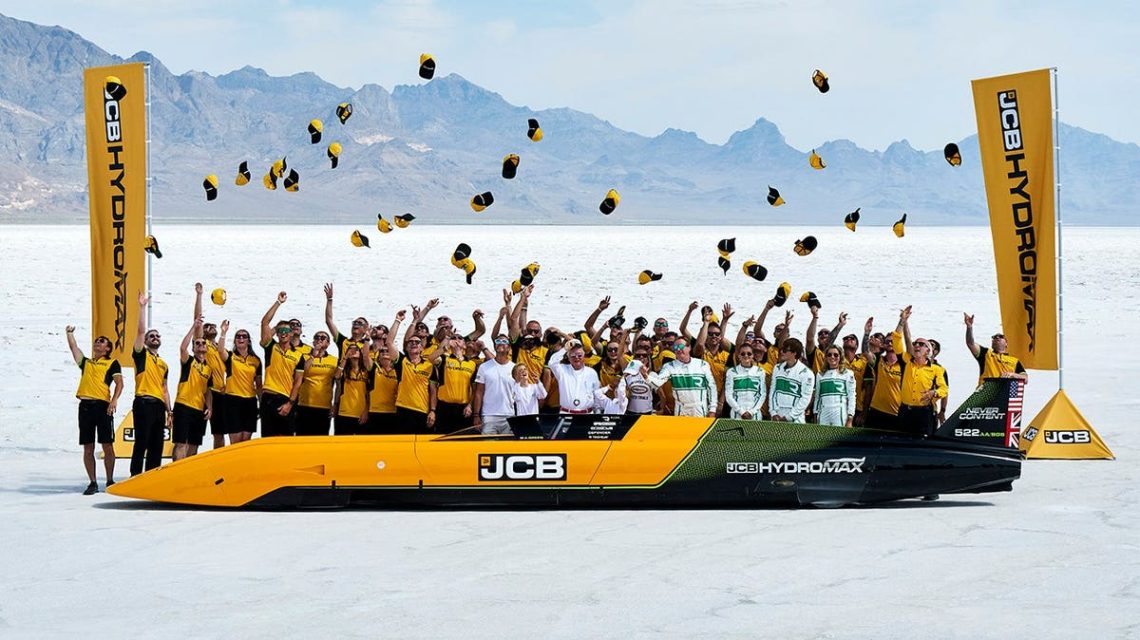
A remarkable feat has been achieved with a hydrogen-powered car setting a new world land speed record at the Bonneville Salt Flats. JCB Hydromax recorded groundbreaking speeds, redefining the capabilities of hydrogen-powered internal combustion engines.
Historic Achievement
The twin-engined, 32-foot vehicle managed two significant runs—one reaching 400.623 mph and another achieving 412.135 mph. The combined average of 406.320 mph established a new world land speed record, far surpassing the previous benchmark set by the BMW H2R in 2004, which was 185.5 mph.
The record is pending official confirmation by the Fédération Internationale de l’Automobile (FIA), yet it stands as the fastest ever for a hydrogen-powered vehicle.
Engineering Excellence
“This is the first of a new breed,” stated Wing Commander Andy Green, OBE, the driver who piloted the car to its accomplishment.
Green highlighted the innovation behind JCB’s achievement, noting the unique technology and class introduced for hydrogen racing at this year’s Bonneville Speed Week. Remarkably, JCB only began its design process a little over a year ago, a milestone that experts anticipated would take five to six years to reach.
Innovative Design and Testing
The development involved nine months of designing and manufacturing components, five weeks of assembly, followed by three weeks of testing in the UK. The application of an optimal fuel ratio for hydrogen engines, which was until now unprecedented, played a crucial role in the success.
The engineering team faced significant challenges, including high-altitude conditions and extreme temperatures. These variables demanded sophisticated solutions, such as the introduction of a cooling system consisting of 400 pounds of ice and water to maintain the engine’s functionality.
Process and Challenges
The team discovered that engine oil had to be heated to precisely 180 degrees Fahrenheit to prevent damage when water inevitably contacted the oil. This delicate balance was essential to avoid catastrophic engine failure.
Ensuring the vehicle could stop safely at these speeds was another priority. A custom-built parachute system was designed to decelerate the 5,500-pound car efficiently.
A Bright Future for Motorsport
Green’s experience as a jet fighter pilot contributed to the success of this project. His understanding of supersonic speeds and his mathematical background made him an ideal candidate for operating such an innovative vehicle.
In 1997, Green set the absolute world land-speed record by reaching 763.035 mph, a title he still holds. His involvement with the hydrogen car signals not just a new record but also a promising development in zero-carbon technology within motorsport.
Green views these advancements as pivotal for the future of motorsport technologies, underscoring the potential for hydrogen fuel sourced from sunlight and water to drive sustainable high-speed automotive innovation.
 Libertyville’s Colten Siebert Drives Team’s Transformation
  College Football Rankings Highlight Dominant Teams
  Colton Ludwig’s Impactful Performances Propel Kaneland Knights
  Sandburg’s Senior Night Celebration with Aubrey Deverick
  Bills Triumph in Thrilling Monday Night Football Clash Against Rams
  Charley Hull Defends Sydney Sweeney’s Sports Betting Commercial