As President Donald Trump intensifies economic pressure on Iran, another pressing issue emerges involving two key U.S. allies. The conflict between Israel and Turkey heightened after an Israeli attack on a Syrian airbase recently visited by a Turkish defense team. This incident sparked accusations from Israel, alleging that Syria breached security protocols by inviting Turkish military presence, while Turkey condemned the Israeli attack as an infringement on Syrian sovereignty. Erdogan demanded Netanyahu’s arrest, accusing him of genocide.
The verbal conflict escalated quickly. Israeli Prime Minister Benjamin Netanyahu criticized Turkish President Recep Tayyip Erdogan as an ‘antisemitic dictator’, while Erdogan’s team dismissed Netanyahu’s claims as ‘petty political tactics’.
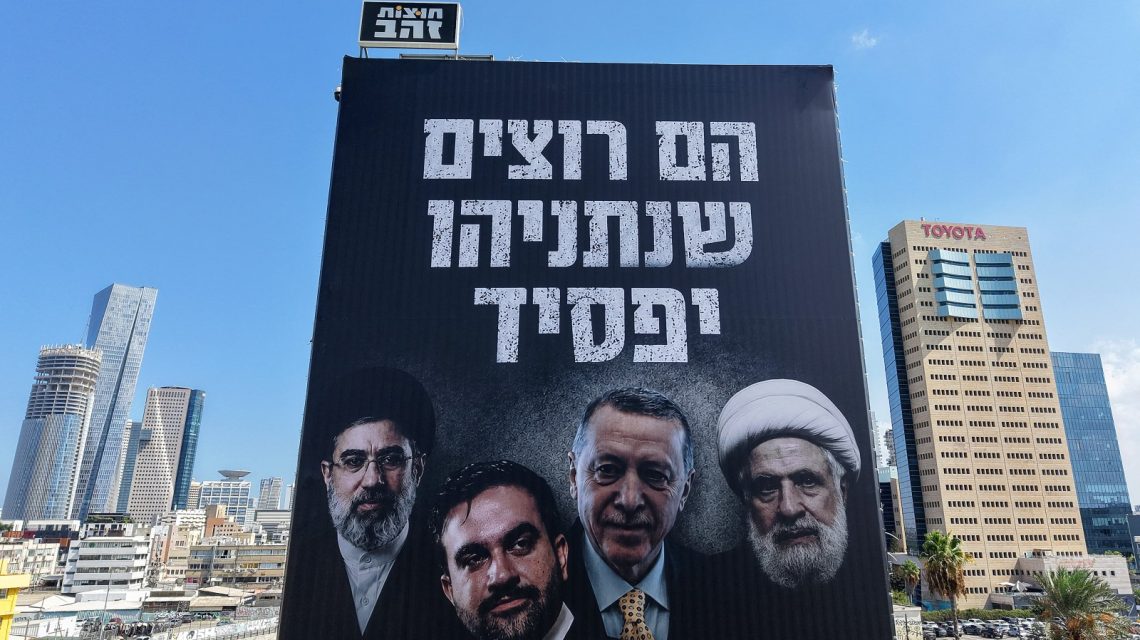
Political tensions remain high as Israeli elections approach. Erdogan’s image appears prominently on billboards in Israel, alongside other figures considered adversaries of Netanyahu. This has led some analysts to caution against dismissing the potential for direct military conflict between Israel and Turkey.
Origins of the Israel-Turkey Conflict
Historically, Israel and Turkey had better relations. Turkey recognized Israel in 1949, becoming the first Muslim-majority nation to do so. Throughout the Cold War, ties fluctuated, with Turkey joining NATO while supporting Palestinian self-determination.
The relationship began to deteriorate in 2009 after clashes in Gaza and Erdogan’s heated interactions with Israeli leaders. Attempts at reconciliation faltered, with rhetoric becoming increasingly hostile. The recent Middle Eastern crisis following Hamas’ attack on Israel has further strained relations.
Israeli officials criticize Erdogan’s hostile stance. Ofir Akunis, Israel’s Consul General in New York, labeled Erdogan ‘extreme’ and accused him of aiding Israel’s adversaries.
Conversely, Turkish officials condemn Israel’s actions under Netanyahu, citing ‘war crimes’ and a disregard for accountability.
Syria remains a focal point. Both nations opposed Syria’s former president, Bashar al-Assad, but aligned differently when President Ahmad al-Sharaa took power, aligning closely with Turkey.
Potential Outcomes
If Israel targets Turkish interests in Syria, Telci warned that Turkey has options, including expanding its influence alongside Damascus or enhancing its air defense along the Syrian border. Turkey’s restraint should not be mistaken for weakness.
Assaf Orion, a former Israeli defense official, noted that Syrian instability post-Assad poses new challenges. While Assad’s fall cut ties between Iran’s coalition and Israel, Turkey’s policy has grown adverse, complicating the regional threat landscape for Israel.
Impact of Trump’s Involvement
Erdogan’s growing rapport with President Ahmad al-Sharaa reflects a shift. Trump has acknowledged successes in resetting U.S. relations with Syria, encouraging cooperation and lifting sanctions. However, Trump’s support for Erdogan and Sharaa concerns Netanyahu.
Strains emerge between Trump and Netanyahu, particularly regarding Syria, highlighting differences in policy objectives. Trump’s administration views Erdogan and Sharaa as regional partners, where Israel sees them as threats.
Turkish-U.S. relations under Trump’s administration focus on stabilizing regional countries and enhancing economic and security cooperation. Telci cited an evident shift from U.S. support for Israel.
Regional Developments
Turkey’s recent defense pact with Saudi Arabia and Pakistan signals a changing regional dynamic. Trump praised these developments, suggesting a unified Middle East capable of self-defense.
Israel, however, has reinforced relations with Greece and Cyprus, countering Turkish maneuvers in the Mediterranean.
Netanyahu promotes the ‘Abraham Accords’ and association with moderate Arab states, while tensions with Turkey hint at evolving regional alignments, such as the ‘Mecca Agreement’.
If Turkey forms a Sunni bloc including Saudi Arabia and Pakistan, Israel’s ability to influence the region may diminish.
Can Escalation Be Prevented?
Escalating tensions pose significant risks, with potential clashes affecting regional stability. Rich Outzen, a former U.S. adviser, noted aggressive Israeli tactics against perceived threats can lead to prolonged conflict.
Mediation, possibly via proposed de-confliction channels, could avert conflicts. The U.S. focus on Iran and managing Israeli-Turkish tensions demands diplomatic resolution.
The prevailing U.S. sentiment desires allies to drive regional improvements, yet this could foster antagonistic blocs if mismanaged.
 Hulk Hogan’s Legacy Lives On with SLAM Sports Bar
  Controversy Over Future of Kennedy Center
  Trump’s Stance on Language and Homeland Security Purchases Under Scrutiny
  Abdul El-Sayed’s Ambiguous Response to Hasan Piker’s Remarks
  Justice Department Sues Ohio Court Over Rule Affecting ICE Arrests
  Democratic Criticism: Carville’s Reaction to Jeffries’ Meeting with Kushner