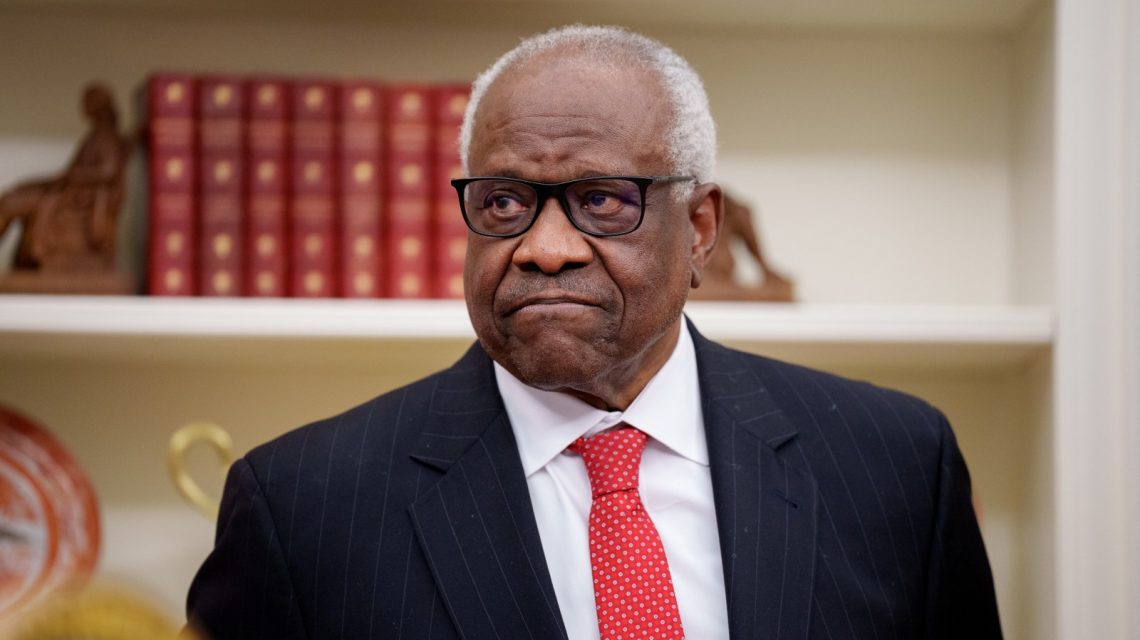
More than twenty years after Justice Clarence Thomas disputed a Supreme Court decision that allowed states to deny scholarship funding to students pursuing ministry degrees, he might have the chance to help overturn it. Virginia college student Bethany Hall recently filed a petition requesting the court to overrule Locke v. Davey, a 2004 ruling. This case permitted states to exclude students pursuing devotional theology degrees from receiving public scholarships, claiming it did not breach the First Amendment’s Free Exercise Clause.
The petition suggests that more recent decisions favoring religious liberty have weakened the reasoning behind Locke. Attorney Steven Fitschen stated to Newsweek, “The Supreme Court only grants about 1% of cert petitions. But we are as confident as we can be with a 1% chance that the Court will both take the case and overrule Locke.” Fitschen added that he expects Thomas to support granting certiorari.
The case comes before a Supreme Court that has recently expanded protections for religious schools, organizations, and individuals concerned with free exercise rights. If the justices agree to hear Hall’s appeal, they will need to decide if states can continue denying financial aid to students pursuing religious ministry and theology degrees.
This decision could impact scholarship programs in Virginia and other states with similar restrictions. Law expert Seth Chandler noted to Newsweek, “If the Supreme Court grants cert, they are most likely to do it to reverse the Fourth Circuit and kill off Locke.”
Who Is Bethany Hall?
Bethany Hall resides in Virginia and studies at Liberty University, a private Christian institution in Lynchburg. As outlined in court documents, Hall initially qualified for Virginia’s Tuition Assistance Grant Program (VTAG), which aids residents attending eligible private colleges in the state. The program provides thousands of dollars annually to students.
Hall initially enrolled as a music education major and received a VTAG grant. However, after arriving at Liberty, she changed her major to Youth Ministries, inspired by what court documents describe as hearing “God’s call.” She later switched to majors in Christian Leadership and Church Ministries and Music & Worship. These majors are classified as ineligible for VTAG funding in Virginia due to their religious training focus.
Consequently, Virginia revoked Hall’s grant before any funds were disbursed. She has continued her studies in the ministry field without VTAG assistance. Hall is eligible for the grant in all respects except regarding the religious nature of her major.
She sued Virginia officials, arguing that excluding her from a generally available public benefit solely because of her ministry-related degree violates the First Amendment’s Free Exercise Clause. Both a federal district court and the U.S. Court of Appeals for the Fourth Circuit ruled against her, stating they were bound by Locke v. Davey. The appeals court noted Hall’s situation as “directly analogous” to the student involved in Locke, stressing that both students lost scholarship eligibility over pursuing religious vocational degrees.
What Was the Decision in Locke v. Davey?
The Supreme Court decided Locke v. Davey in 2004 with a 7-2 vote. The case concerned Joshua Davey, a Washington state scholarship recipient who opted for a double major in pastoral ministries and business management. Washington state provided scholarships to academically successful students but barred recipients from using the funds for devotional theology degrees.
After Davey chose a ministry program, he was informed he could not use the scholarship. Davey challenged the restriction as unconstitutional religious discrimination.
Writing for the majority, Chief Justice William Rehnquist asserted that Washington’s policy did not breach the Constitution. The state had merely chosen not to fund a “distinct category of instruction” related to training clergy. The majority pointed to a “historic and substantial state interest” in abstaining from using taxpayer money to support minister and church leader training.
According to the opinion, that concern positioned the restriction within the constitutional space between what the Establishment Clause permits and what the Free Exercise Clause requires. Locke has since stood as a narrow yet significant exception, allowing states to deny public funding for vocational religious degrees—while still funding other educational forms.
Hall’s petition argues that subsequent Supreme Court precedents have narrowed this decision and left it isolated from the court’s broader religious liberty jurisprudence.
Fitschen told Newsweek that scholarly criticism of Locke began “the day it was decided.” A lower court judge even called for the Supreme Court to overrule Locke. Fitschen and Hall remain hopeful that the Court will grant certiorari, presenting the issue of whether Locke was improperly decided squarely before it.
What Did Clarence Thomas Say in Locke v. Davey?
Thomas joined Justice Antonin Scalia’s dissent and has been a vocal critic of Locke. In the original case, Scalia argued that a broadly available scholarship benefit was being withheld for theology only. He viewed this as unconstitutional religious discrimination, asserting that denying scholarships based on religious choices was unconstitutional. Thomas fully agreed with this opinion.
Thomas also penned a short dissent where he suggested that studying theology “does not necessarily implicate religious devotion or faith.” He emphasized that “theology” traditionally includes secular studies alongside religious ones.
Throughout the Hall petition, Thomas’s later writings questioning Locke appear frequently. In Trinity Lutheran Church v. Comer (2017), Thomas described Locke’s “endorsement” of religious discrimination as troubling. In Espinoza v. Montana Department of Revenue (2020), he argued that Locke had misinterpreted the Establishment Clause. He suggested the court should restore the proper scope to that constitutional provision.
The petition asserts that Thomas’s position now aligns with the court’s wider approach to religious liberty.
It argues that three major cases—Trinity Lutheran, Espinoza, Carson v. Makin—have rejected or undermined many of the premises underlying Locke.
The Fourth Circuit shared a similar view but stated lower courts lacked the authority to discard Supreme Court precedents. Judge Julius Richardson remarked that Locke “was wrongly decided,” rested on “bad history and bad reasoning,” and has become a “stain on our Free Exercise jurisprudence.” He concluded that the court should formally overrule it.
Richardson also noted that the court’s recent decisions have rejected or ignored every Locke premise except its historical analysis.
Will the Supreme Court Take Hall’s Case?
Chandler believes the Supreme Court is “better than average, but not a lock” to take the case. He observed that lower courts “all but begged” the Court to take the case. However, circuits aren’t split on the Hall case, making the Supreme Court’s decision easier.
Usually, if lower courts disagree about a legal precedent, the Supreme Court addresses the case to resolve the dispute.
If the Supreme Court accepts the case, Chandler expects Thomas and Justice Neil Gorsuch to confidently vote to overturn Locke. While Justices Samuel Alito and Brett Kavanaugh have participated in majority opinions weakening Locke, they haven’t written opinions as strong as Thomas’. Chandler still predicts they’d support overturning Locke.
Chief Justice Roberts, referred to by Chandler as the “wild card hiding in plain sight,” authored majority opinions in all three cases that challenged Locke’s reasoning—Trinity Lutheran, Espinoza, Carson.
Considering Roberts stopped short of completely overturning Locke, Chandler speculates he might be poised for a definitive decision or that he might prefer leaving an ineffective precedent intact.
Justice Amy Coney Barrett could potentially side with the conservative majority. However, Chandler doubts there would be sufficient votes to sustain Locke if the Court considers the case.
Advocates for Supreme Court review might argue Hall’s case is an optimal vehicle since even lower courts recognized its similarities to Locke.
The Fourth Circuit stated the facts were “on all fours” with the earlier case, meaning the justices could directly confront the precedent if they decide to take the appeal.
The petition notes several states retain laws restricting scholarship funding for theology and ministry programs, such as Alabama, Florida, Illinois, Michigan, Minnesota, New Jersey, New Mexico, Ohio, Oregon, and South Carolina. If Locke is kept, affected students pursuing religious vocations may continue facing funding issues.
If Locke gets overturned, Chandler suggests states might have to either fund every major equally or end the aid program to prevent seminary students from accessing it. However, Chandler doubts politicians would revoke scholarships.
 Republican Senator Criticizes Trump’s $5,000 Check Proposal
  Trump’s Approach to Iran at the United Nations
  Trump’s Triumphal Arch Controversy
  Concerns Over Abdul El-Sayed’s Potential Senate Role and National Security
  Kentucky Governor Andy Beshear Discusses Tariffs, Faith, and Political Ambitions
  Sunday Highlights: Lane Kiffin, Nancy Mace, and College Football Drama