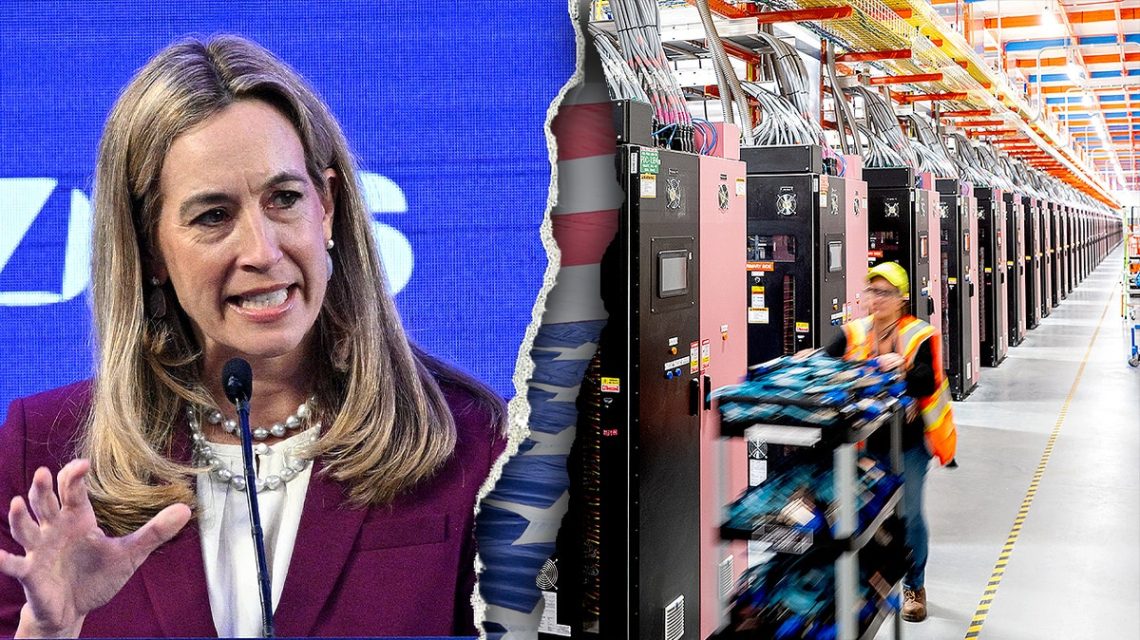
The demand for electricity is growing as artificial intelligence rises, prompting diverse approaches in different states. New Jersey and Indiana are handling this challenge in distinct ways, aiming to prevent higher utility bills for residents.
New Jersey’s Legislative Approach
New Jersey Governor Mikie Sherrill has enacted laws to regulate electricity demands from large data centers. A key law mandates the New Jersey Board of Public Utilities to develop a special rate structure for these centers. It ensures that costs for grid enhancements needed by data centers do not burden other customers.
The legislation requires data centers to commit to at least 85% of their requested electricity capacity for a decade, even if they decrease usage or close. Moreover, it instructs regulators to encourage the adoption of clean energy solutions, efficient power usage, and demand reduction during emergencies.
Sherrill has complemented these measures with new requirements for transparency. Operators must report energy and water usage biannually. This aims to provide a clearer understanding of data center demands and assist communities in negotiating with developers.
Indiana’s Collaborative Solution
Indiana has chosen to work collaboratively, without imposing statewide mandates. Indiana Michigan Power (I&M), along with consumer advocates and tech companies, negotiated a deal to address power needs amid large-scale data center projects.
I&M’s agreement requires data centers to make long-term financial commitments for the electric service they demand. This arrangement allows I&M to turn increased demand into benefits for current customers. The utility plans to cut base rates by $59 million in 2027, attributing potential savings to revenue from large customers.
The proposal, pending approval, would potentially save Indiana households around $100 annually. It also suggests freezing rates for three years, with a decision expected in June 2027.
Debate and Impact
Daniel Turner, executive director of Power The Future, argues that Indiana’s approach is preferable. He suggests companion power generation facilities should accompany every data center to supply and contribute to the grid. Turner believes the challenges of data centers are manageable with sufficient political motivation.
Concerns persist over local impacts, such as increased water use and environmental effects, as evidenced by protests against large projects in Utah. Nationally, the Trump administration initiated a Ratepayer Protection Pledge. This initiative, supported by major tech companies, commits them to cover additional power generation costs for AI data centers.
International Competition
Turner highlights the global stakes, warning against letting countries like China dominate AI advancements. This issue extends beyond utility costs, touching on national security and technological leadership.
The United States must strategically address AI-driven energy demands to ensure competitive positioning in the international arena.
 Reassembling the F-117 Nighthawk at Smithsonian
  Early Research Suggests Bans Aren’t the Answer
  Elon Musk: The Modern-Day Musketeer with Mega Power
  Tesla Roadster: Revolutionary Prototype with Flying Capabilities
  Meta’s Settlement and AI’s Impact on Youth
  Potential Scenarios of an AI-Controlled World