Ron Pitelka was a young man of 23 when he first brought a large rock home from a construction site. At that time, he was working in the southwest suburbs of Chicago. There, workers unearthed an egg-shaped limestone boulder, about 5 feet wide. Having his first dump truck, Pitelka transported the 10,000-pound rock to his residence. Now aged 45, he operates an excavator as part of Local 150. His passion for collecting rocks has grown over two decades, amassing several hundred. Some reside at his mother’s place in New Lenox. About a hundred are at his home in Homer Glen, located 45 minutes southwest of downtown Chicago. They line his driveway and the side of his house, much to the likely annoyance of his neighbors.
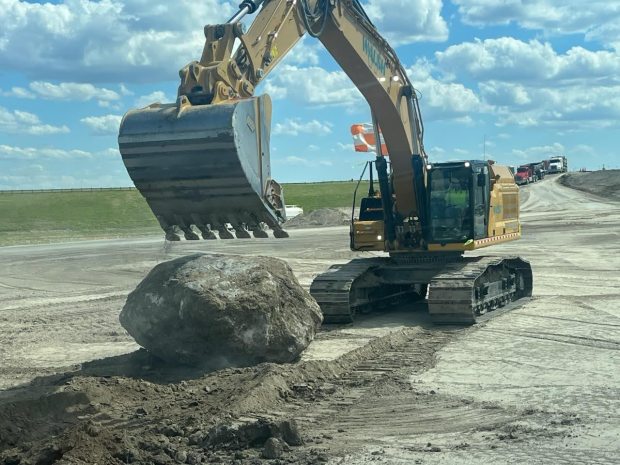
None of the rocks Pitelka owns match the size of a recent find from under the airfield at O’Hare International Airport. During summer, using a Caterpillar 352 excavator, he helped uncover a massive boulder. In June, while working on a project for Walsh Construction at O’Hare, he and bulldozer operator Matt Tracy unearthed a 50-ton boulder. This excavation was part of an $8.8 billion terminal modernization project at the airport. According to Cortney Harris, a project manager for the Chicago Department of Aviation, the boulder was discovered about 30 feet deep while relocating dirt for stormwater detention basins.
“Finding an object of this size during airport excavation is quite remarkable.”
The boulder was examined by a geologist involved in the terminal expansion. Identified as a dolostone, the rock shares similarities with limestone. Dolostone contributes to much of Illinois’ bedrock and was declared the state’s official rock several years ago, thanks to suburban elementary school students’ efforts. The Aviation Department has initiated a public naming contest for the boulder, receiving over 2,300 suggestions. Some proposed names include Da Layover, Jean Baptiste Point du Pébble, Ferris Boulder, and The BaRock Obama Presidential Memorial Airport Boulder.
Aviation Department staff will select finalists, with a public vote deciding the name. Pitelka learned of this contest from a neighbor who saw it on Channel 7. Pitelka expressed delight at the opportunity. He recalled instances when contractors buried or fragmented boulders to save on costs, an action he finds displeasing.
Pat McLaughlin, principal research scientist at the Illinois State Geological Survey, estimates that the rock material forming the O’Hare boulder is over 400 million years old. In the past, the Chicago area was tropical, covered with shallow seas teeming with critters. Their secreted seashells turned into limestone, later becoming dolostone. Glaciers then moved these rock chunks, forming the current boulder 12,000 to 15,000 years ago.
The boulder now sits for public display outside the O’Hare Multi-Modal Facility at 10255 W. Zemke Boulevard. This facility hosts rental car operations, a people mover stop, and Metra and Pace connections. Clara Blättler, an associate professor at the University of Chicago, suggests observing the rock for fossils to determine its exact age.
“Rocks like these are rare in Chicago, making this find significant.”
Pitelka’s interest in excavation runs in the family, as his father and uncle were also in the field. He began operating excavators as a child, accompanying his father on construction sites. His fondness for boulders developed early on, starting with the ones placed outside his childhood home. Even now, Pitelka relishes the thrill of unearthing finds.
While many excavators dream of finding dinosaur remains, Pitelka yearns to discover a meteorite. He highlights that excavation work requires skill and focus, though it also brings enjoyment. His suggestion for the boulder’s name is “Geo,” which he feels appropriately reflects its geological nature. For Pitelka, the boulder’s longevity symbolizes something enduring beyond his lifetime.
 Nor’easter Threatens East Coast with Heavy Rain and Strong Winds
  California’s Growing EV Community Faces Challenges
  Trump’s Greenland Agreement
  Manhunt Underway for Armed Suspect in Placer County
  Midair Brawl Erupts on London-Bound Flight
  Passenger Jumps Overboard on Carnival Panorama Cruise