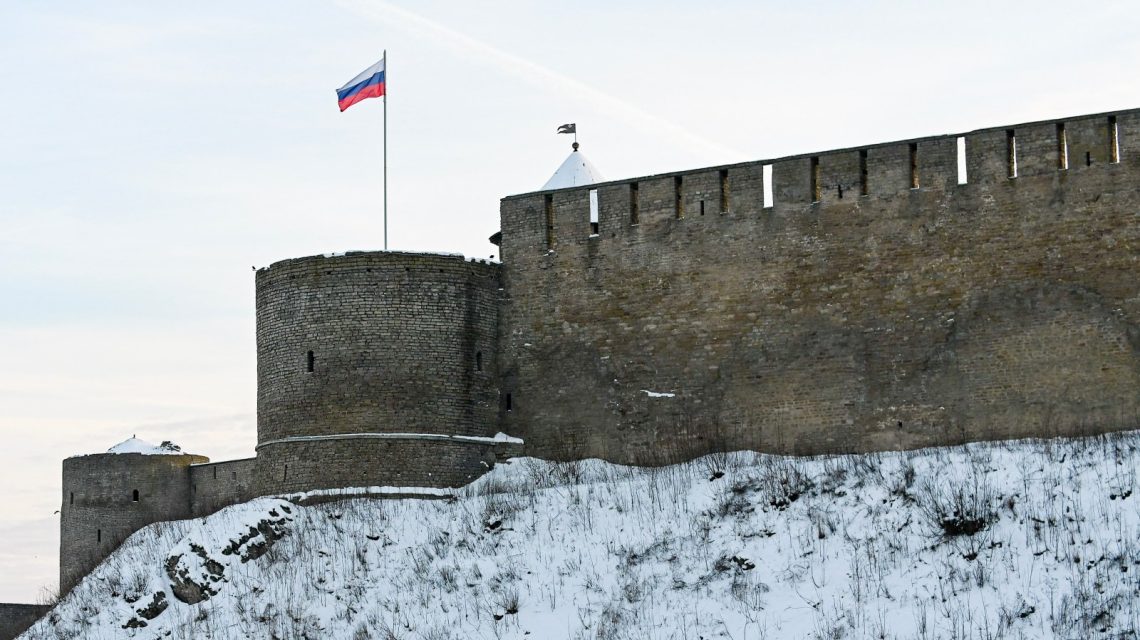
Amid rising tensions between Moscow and Tallinn, the Institute for the Study of War (ISW) suggests that Russia might attempt a limited incursion into Estonia to challenge NATO’s resilience. This possibility emerges as Russia’s Federal Security Service (FSB) recently imposed restrictions on the evening movement within two districts bordering Estonia in the Leningrad region: Kingisepp and Slantsy. They also limited access to parts of the Narva River, shared by both countries.
Estonia has stated it would close its border with Russia if a mass mobilization is ordered by President Vladimir Putin to replenish losses in Ukraine, potentially leading to a mass exodus. Concerns among officials in the Baltic region regarding Russian drone incursions, airspace violations, and sabotage activities are intensifying. The ISW suggests Narva, a Russian-speaking border town, may be targeted by Moscow. This would test NATO’s Article 5 mutual defense clause.
The ISW highlights that there is currently no Russian military buildup in the Baltic states, making an invasion unlikely as Putin focuses on Ukraine. However, even a limited incursion would challenge NATO’s military structures. Newsweek has contacted the Kremlin and Estonian foreign ministry for comments.
Propaganda Campaign Possible
The ISW has noted that tensions at the border provide context to Moscow’s view that Estonia could be used as a stepping stone to potential conflict with NATO. Propaganda may be utilized to allege Estonia’s oppression towards Russian-speaking citizens or link Estonian aid to Ukraine with attacks against Russia.
Russia might position drone units within reach of Narva and the nearby military base of Johvi. Long-range and shorter-range drones could be used against NATO positions. Russian agents might seize vital buildings in Narva to declare a “Narva People’s Republic,” inviting Moscow to intervene.
The ISW predicts Russian forces could use pre-positioned drone and air defense units without formally entering Estonian territory unless there is escalation from Tallinn. This dynamic could result in a stalemate, as Estonia might struggle to defend against Russian FPV strike drones. Russia could demand recognition of the NPR or threaten to expand its strikes while denying any attack on NATO.
NATO’s Response Uncertain
Estonia may seek activation of Article 5 or support from NATO allies. Nonetheless, alliance members could hesitate over a limited incursion due to the risk of full-scale conflict with Russia. Should Article 5 not be activated, its significance would be undermined, presenting Putin with a strategic advantage.
Tensions between the United States and Europe over protecting NATO territory could delay or impact U.S. involvement, with Russian cognitive warfare potentially deepening the divide. Despite this, the scenario would also see Putin facing the risk of NATO escalation, forcing him to balance conflict with NATO and the war in Ukraine.
Theoretical Scenario
The ISW’s scenario on Narva is hypothetical, illustrating how Moscow might execute a minor operation to test NATO’s response. This scenario bears similarities to Carlo Masala’s book, “If Russia Wins: A Scenario,” which explores Russia’s potential influence on NATO and suggests a disinformation campaign could accompany the operations.
Masala’s analysis portrays NATO split on invoking Article 5 with a diminished U.S. commitment. However, his scenario differs as it places the attack after Ukraine’s conflict ends in Russia’s favor, projecting Kyiv’s surrender of territory. He notes a growing belief within Moscow, seeking opportunities to test NATO’s deterrence.
Masala shared his views with Newsweek, expressing increasing Russian recklessness in challenging NATO, aiming to divide European members. This perspective emphasizes the evolving threats NATO might face from Russia.
 Former CEO Sentenced for Bank Fraud and Sanctions Evasion
  Senators Urge Action to Free Imprisoned Journalist in Iran
  Trump’s Address at UNGA and Key Political Developments
  Irish Athletes Urge Boycott Against Israel
  U.S.-China Summit and the Taiwan Dilemma
  U.S. Military Rights Expanded in Greenland: A New Security Agreement