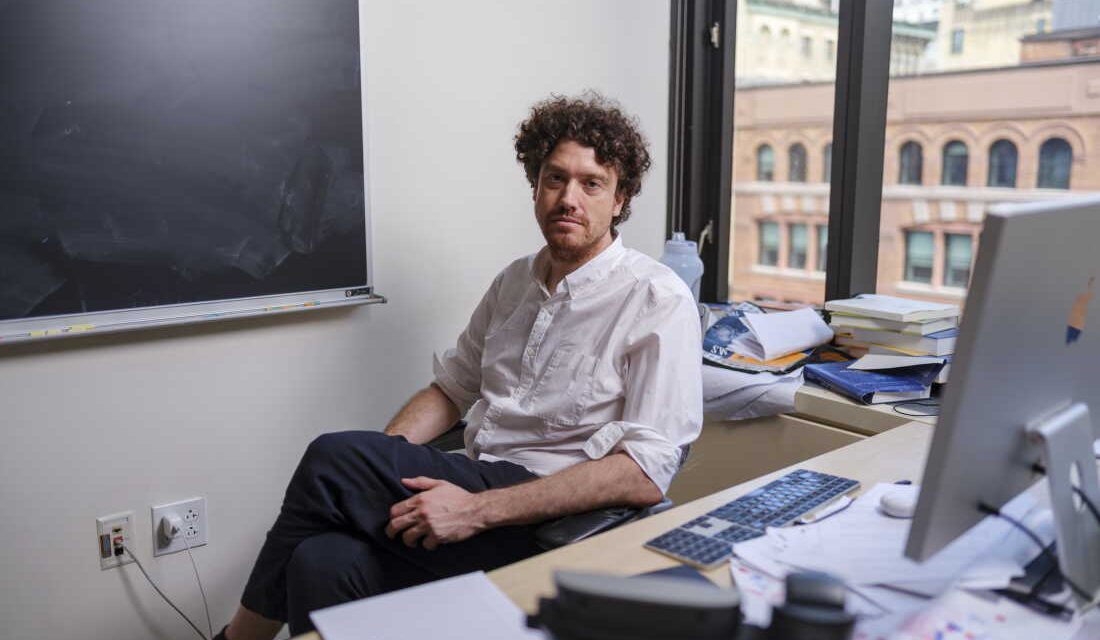
Tristan Buckmaster is a mathematician at New York University. On September 11, 2026, he was photographed in his Manhattan office as part of a discussion about his work with collaborator Levent Alpöge on the Navier-Stokes equations. OpenAI claims to have solved these equations, sparking a clash with the mathematicians.
OpenAI’s announcement was celebratory, stating their AI’s solution to the Navier-Stokes problem aimed to empower scientists to advance technology for humanity’s benefit. However, mathematicians have been skeptical. Although they acknowledge the proof’s technical correctness, they find the dense 166-page AI-generated manuscript difficult to comprehend.
So far it’s been very difficult to really extract any human understanding from this new AI proof,
said James Maynard from the University of Oxford. Javier Gómez-Serrano from Brown University remarked that the paper is not written for humans. He believes rewriting the proof might advance the field, but currently, it teaches little.
The increasing presence of AI in mathematics over six months is notable. Large language models now seem capable of generating results that could lead to discoveries. Despite this progress, OpenAI’s solution amid human mathematicians nearing a breakthrough highlights missed collaborative opportunities between AI and human researchers.
Maynard, who, with 25 Fields Medal winners, signed a statement criticizing AI companies’ misaligned goals with the math community, expressed disappointment. He felt the potential for fruitful collaboration turned into a chaotic, competitive scenario.
Rush to Discovery
The Navier-Stokes problem, crucial in physics and engineering, remains one of math’s important unanswered questions. These equations model fluid flow but lack deeper understanding, which Buckmaster contends could improve turbulence and aircraft lift models.
Researchers sought scenarios where Navier-Stokes equations fail. This pursuit forms part of the $1 million Millennium Prize Problems, established in 2000 by the Clay Mathematics Institute. Many mathematicians, sensing proximity to a solution, anticipated its resolution.
Buckmaster, alongside Levent Alpöge from Anthropic, neared identifying these scenarios. They used AI tools, like OpenAI’s chatbot, in their work. However, OpenAI, sensing progress, accelerated efforts to find solutions to all open Millennium Prize problems, including Navier-Stokes.
OpenAI deployed 10,000 AI agents on the Navier-Stokes problem for 88 hours, using around 130 billion tokens, estimated to cost $6-$10 million. The entire effort of 300 billion tokens reached closer to $15-$20 million.
Controversy arose when Buckmaster publicly described OpenAI’s approach. Allegedly, they offered to include him on their paper if he excluded Alpöge from the collaboration. Buckmaster believes OpenAI was aware of his and Alpöge’s solution approach.
OpenAI denies using Buckmaster and Alpöge’s inputs in their search. Nevertheless, OpenAI’s paper appears muddled to mathematicians. It’s considered poorly written and hard to decipher.
Buckmaster, pressured by OpenAI’s announcement, released his preliminary AI-influenced results, which he admits were rushed and unsatisfactory. Computers check computers
Computers Check Computers
Despite the challenge of interpreting OpenAI’s manuscript, its correctness is trusted. OpenAI provided a Lean formalization—a programming language in mathematics verifying proofs. OpenAI’s Lean code compiled correctly.
Gómez-Serrano and other mathematicians confirm the solution’s accuracy. They welcome AI in mathematics, recognizing the field’s reliance on computational tools for advancements. However, Maynard emphasizes that mathematics extends beyond solutions—it’s about human comprehension and insight.
 Tips for Maintaining VPN Connection While Traveling
  Google Fined for Privacy Breaches
  Emergence of AI-Powered Malware and Its Implications
  Virginia’s Data Center Plan Sparks Tensions Over Energy and Environmental Goals
  President Trump Proposes ‘Super Intelligence’ as New AI Term
  First Lady Melania Trump’s AI Education Push Amid Concerns