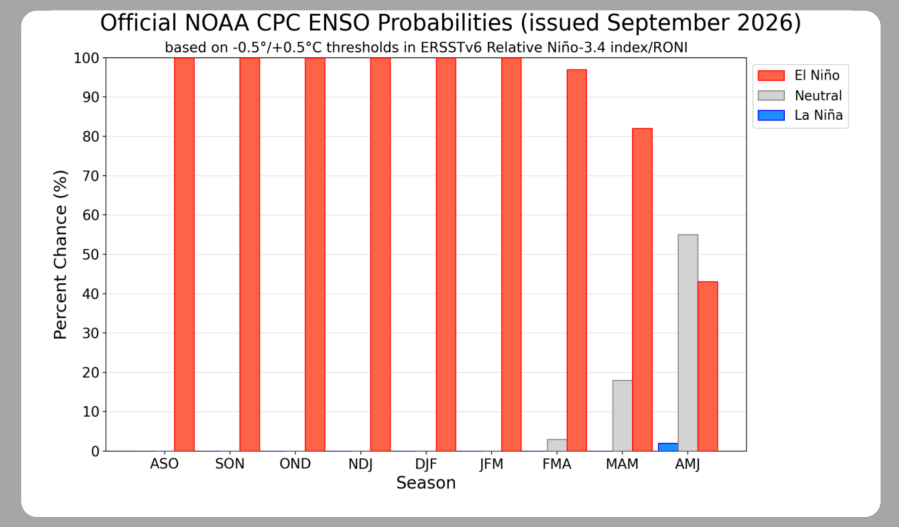
El Niño is currently growing stronger and is expected to persist through the upcoming seasons. Climate models now predict that this weather phenomenon will last not only through the fall and winter but also into spring 2027.
Columbia University climate scientist Azhar Ehsan recently shared projections showing a nearly certain chance of El Niño continuing into spring. He stated, “I wrote near-certain but it’s 100%.” The National Oceanic and Atmospheric Administration’s (NOAA) Climate Prediction Center concurs, estimating a 100% likelihood of El Niño lasting for an additional six months.
Climatic data presented by NOAA’s Climate Prediction Center illustrates the likelihood of El Niño over varying three-month intervals, such as August/September/October, September/October/November, and others.
This El Niño is poised to be both lengthy and intense, accelerating faster than any past El Niño events. Forecasts indicate it will reach “super” strength in the fall or winter months, impacting weather significantly, noted Brian James, chief meteorologist at Nexstar.
Currently influencing hurricane seasons, this El Niño has led to increased activity in the Pacific while calming conditions in the Atlantic. As the winter months approach, changes will vary across the United States. In general, the northern states will experience drier and warmer conditions, whereas the southern states are likely to see cooler and wetter weather.
James explained that while cooler air might occasionally affect the central U.S., the overall weather pattern will not heavily favor snow in the northern regions.
El Niño’s influence is expected to diminish from “very strong” to “strong” by early spring. Eventually, it will moderate, according to the Climate Prediction Center.
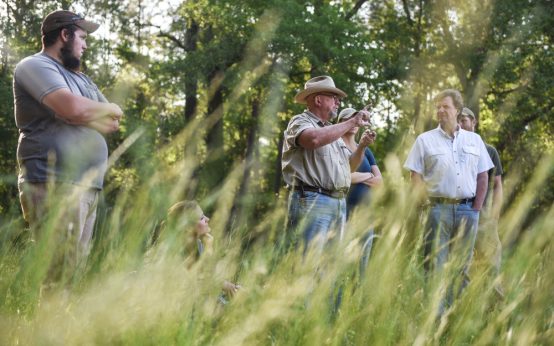 Farming Evolution in Bluffton: Will Harris’s Journey
 Gray Wolves Stir Controversy Over Wildlife Management
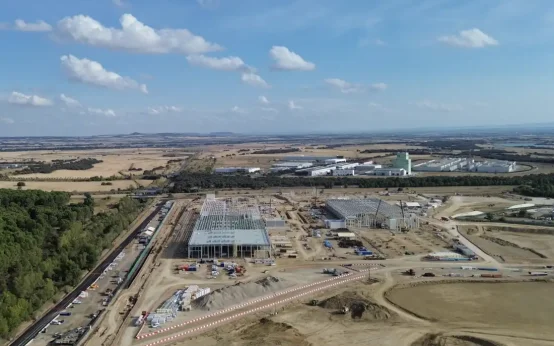 Protests Rise in Spain Against Data Center Expansion
 Highlights from Recent News Stories
 Lewis Pugh’s Swim Through Danger Highlights Strait of Hormuz Crisis
 House Urged to Embrace Historic Permitting Reform