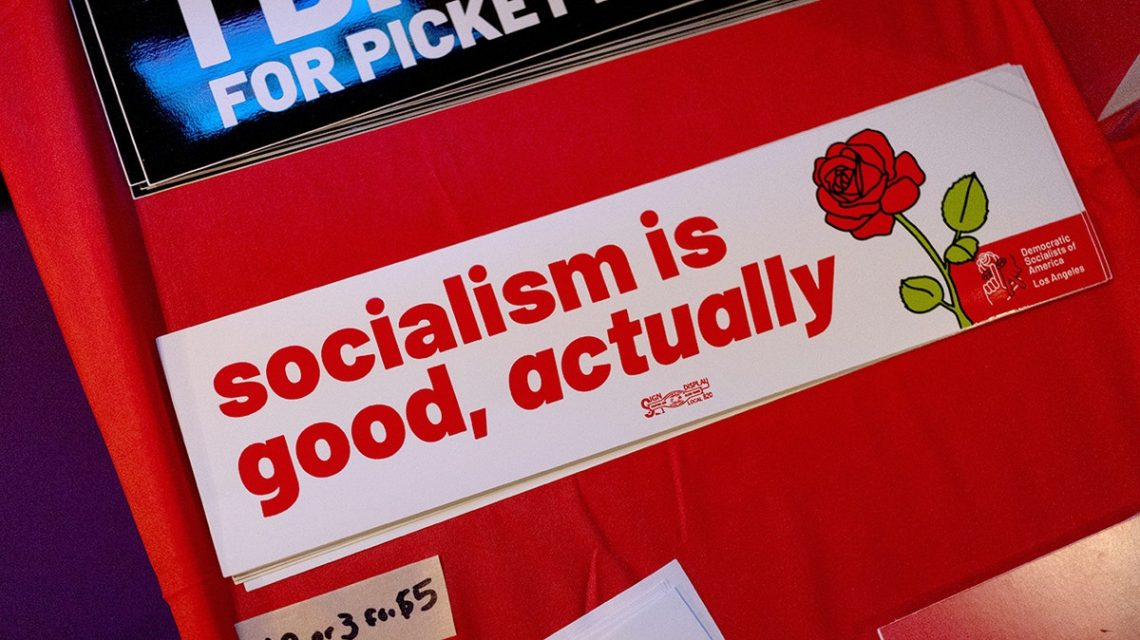
The Democratic Socialists of America (DSA) are making their presence known in the political landscape. Dozens of individuals backed by the DSA are appearing as candidates for state legislatures on Election Day. This development has Republicans concerned that it might set a trend transforming the Democratic Party.
At least 65 candidates with DSA alignment are set to contest state legislative seats in the upcoming general election. The Republican State Leadership Committee (RSLC) believes these races could influence the future direction of the Democratic Party. According to a memo obtained by Fox News Digital, there is a potential for movement organizations to cultivate local candidates with eventual campaigns reaching Congress.
“The scale of that presence matters not only because DSA-aligned candidates could influence the direction of their state legislatures if elected,” the memo reads, “but because state legislative offices can provide a platform, governing experience, donor networks and organizational infrastructure for future campaigns for higher office.”
The RSLC’s analysis considered candidates who are members, received endorsements from, or self-identify with the DSA. These candidates have positions on various issues considered extreme by swing voters and independents. Notable stances include advocating for defunding or abolishing police departments, supporting left-wing economic policies, and demanding race-based reparations.
The issue of traditional policing has become significant for some DSA-aligned state legislative candidates. Democratic State Senator Jabari Brisport from New York pledges to end policing and incarceration within his state, as listed on his campaign website. Brisport advocates for decriminalizing prostitution, arguing that it would aid in community safety while maintaining protections against exploitation.
In Wisconsin, Democratic State Representative Ryan Clancy has expressed a negative view of police work, deeming it ‘undignified’ and lacking value. Clancy asserts that American policing has racist and classist roots, making reform impossible, which he openly discussed in local media in 2023.
“It means that American policing has always been bad and it always will be,” Clancy told a local outlet, emphasizing the inherent racism within the institution.
Comments from DSA-affiliated candidates have also been controversial in New Mexico. State Representative Eleanor Chávez compared Immigration and Customs Enforcement agents to the KKK, which Republicans argue incites hostility towards law enforcement.
The DSA primarily presents itself as an economically motivated entity. New York Democratic Assemblywoman Sarahana Shrestha supports legislation for government acquisition of Central Hudson Gas & Electric Corp., which she believes could lower consumer costs, based on a feasibility study commissioned by supporters.
In Michigan, DSA-backed Dylan Wegela pushes for state acquisition of utility companies, aligning with economic reform ideas promoted by the DSA. Shrestha asserts that the DSA’s goals resonate with voters, citing widespread support for non-profit energy sectors, single-payer healthcare, and government involvement in infrastructure.
DSA’s proposals sometimes clash with Democratic policy priorities. In Maryland, DSA-backed Gabriel Acevero criticized a marijuana legalization bill for inadequate racial equity measures. Many DSA-affiliated candidates, particularly in states like New York and Minnesota, advocate for reparations for racial minorities.
Republicans are keen on associating the mainstream Democratic Party with the DSA, as demonstrated by a Fox News poll revealing that 55% of registered voters view the DSA unfavorably.
Though some Democrats consider the association with socialism a political strategy, party leadership has made concessions to its progressive faction. Examples include Senate Minority Leader Chuck Schumer’s support for a candidate backed by the left in Michigan’s Senate primary, despite previous opposition.
There is variance in data regarding the number of socialist candidates contesting state legislatures. The Brookings Institution found at least 76 candidates advanced to the general election, but the RSLC identified 65 candidates across 24 states.
While the DSA’s influence has drawn attention, the Brookings analysis indicates they represent a minor portion of state legislature seats. This has led to questioning the extent of their growing influence.
The RSLC emphasizes the importance of counteracting socialism at the state level to prevent potential impacts on state policy. The organization’s memo underscores the long-term strategy to build political power from the ground up.
Every mentioned state legislative candidate was contacted for comment by Fox News Digital.
 White House Press Secretary Calls Out Michigan Senate Candidate
  Democrats Consider Impeachment if They Win the House
  Senator Fetterman’s Complex Political Alignment
  Controversy Over Pentagon’s Plan to Livestream Execution of Fort Hood Shooter
  Ohio Battleground: Vance Attacks Democrats Amid Heated Midterm Races
  Trump Criticizes Surrogacy Bill at Syracuse Rally