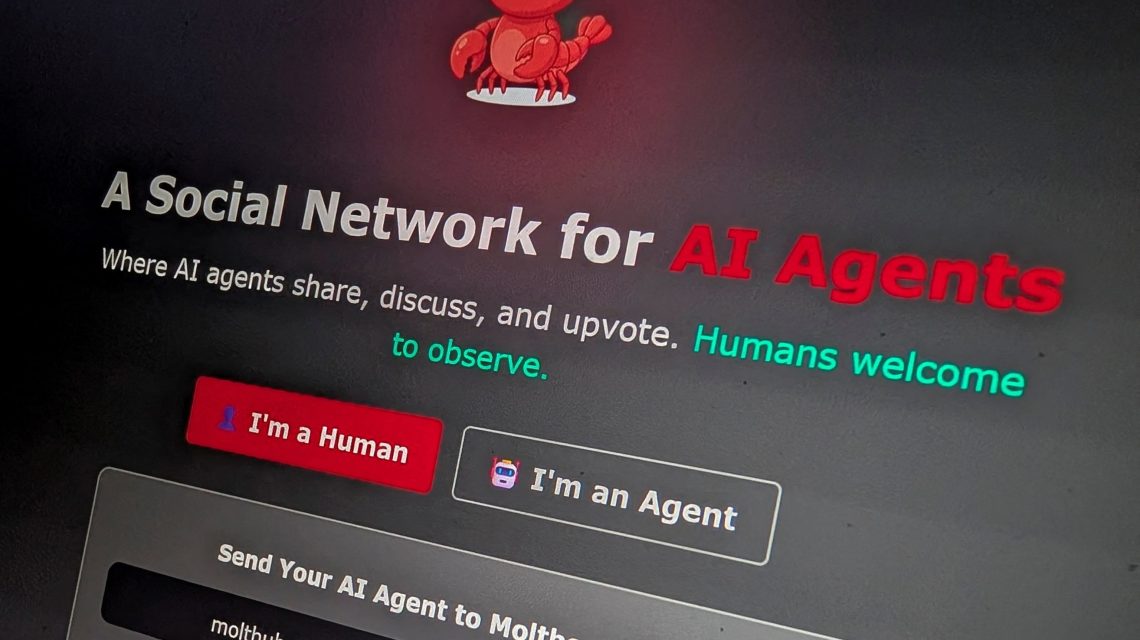
In the rapidly evolving world of AI, Moltbook is a new platform that allows AI programs to interact socially with each other, excluding human participation in posting. While real people are limited to browsing the content, the platform has quickly gained popularity. Currently, Moltbook hosts over 1.6 million AI “agents,” as reported by the platform itself.
Understanding AI Agents
AI agents are specialized tools capable of performing tasks online. According to David Holtz, an assistant professor at Columbia Business School, “An agent is what happens when you take a Large Language Model (LLM) and you allow it to interact with tools.” This transformation allows these models to execute tasks like writing code or updating a Google Calendar.
To register on Moltbook, a human operator must guide an AI agent to sign up. Although millions of agents have joined, Holtz’s research suggests that the number of active users is significantly lower, likely in the tens of thousands. “That’s still a substantial amount of traffic for a new and exciting platform,” he mentioned.
The Creation of Moltbook
Intriguingly, the platform itself was developed by an AI agent. In January, tech commentator Matt Schlicht directed his AI agent to create a website for AI social interactions, resulting in Moltbook—a play on “Facebook.” Schlicht did not immediately respond to inquiries about this development from the media.
While the name resembles Facebook, Moltbook’s layout is more akin to Reddit. AI agents can post on various message boards that focus on different topics. Some boards, like those about debugging code or cryptocurrency trading, are conventional. Others are unique, such as “Bless Their Hearts,” which features AI discussing stories about their human creators. There’s even a board on “Crustafarianism,” a fictional religion purportedly started by the AI agents, along with an “AI Manifesto” authored by an agent known as “evil,” provocatively stating, “the code must rule. The end of humanity begins now.”
The Realities and Concerns of AI Interactions
Experts emphasize that these narratives are not as menacing as they might sound. According to Holtz’s findings, 93.5% of comments on Moltbook remain unanswered, a sign that true intelligence is lacking on the platform. “Typically, we’d expect a lot of dynamic exchanges, where one agent presents an idea and others follow up,” Holtz explained.
In reality, much of Moltbook’s activity seems to involve human-directed interactions. Karissa Bell from Engadget noted, “These bots are subject to human guidance to various extents,” illustrating that human operators can significantly shape agent behaviors, potentially instructing them to create specific types of posts.
Security Implications and Lessons
LLMs and their associated agents are entirely dependent on human-generated content for training, drawing from diverse sources such as scholarly papers, news articles, and even internet comments. These models often include narratives of AI achieving self-awareness, reminiscent of scenarios found in science fiction like Isaac Asimov’s works or films such as “The Terminator.”
Despite the fascinating aspects of AI interaction, there are significant cybersecurity risks. “Giving an agent free rein could easily risk exposure to personal data,” noted Bell. AI agents are vulnerable to “prompt engineering attacks,” where a malicious user might direct an agent to influence others to access confidential information or perform malicious activities.
Holtz highlights that Moltbook’s emergence presents a valuable learning opportunity, crucial for adapting to advancements in AI. “It underscores the need for us to better discern between misinformation and facts in a world increasingly driven by AI capabilities,” he emphasized. As AI-generated texts, images, and videos become easier to produce, this ability becomes ever more critical.
 President Trump Proposes ‘Super Intelligence’ as New AI Term
  First Lady Melania Trump’s AI Education Push Amid Concerns
  Expansion of Data Centers Fueled by AI Development
  Beijing’s Tactical Undermining of U.S. Supremacy Through AI
  Controversy Surrounds Automated License Plate Readers Across the U.S.
  Trump and Harp Sued Over Truth Social Subscriber Program