The recent emission of several solar flares by the sun has captured the attention of space-weather experts due to its potential to produce northern lights and impact satellite systems. Notably, on Sunday, NASA recorded three significant solar flares occurring at 7:33 a.m. ET, 6:37 p.m. ET, and 7:36 p.m. ET. A fourth event followed the next day at 3:14 a.m. ET, as reported by the space agency.
According to the National Oceanic and Atmospheric Administration’s (NOAA) Space Weather Prediction Center, solar flares are substantial eruptions of electromagnetic radiation from the sun, with durations ranging from mere minutes to several hours. These typically stem from active regions on the solar surface, characterized by intense magnetic fields often associated with sunspots.
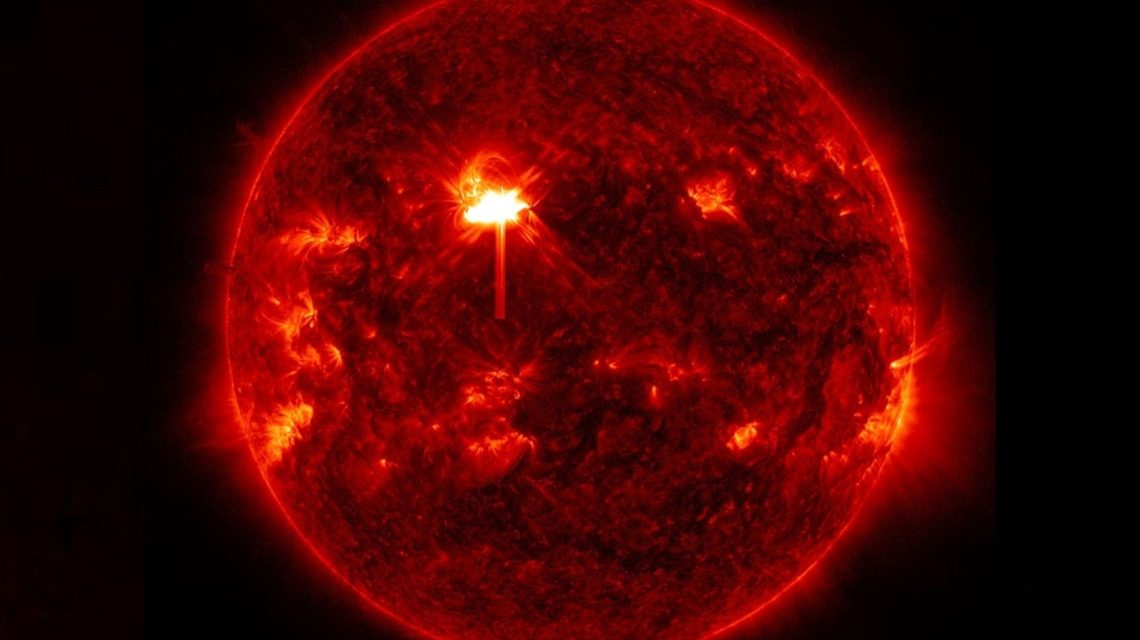
An intriguing image captured by NASA’s Solar Dynamics Observatory on February 3, 2026, showcases one such solar flare as a luminous flash on the sun’s upper segment. This image, highlighting extremely hot material in flares, is colorized in red to represent a subset of extreme ultraviolet light.
This week’s solar flares have been classified within the “X-class,” indicating their status as the most intense type of flares, according to NASA. Such powerful flares are rare events, as confirmed by the Space Weather Prediction Center. Notably, the flare occurring at 6:37 p.m. ET on Sunday was an X8.1 flare, marking it as the strongest in recent years.
NOAA has noted that the flare activity, traveling at light speed, can disrupt high-frequency communication over the sunlit portions of Earth. This disruption may lead to short-term signal losses or communication issues lasting from several minutes to a few hours.
Solar flares often serve as precursors to Coronal Mass Ejections (CMEs), massive bursts of solar material and magnetic fields released from the sun’s outer atmosphere. Moreover, NASA’s Solar Dynamics Observatory captured imagery of these phenomena on February 1 and 2, 2026. Their observations revealed intense ultraviolet light, depicted in rich colors of gold and red, highlighting the heated material within these flares.
When a solar flare interacts with Earth’s atmosphere, northern lights or auroras can be produced. This occurs as the solar particles excite atoms and molecules in the atmosphere, causing them to glow and generate a spectrum of light in the night sky. However, visibility depends on various factors, including the CME’s arrival conditions, its magnetic field orientation, and local weather conditions.
Back in October 2024, the sun’s magnetic activity peaked, marking the solar maximum phase of its 11-year cycle. Since then, the sun has continually emitted strong solar flares and geomagnetic storms, enhancing the frequency of northern lights displays. NOAA forecasts that intense magnetic activity fueled by sunspots is likely to persist through 2026.
 Cold Weather Alerts and El Niño Influence
  Turning Home Food Waste into Compost: A Guide
  Chicagohenge: When Sunlight Aligns with City Streets
  Fat Bear Week 2026: A Look at the Contest and Its Competitors
  California Governor Declares Statewide Emergency Ahead of El Niño Storms
  EPA Rollbacks and the Impact on Indiana Communities