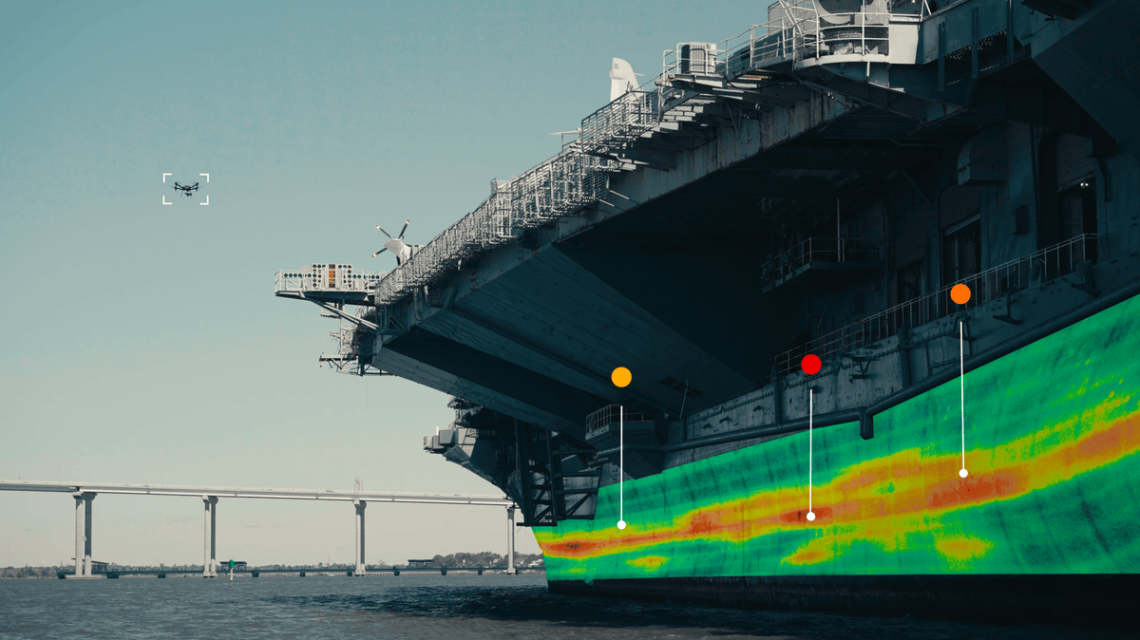
The U.S. Navy has significantly increased a contract for AI-powered robots, meant to inspect warships, raising its value to $300 million. This decision comes months after beginning to use the technology to speed up ship maintenance. The enhanced contract with Gecko Robotics highlights the military’s focus on tech-based maintenance solutions.
The Navy initially set the contract ceiling at $71 million but has now boosted it as part of efforts to enhance fleet readiness amidst a growing shipbuilding disparity with China. Gecko Robotics’ CEO, Jake Loosararian, expressed that while production may not surpass China’s, strategic maintenance can offer an edge. He noted the technology could save up to $8 million per ship in repair costs and detect structural issues significantly faster than traditional methods.
Gecko Robotics employs robots and AI software to map the structural conditions on Navy warships, aiding crews in pinpointing areas needing repairs.
The company has introduced ‘Komodo’, a robot designed for inspecting steel under thick coatings on warship decks without the need for removal. This innovation provides maintenance teams with detailed insights into areas requiring attention. Loosararian explained the robot’s function is akin to a CAT scan, allowing a clear understanding of underlying conditions.
Traditionally, assessing the condition beneath a ship’s non-skid deck could require material removal before evaluating damage. Komodo eliminates this step, providing crucial information without dismantling surfaces.
Loosararian cited a scenario where inspection reduced the estimated repair work from 1,200 to about 300 square feet, highlighting enhanced accuracy in damage assessment. These robots inspect surfaces, gather data on corrosion and structural issues, and utilize the Cantilever platform for analysis, ultimately focusing repair efforts and prioritizing urgent needs.
The Navy’s Goal
The Navy’s goal with this expanded contract is to improve fleet readiness by addressing maintenance challenges and avoiding prolonged shipyard stays due to unexpected repair needs. With China’s Navy expanding rapidly, maintaining the operational readiness of current vessels is crucial for the Pentagon.
Gecko’s robots and AI provide another advantage by potentially minimizing dangerous inspection tasks, allowing skilled workers to focus more on repair work. This approach caters to the need for efficiency amidst a skilled labor shortage in shipyards.
Looking forward, Gecko aims to use accumulated inspection data to predict potential issues before they escalate, thereby pre-emptively organizing maintenance plans. This strategy intends to optimize the workforce, ensuring more time is spent on actual repairs rather than assessment.
Loosararian emphasized the importance of such advancements for a Navy dealing with a rapidly growing Chinese fleet. He argued that smarter maintenance and operation strategies could be as critical as increasing production capacity.
 Data Centers Spark Political Debate Across the U.S.
 Allegations of Surveillance by Former OpenAI Engineer with Saudi Connections
 Debate Over Autonomous Vehicles in D.C.
 Elon Musk Pledges SpaceX Shares for American Children
 NATO’s Air Defense: Tackling Rising Drone Threats
 TikTok’s Internal Concerns Over Child Safety and Content Risks