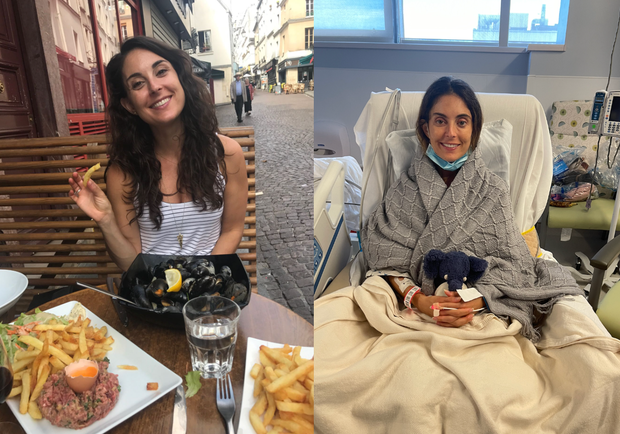
Becca Valle had no idea why she was plagued by persistent headaches. Her life was seemingly perfect: she took pleasure in a new job, enjoyed living with her boyfriend near family, and had just completed a marathon, marking a significant personal achievement. Yet, despite minimal stress, the headaches began to interfere with her daily life in September 2021, escalating to debilitating levels.
Valle initially attributed these headaches to migraines, while her doctor considered sinus issues. However, one day, the pain became unbearable, rendering her unable to sit up or prevent vomiting. Her concerned boyfriend took her to the hospital, where a scan revealed a dire condition—bleeding in her brain. This discovery led to an exploratory craniotomy, a procedure where a portion of the skull is removed for brain examination.
“I was probably too out of it to grasp the severity of the situation, which was fortunate. If I had truly processed that surgeons were removing part of my skull to access my brain, I might have been terrified,” recalled Valle, then 37.
The subsequent surgery discovered a brain tumor, and later testing identified it as glioblastoma. Fortunately, in a second craniotomy, the tumor was successfully removed. Despite complete removal, treatment for glioblastoma usually involves chemotherapy and radiation, given the aggressive nature of the cancer. According to MD Anderson Cancer Center, only around 10% of patients survive more than five years post-diagnosis.
Glioblastoma presents unique treatment challenges due to the blood-brain barrier—a protective cellular layer that keeps many medications from reaching the brain, complicating treatment of the organ.
Clinical Trials as a Path to Progress
Observing her situation, Valle was presented with an opportunity to join a clinical trial designed to temporarily open the blood-brain barrier. “It was an obvious choice: a potential life-saver,” she noted.
Dr. Graeme Woodworth, the lead researcher and the head of neurosurgery at the University of Maryland Medical Center, hypothesized that a focused ultrasound could safely breach the blood-brain barrier, enhancing chemotherapy’s effectiveness. Utilizing sound waves to activate microbubbles—typically used in imaging tests like echocardiograms—the technique allowed chemotherapy drugs to penetrate the blood-brain barrier for limited periods.
Valle was one of the 34 participants in this trial undergoing between three to six ultrasound treatments over six months, complemented by frequent MRIs to monitor their condition.
Early Success and Future Research
According to Dr. Woodworth, the early findings indicated a survival advantage for patients who received both chemotherapy and ultrasound treatments versus those with only chemotherapy. This approach added a new dimension to glioblastoma treatment, although more research is necessary. The comparative control group demonstrated a longer survival for those using this innovative method.
Dr. Patrick Wen, a neuro-oncologist not involved in the trial, lauded the research as a significant step forward, advocating for further systematic studies to validate these findings.
Currently, further studies are pursued to expand upon this promising research, although the University of Maryland isn’t offering the treatment clinically as it undergoes FDA review. They are also exploring its application for brain metastases in certain lung cancer patients. Additionally, the study indicates that liquid biopsies might be feasible to track progression in brain cancers, an exciting avenue for future exploration.
Dr. Woodworth envisions a future where an FDA-approved device could open the blood-brain barrier consistently and safely, fostering collaboration across medical and biotech fields for innovative therapies.
Living Beyond Statistics
For Valle, the trial involved no adverse effects and, four years post-diagnosis, shows no signs of disease—a remarkable outcome given the typically grim prognosis.
“I am truly an outlier,” Valle, now 41, reflected.
Today, Valle enjoys renewed vitality, planning trips and focusing on her present experiences rather than potential relapses. Reflecting on her outlook, she emphasized: “Worrying doesn’t serve me. I’ve always believed in living life to the fullest. Why change now?”
 Historical Foodborne Illness Outbreaks in the U.S.
  Joe Biden’s Battle with Prostate Cancer: A Deeper Look
  Rising Cases of Vibrio Vulnificus Infections in Louisiana and Florida
  Ethan Suplee’s Approach to Weight Loss and Sobriety
  MaineHealth to Close Lincoln Hospital Maternity Unit Despite Community Opposition
  A Personal Journey with Cancer: Strength, Family, and Hope