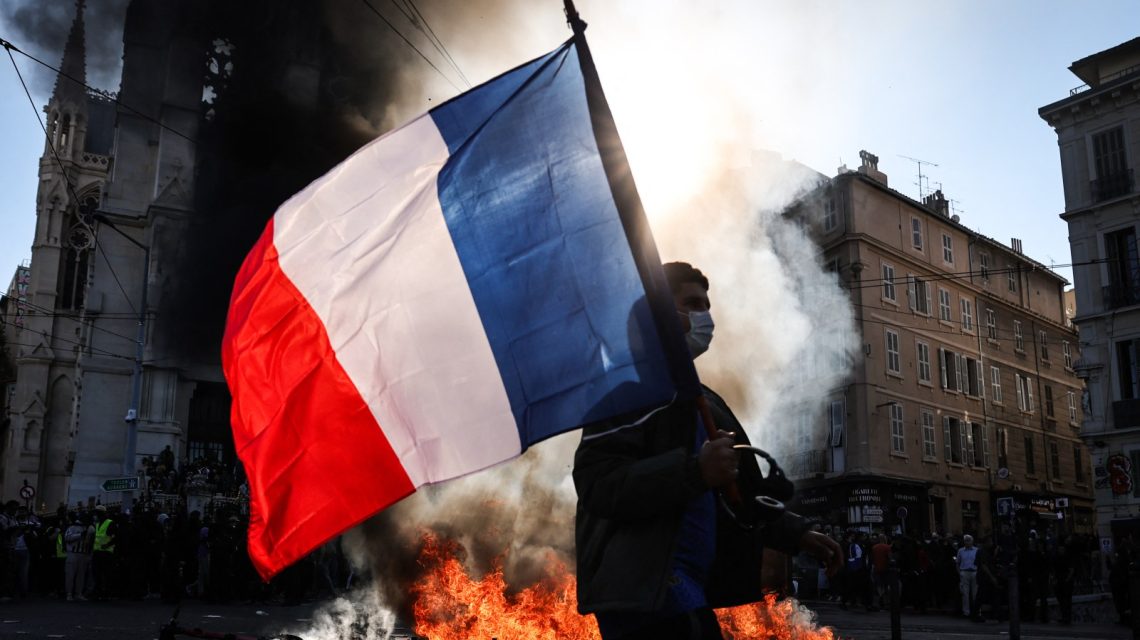
On October 17, over half a million French citizens marched peacefully in protest against the high cost of living and failing schools. By the end of the day, the town hall in Limoges, which had survived two world wars, was reduced to a smoldering shell. Nearly 2,400 individuals were arrested. Around 1,000 police officers and firefighters sustained injuries, and approximately 3,000 businesses faced looting or damage. Countless cars were set ablaze. What started as a public protest rapidly evolved into a crisis of public order, serving as a warning for the Western countries.
France has experienced protests before, and this unrest isn’t new to Europe either. However, this situation prompts a critical question: What occurs when organized radical movements exploit genuine grievances to undermine the institutions essential to a free society? It reflects a decline in a civilization’s ability to defend itself effectively.
Responses from French Leaders
French leaders are sounding the alarm. Prime Minister Sébastien Lecornu informed parliament that certain far-left groups had pursued an “insurrectionary plan,” with intelligence reports indicating that networks were aiming to incite chaos through next year’s presidential election. President Emmanuel Macron accused far-left activists of attacking law enforcement and public edifices. His interior minister conceded that authorities had “lost control” in major urban centers.
While peaceful protest is a democratic right, trouble arises when radical and Islamist factions, alongside foreign actors, exploit public grievances to assault law enforcement, destroy businesses, and compromise institutions. These actions transcend legitimate dissent and venture into intimidation.
Investigation into Organization and Funding
An inquiry into the funding behind these attacks raises questions. Reports scrutinized the 54 organizations associated with the French demonstrations and found only 16 were student or youth groups. The remainder comprised political parties, communist and Islamist groups, pro-revolutionary organizations, and other advocacy groups. Any potential ties between these groups and the violence need substantiation through evidence. Transparency is crucial so that citizens understand when organized networks mobilize against law enforcement and Western institutions.
Modern activist movements frequently operate through layers of intermediaries and nonprofits, making funding sources obscure. Among those scrutinized for their financial networks is tech mogul Neville Roy Singham. Allegations suggest his global political operation has connections to the Chinese Communist Party. Singham finances the nonprofit Tricontinental, whose leader, Vijay Prashad, publicly supported the protests. BreakThrough News, another entity linked to Singham, also amplified the demonstrations. While these connections do not conclusively indicate involvement in the recent violence, they warrant investigation given their growing global impact.
Implications of Radical Organizations
These well-funded radical organizations have domestic implications. International progressive groups have been financing campaigns against Immigration and Customs Enforcement (ICE) agents and local businesses. Notable among these is the Sunrise Movement, which has used financial leverage against hotels accommodating ICE agents. This harassment affects hotel employees, business owners, and ordinary Americans seeking income.
Despite differences, Marxist revolutionaries, Islamists, and regimes hostile to the West share an interest in weakening Western institutions and deepening social divisions. When such cooperation occurs, it merits investigation and legal action, not mere lamentation.
Statements from U.S. Authorities
The Trump administration frames the challenge as a matter of civilization. Secretary of State Marco Rubio, speaking in Athens, referenced “thumos,” the Greek concept of passion, strength, courage, and pride. He cautioned that without it, nations lose “their will to fight, to strive, to survive.” During the Munich Security Conference, he warned of “civilizational erasure.” Vice President JD Vance reiterated this sentiment, emphasizing the importance of governments enforcing their laws and securing their borders.
In November 2025, the State Department designated four European far-left groups as foreign terrorist organizations. However, Americans can witness similar dynamics domestically. In the summer of 2020, well-organized riots erupted across American cities, where police stations burned, small businesses were ravaged, and communities suffered enduring harm.
These Louis Vuitton boutiques demonstrate how public order can swiftly deteriorate when violence persists unchecked. The choice for Americans is clear—to support a flourishing civil society or allow intimidation and extremism to erode it. This choice demands transparent political financing, strict law enforcement, safeguarding civil and peaceful protests, and holding accountable those responsible for violence. Socialism and radical extremism regard people as material for movements, accepting sacrifices such as shopkeepers’ livelihoods or hotel workers’ wages for power. Conversely, America First prioritizes citizens before causes.
“E Pluribus Unum” extends beyond a motto. It signifies a collective commitment to a nation where people can live freely, raise families, practice faith, prosper, and dissent without fearing mob rule. The disturbances in France serve as a cautionary tale. Civilizations don’t collapse overnight; they weaken when leaders excuse disorder, institutions falter, and citizens lose the will to protect what ancestors established.
The choice regarding the future is imminent. Will society diminish under intimidation, or pursue greatness through the spirit of thumos? Choosing the latter returns stability and growth.
Chad Wolf occupies the position of chair of Homeland Security and Immigration Policy at AFPI. He previously served as the acting secretary of the U.S. Department of Homeland Security during President Trump’s administration. The opinions in the article reflect the author’s personal views.
 Democrats See Changing Fortunes in Senate Race Amidst Iranian Conflict
 Israel Faces Political Deadlock After Election
 The Chicago Network Introduces New Cohort ‘The Rung’ to Empower Women in Leadership
 Ashley Hinson Adjusts Her Message as Election Day Approaches
 Controversy Surrounds Mary Peltola’s Campaign Amid Allegations
 Economic Trends, Security Incident, and Cultural Icon Passing Impact on Society