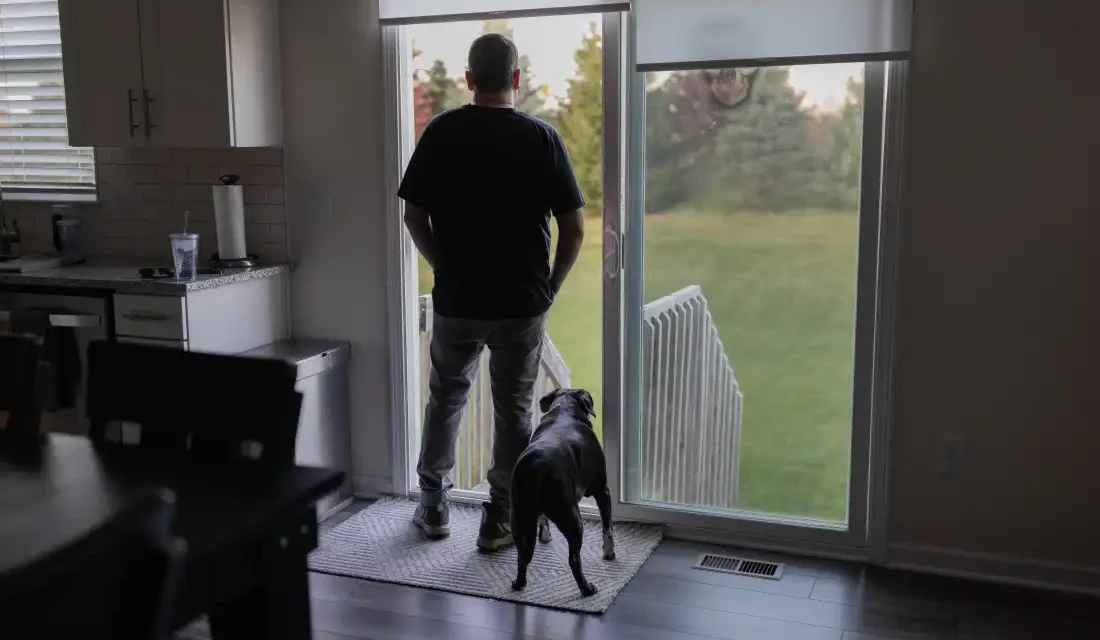
Army veteran Scott Boyd and his dog, Jessi, reside near Columbus, Ohio. Recently, Boyd’s monthly VA home loan payment surged by nearly $1,200 due to a loan modification. Boyd, who has a background in military intelligence, requested that his face not appear in photos.
Thousands of military veterans with VA-backed mortgages have grappled with increased interest rates and monthly payments since a low-interest program was terminated last year by the Trump administration. According to an NPR investigation, this program’s closure impacted over 15,000 veterans, who experienced monthly payment hikes of at least $150. More than 700 veterans saw increases of $1,000 or more.
Lenders modify loans to help homeowners catch up on missed payments. Such modifications often result in lower or unchanged payments for most Americans, based on their financial situation. However, since the VA program ended, many VA loans have not followed this trend. NPR found that 63% of veterans receiving loan modifications faced increased payments compared to only 2% for loans backed by Fannie Mae and Freddie Mac, which dominate the U.S. mortgage market.
California Democratic Rep. Mark Takano criticized the situation, stating, “These veterans are already under financial pressure; they were in difficulty even before this.” Veterans like Boyd have faced severe consequences.
Boyd, who enlisted in the military early to support his family after his father’s death, served in the infantry and Army intelligence. After leaving the service in 2002, he pursued a career in tech. In 2021, he purchased a house using a VA loan and secured a favorable low-interest rate. However, after losing his job in a mass layoff and experiencing PTSD, he fell behind on his mortgage payments. Despite assurances of a loan forbearance program, he was forced into a more expensive modification when the VA program was abruptly ended.
Mark Takano emphasized that the VA home loan system should not burden veterans further. Boyd, among many others, was left to adapt to higher costs. Efforts to address these issues have seen varying support. Illinois Republican Rep. Mike Bost and Wisconsin Republican Rep. Derrick Van Orden, members of the House Veterans’ Affairs Committee, did not provide comments.
Before its closure, the Veterans Affairs Servicing Purchase (VASP) program had aided thousands by converting missed payments into new loans with low 2.5% interest. Without VASP, veterans like Boyd have been forced into loans with higher rates. Boyd’s loan now carries a significant payment increase and a term extended to 40 years.
The abrupt end of VASP was forewarned by industry and housing groups, which urged not to eliminate it without a backup plan, leading to a gap that left many veterans vulnerable.
Following the program’s termination, Congress approved the new VA Partial Claim Program (PCP), designed to help veterans manage missed payments without significantly altering their mortgage terms. However, its implementation took over a year, forcing many into costlier modified loans in the interim.
Boyd, still managing the elevated payments, reflects on his decision to accept the loan modification under pressure, even though the new PCP could have maintained his original loan conditions. The VA has faced criticism for how these programs were handled, and discussions continue about potential legislative or VA-led remedies for those like Boyd affected by the program gap.
 The Journey to Citizenship: Voting for Family and Future
 Airlines Challenge New Ebola Travel Rules
 CEO of California High-Speed Rail Resigns Amid Allegations
 Residents File Nuisance Complaint Over Hollywood Sign Tourism
 Tragic Hiking Accident in Colorado
 State Line Bridge Removal Marks New Chapter for Kankakee River