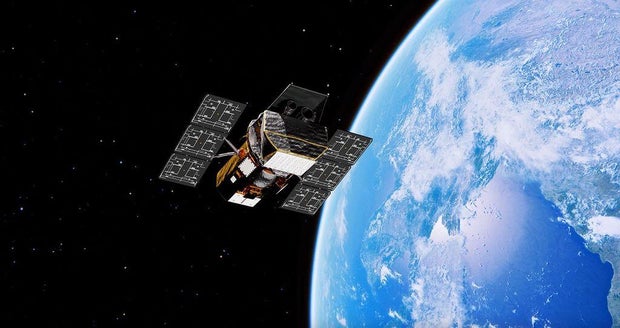
The Swift Observatory, a significant NASA telescope weighing around 1.5 tons, crashed back to Earth after efforts to save it failed. Launched over 20 years ago, it reentered Earth’s atmosphere at 7:39 a.m. ET above North Sumatra, Indonesia. Much of the 3,200-pound structure disintegrated on reentry, though some parts might still be found scattered across different regions, according to NASA.
The reentry path was monitored by NASA and the U.S. Space Force, with reentry predicted around 3:30 a.m. EST on November 4. An 11-hour window of uncertainty surrounded this prediction. NASA had earlier indicated that the risk of harm to people on Earth was low, with odds estimated at about 1 in 2,100.
First launched into low-Earth orbit on November 20, 2004, the Swift Observatory aimed to detect massive cosmic explosions like gamma-ray bursts and supernovas. Its name reflects its ability to rapidly pivot towards such phenomena. While initially expected to operate for two years, it continued to function for nearly 22 years, operating until last month when solar activity caused it to descend back to Earth.
In July, NASA partnered with Katalyst Space to attempt a rescue mission. A three-armed robot called Link was sent to push the telescope back into position. However, it encountered difficulties and couldn’t get within seven miles of the telescope, eventually falling back to Earth in September. By August, the decision was made to allow the Swift Observatory to return to Earth.
The observatory kept transmitting data until late October, at which point NASA determined its orbit was too low for stability, leading to a shutdown of its systems. During its lifespan, the Swift had detected over 2,000 gamma-ray bursts and 1,400 supernovas. It worked in tandem with the Hubble and Webb telescopes, alerting them and other facilities to conduct further investigations of the phenomena it observed.
“Swift has broadened our understanding of a wide variety of cosmic objects and events, from active galaxies powered by supermassive black holes and stars undergoing X-ray flares, to supernova explosions and comets and asteroids in our own solar system,” NASA stated in a blog post.
Efforts are now underway to find ways to replicate the contributions of the Swift Observatory. John Nousek, an astronomer from Pennsylvania State University, noted, “We’ve known this day would come since before Swift was launched. At least in low-Earth orbit, what goes up must come down. And that end is catastrophic.”
Nousek added that the hope is that what has been learned from Swift’s successes may help guide future space missions and continue to expand our knowledge of the universe.
 Coastal Flooding Highlights El Niño’s Impact on Southern California
 Radiation Risks for Satellites as Solar Storms Breach Boundary
 Pentagon UFO Investigation Challenges Reported Sightings
 Study Explores Effects of Physically Interacting With Dogs on Stress
 Reassessing Josephus’ Account of Jesus
 Cannabis and Sleep: Surprising Research Findings