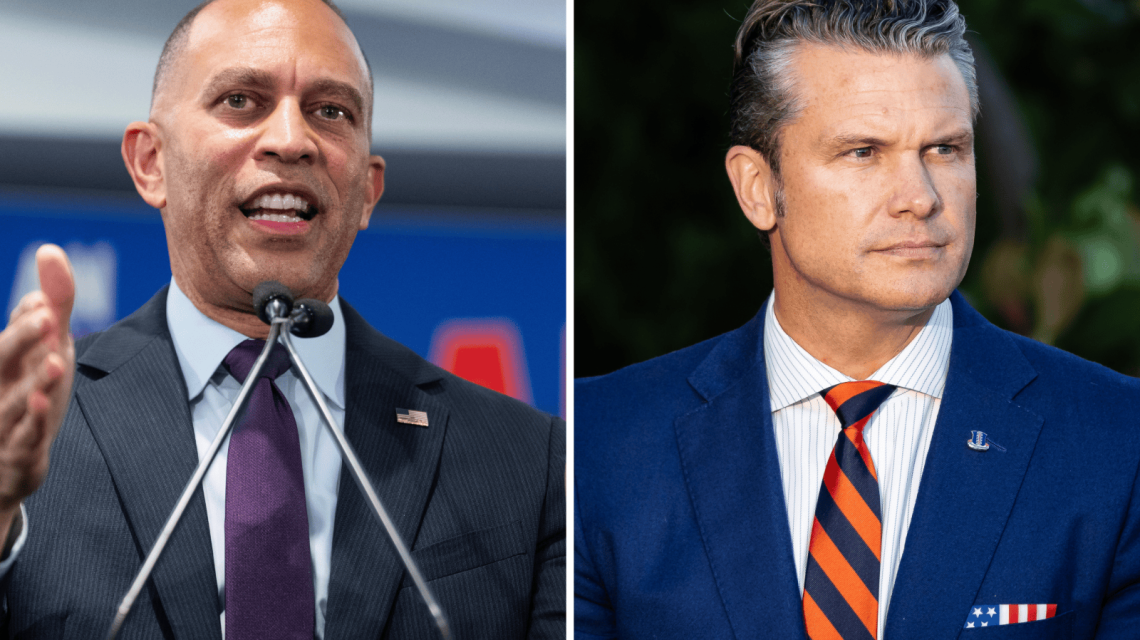
House Minority Leader Hakeem Jeffries, a Democrat from New York, voiced support for a Republican-led initiative to impeach Defense Secretary Pete Hegseth. On Sunday, Jeffries expressed his firm endorsement of the upcoming resolution, stating that the Pentagon leader ‘has got to go.’ This aligns Democratic leadership with outgoing Representative Thomas Massie, a Kentucky Republican, who plans to reintroduce a privileged impeachment resolution against Hegseth soon. Massie initially introduced an eight-article impeachment resolution in September.
Jeffries declared on ABC News’ This Week, “I’m a hard yes on the Hegseth resolution. The so-called Secretary of Defense has abused his power, undermined our national security, and started this reckless and costly war in Iran. Prices have surged, and the country is less safe. Pete Hegseth has got to go.”
The bipartisan push follows significant Democratic victories in recent midterm elections. The party gained control of both congressional chambers by turning at least seven Senate seats and over two dozen House seats. Following Republican losses, calls for Hegseth’s removal intensified. Some Republicans attribute these electoral setbacks to the ongoing Iran conflict and rising gas prices.
Massie announced his resolution’s reintroduction could occur during the current lame-duck session with the existing Republican House majority. Newsweek tried reaching the Pentagon for comment.
Massie’s Impeachment Articles Focus on War Powers
Massie’s resolution, read on the House floor in September, presents eight articles of impeachment against Hegseth. Article I accuses Hegseth of executing unlawful orders, contravening the War Powers Resolution of 1973. The resolution claims Congress holds constitutional authority to initiate war, alleging Hegseth introduced U.S. forces into hostilities without a declaration of war or valid authorization.
Further articles cite additional War Powers issues, along with allegations of civilian casualties and other military actions. These efforts stemmed from long-standing opposition to the administration’s Iran campaign. In June, the House passed a war-powers resolution by a narrow margin, aiming to reduce unauthorized military activity. Notably, four Republicans joined Democrats in this measure.
In a recent social media video, Hegseth criticized Massie’s actions as political theater, deeming the impeachment articles as ‘sham.’ He argued that Massie’s motives resemble past attempts to impeach President Trump, driven by a focus on personal destruction over policy.
Trump’s Position on Hegseth
Following the midterm results, questions about Hegseth’s future have grown. Reports surfaced that President Trump privately questioned Hegseth’s role. Yet, Trump publicly denied contemplating Hegseth’s removal, stating his belief in Hegseth’s competence. The White House affirmed Trump’s ‘full confidence’ in Hegseth, dismissing speculation about Hegseth relocating to a different role.
Impeachment Process and Next Steps
Though Jeffries remains firm in his stance, he did not promise unanimous Democratic backing for the resolution. He assured discussions among Democrats will happen when Congress reconvenes. As the potential future House speaker, Jeffries anticipates strong support for the resolution.
For privileged resolutions, House leaders must schedule action within two legislative days of introduction. Under the U.S. Constitution, impeachment demands a simple majority in the House. If articles pass, the Senate must reach a two-thirds majority for conviction and removal.
If the resolution does not pass in the current session, incoming Democrat majorities could initiate new investigations or resume impeachment efforts when taking control in January.
 European Officials to Attend U.S.-Mediated Peace Talks
 NASA Seeks Next Generation of Astronauts for Historic Missions
 Alaska Senate Race: Ongoing Close Contest Between Sullivan and Peltola
 Potential Impeachment and Political Developments Surrounding Pete Hegseth
 Trump Administration Shuffles Key Staff and Faces Allegations
 Trump’s Strategic Moves Against Iran and Their Implications