
The Democratic Party is trailing Republicans in the race to draw congressional maps for the U.S. House, with several seats behind heading into 2026. The party might catch up in 2028, but only by overcoming redistricting obstacles that Republicans do not encounter. Many Democrats face constraints, often self-imposed, that limit their ability to draw partisan political lines.
States like Colorado, New Jersey, New York, and Washington rely on redistricting commissions that aim to prevent party favoritism. Democrats would need voter permission to dismantle these popular bodies and implement maps that reflect partisan interests, similar to actions taken by Republicans following former President Donald Trump’s call for a major redrawing. If the Democrats misstep in the process, courts might overturn new maps, as seen in Virginia, where the state Supreme Court invalidated maps giving Democrats four additional seats due to procedural errors.
According to Adam Kincaid, executive director of the National Republican Redistricting Trust, this endeavor will be challenging, expensive, and unpopular. Yet, despite setbacks, Democrats remain hopeful of gaining control of the House, especially after the U.S. Supreme Court weakened a Voting Rights Act provision, allowing Republicans to remove at least three majority-Black Democratic seats in the South.
Redistricting and Future Elections
Midterm elections typically favor the party not holding the presidency, enhancing Democratic chances this year. However, securing a majority in 2028 appears tougher. Presidential races are generally tighter than midterms, and Republicans could further erode Democratic-held districts due to a recent Supreme Court decision. Potential opportunities exist in states like Indiana, Kentucky, and Kansas, where Republican influences might shift seat allocations.
Pressure mounts on Democrats to enhance their mapmaking strategies to increase their 2028 House chances, alongside aspirations to reclaim the Senate and the White House. A national ban on partisan gerrymandering could counter Republican advantages. Following the 2030 census, states with fast-growing populations controlled by Republicans could gain up to ten seats, mostly at the expense of Democratic areas like California and New York.
John Bisogano, executive director of the National Democratic Redistricting Committee, emphasized the urgency in prohibiting partisan gerrymandering at a federal level.
Challenges in Overcoming Redistricting Hurdles
While Republicans face legal hurdles, such as challenges in Florida regarding constitutional bans, Democrats encounter more significant barriers that require complex political maneuvering. Illinois and Oregon present opportunities for Democrats to gain additional seats with fewer obstacles.
In states like Colorado, New York, and New Jersey, Democrats could achieve significant gains, but constitutional amendments are necessary. Maryland Democrats aim to place a constitutional amendment on the November ballot to eliminate the state’s lone Republican House seat by 2028. Party supporters show a willingness to abandon reformist stances to match Republican redistricting practices.
In California, a new map proposition passed easily, allowing potential seat gains. Though narrow, Virginia approved a similar map, and Democrats remain committed to the 10-1 map strategy for 2028. Washington state’s Democrats must secure a two-thirds legislative majority to revise maps.
Particularly in states like Minnesota, Pennsylvania, and Wisconsin, Democrats aim to gain control of legislative seats, enhancing their ability to influence map drawing.
Policy Change and Democratic Strategy
New York illustrates the necessity for constitutional amendments to revise maps, requiring consecutive legislative votes over two years before a statewide ballot measure. Colorado’s Democrats, initially supportive of independent commissions, now seek voter approval to revert maps for a Democratic advantage.
Curtis Hubbard, representing Democrats in Colorado, emphasized that voters reject manipulative tactics by Republicans. Strategic responses to Republican maneuvers contrast past reforms emphasizing nonpartisanship. Democratic stance change is evident with support from key figures including Barack Obama, reflecting the shift towards aggressive redistricting as a response to perceived existential threats posed by Republican strategies.
Harvard Law Professor Nicholas Stephanopolous noted Democrats’ determination to counter these threats, highlighting their readiness to act decisively.
Contributions from Associated Press writer Scott Bauer underscore these insights into evolving strategies.
 Oregon School District Sued Over Denied Curriculum Reimbursement
  Democrats Anticipate Senate Gains Amid Poll Cautions
  Republicans Face Reelection Challenges Amidst Rising Living Costs
 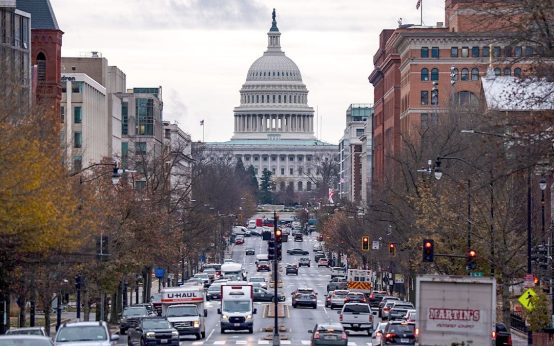 Congress Avoids Autumn Shutdown But Faces Post-Election Spending Battles
  Cornel West and Sean Hannity: Discussing Differences with Respect
  The Final Showdown for Congress Control