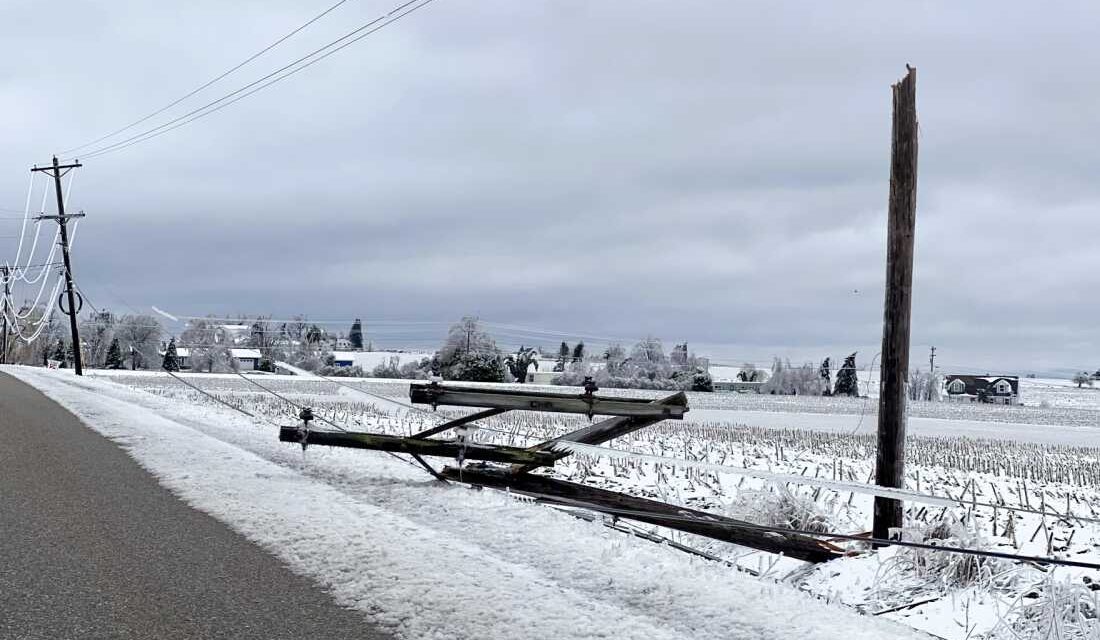
An ice storm in northern Michigan struck in March 2025, toppling trees and power lines. The storm led to significant damage and outages. Research indicates that with climate change, the area will experience more freezing rain instead of snow, likely increasing ice storm occurrences.
Power lines across the United States were not designed for the evolving climate. Many outages occur annually due to fallen trees on above-ground lines. Installing power lines underground can enhance reliability, especially with more frequent severe weather. Despite its benefits, only about 20% of the nation’s lines are buried, according to a U.S. Department of Energy report.
In response to the March 2025 storm, some utilities in northern Michigan aim to bury future lines. Thousands of residents were left without power for weeks. Among them was Wanda Whiting from Lewiston, MI, who faced a power outage during her husband’s health crisis. She navigated dark roads littered with fallen wires and poles to reach a hospital.
The blackout highlighted the vulnerabilities of the power grid during extreme weather. Michigan is already known for having extended power outages, a situation worsened by climate change. Richard B. Rood, a climate change adaptation expert from the University of Michigan, emphasizes the importance of planning for this altered climate reality.
“You can’t think of what we’re experiencing as, ‘this is how it used to be, and this is where it will be,'” Rood says. “You are right in the middle of the change here.”
The state’s largest electric co-op plans to bury all new power lines underground. This decision follows the severe storm that snapped utility poles and disrupted electricity for over 66,000 people, costing approximately $150 million in damage.
More Reliable but Costly Solutions
Burying power lines, although more reliable, is expensive. Utilities report that underground lines can cost significantly more than overhead ones. The Michigan Public Service Commission estimates that in urban areas, burying lines can range from $2-3 million per mile versus lower costs for overhead lines.
To curb expenses, some utilities opt to bury lines during new constructions. This approach allows integration with other utilities like water or gas, reducing costs. Tony Chartrand from Traverse City Light & Power acknowledges the financial balancing act utilities face.
“Part of that solution is undergrounding lines,” Chartrand says, “but it’s not necessarily undergrounding everything.”
Great Lakes Energy plans to bury new power lines, recognizing the substantial cost but also long-term reliability benefits. Shari Culver from Great Lakes Energy says that while burying lines can be three to five times more expensive, it helps prevent outages in the long run.
Financial Implications and Planning
Nationally, efforts to bury power lines increase, but higher electricity bills remain a concern. Investments in grid upgrades to meet rising demand add pressure. Tao Sun from Stanford University highlights the need for careful planning and community buy-in before disasters occur.
“If the utility wants to make any investment, this money doesn’t come from nowhere,” Sun says. “They have to pass on those costs to their customers.”
Examples like PG&E’s undergrounding project in response to California wildfires show that action often comes post-disaster. Yet, proactive planning could avert such reactive measures. Post-ice storm, many in Michigan, including Wanda Whiting, continue to consider better solutions for future storms. Whiting supports the move to underground lines.
“If it means going underground,” she says, “Then by God, go underground!”
 Running in Rising Temperatures: Marathon Challenges and Adaptations
  Fisher Discovers Ancient Bison Skull in Alberta Creek
  Major Earthquake Strikes Indonesia Causing Casualties and Damage
  NOAA Withdraws Direct Support for 2026 Arctic Report Card
  Mayor Johnson Orders Stricter Data Center Regulations in Chicago
  Concerns Grow Over White Mesa Mill’s Impact on Environment