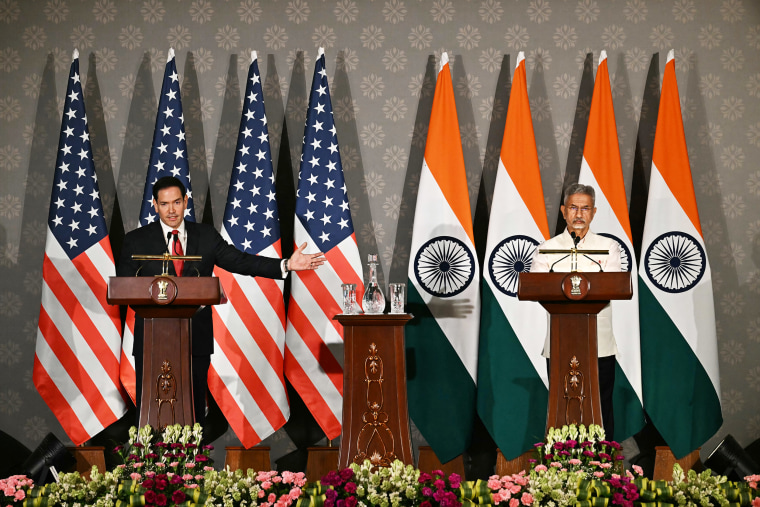
Summers in New Delhi can be severe. Secretary of State Marco Rubio arrived to temperatures exceeding 100 degrees. His four-day visit included meetings with key figures like Indian Prime Minister Narendra Modi and foreign ministers from India, Australia, and Japan. Social media users expressed concern over Rubio’s exposure to the sweltering conditions.
At the U.S. Embassy inauguration in New Delhi, Rubio remarked humorously about the heat. Despite the intense climate, his visit had significant diplomatic objectives.
“I wanted to keep this brief because it’s hot. It’s hot,” Rubio commented at the ceremony.
Rubio’s trip occurred at a crucial point for the Quad, also known as the Quadrilateral Security Dialogue, and for U.S.-India relations. Recent tensions have arisen over tariffs on Indian exports imposed by the Trump administration. Although an interim trade agreement was reached, issues, especially concerning energy, remain unresolved. Washington’s engagement with Pakistan over the Iran conflict further complicates New Delhi’s stance.
On Tuesday, Rubio labeled his meetings with Quad counterparts as “productive,” announcing several Indo-Pacific initiatives. These included projects focusing on maritime surveillance, port infrastructure, and critical minerals.
China responded that such cooperation should not target third parties, with an emphasis on maintaining regional trust and collaboration. Foreign Ministry spokesperson Mao Ning addressed the issue in Beijing.
Rubio’s itinerary also included a visit to Jaipur’s Amber Fort in Rajasthan, known for historical forts and palatial structures. The heat, however, was even more oppressive there. The Rubios also paid their respects at Mother Teresa’s resting place in Kolkata and toured the iconic Taj Mahal.
Amid the challenging climate, fuel prices in India have risen sharply due to disruptions in oil imports caused by Iran’s actions in the Strait of Hormuz. Discussions about this and the war with Iran were part of Rubio’s agenda during his visit. He suggested a reopening of the Strait as a potential element of future negotiations between Washington and Tehran.
Despite the severe conditions, Rubio spoke positively about the U.S.-India relationship. He noted the significance of their partnership and the opportunities it presents. A strategic agreement on critical minerals and rare earth supply chains was signed, highlighting cooperation on mining and recycling. His comments suggested a strategic aim to diversify resource dependencies, notably concerned with Chinese monopolies.
China was indirectly addressed in a joint statement by Quad countries, rejecting destabilizing actions that threaten regional peace, particularly in the South China Sea.
Following India, Rubio traveled to Yerevan for a Memorandum of Understanding signing with Armenian Foreign Minister Ararat Mirzoyan. Armenia, traditionally reliant on Russian energy, is gradually seeking alternatives.
 Oregon’s Wildfire Crisis Calls for New Solutions
  The U.S. DOGE Service and Government Dysfunction
  Selective Accountability in Education Raises Concerns
  Democratic Candidates Bring Faith to Their Congressional Campaigns
  Republicans Face Challenges in Upcoming Midterm Elections
  Bobby Pulido’s Unique Congressional Bid