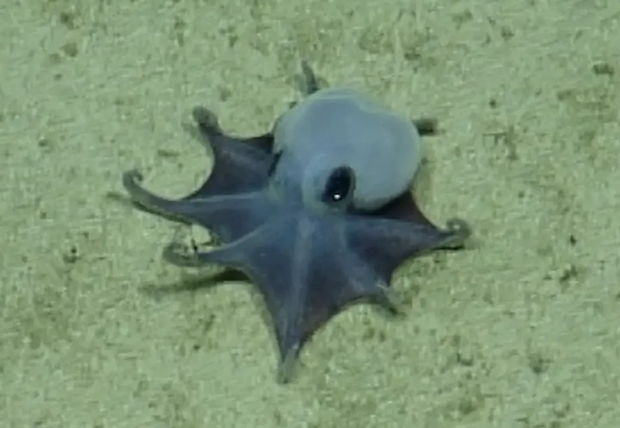
Scientists exploring the ocean floor near the Galapagos Islands uncovered a striking discovery. They found a small octopus, as blue as the sea, that could fit in the palm of one’s hand. An enthused researcher exclaimed, “He’s tiny! It’s blue!” upon spotting the octopus via submersible footage.
The Charles Darwin Foundation’s team revealed this new octopus species found about 5,900 feet deep. This revelation followed research released on a recent Monday. Janet Voight, an expert on octopuses, identified this peculiar creature. Initially, she relied on photos sent to her by the Field Museum of Natural History in Chicago. Later, she received the actual preserved specimen.
“When it arrived, my reaction was ‘Oh! My goodness! It’s beautiful,'” Voight shared with AFP. Remarkably, the nearest known octopus with a similar shape resides off Uruguay’s coast, far across another ocean. Normally, examining a new octopus species involves dissecting its features like the mouth and beak. Voight refrained from dissection since there was only one specimen.
Instead, the Field Museum harnessed CT scan technology. They collected thousands of X-ray images to construct a detailed 3D model of the octopus’s internal structure. Stephanie Smith, who leads the museum’s X-ray lab, stated, “There’s nothing like spending the day looking at something no other human has ever seen.”
The newly named species, Microeledone galapagensis, has more to note than its unique hue, which is considered rare in nature. The octopus is considerably smaller than its relatives in the Megaleledonidae family that typically inhabit the Southern Ocean surrounding Antarctica. It possesses short arms, each featuring only one row of suckers.
Amongst octopuses with short arms and single sucker rows, its color and smooth skin remain unique. Voight noted that while light blue covers its back, a deep purple shades its underside. She explained that such coloring might provide safety. If the octopus captures bioluminescent prey, its dark web conceals the light, reducing its visibility to predators.
Discovering new octopus species in unexplored ocean zones is quite common. Voight mentioned the vastness of the ocean floor, saying it covers more area than all Earth’s land combined. She last discovered a new octopus off Costa Rica’s coast in 2023.
The first sighting of this blue octopus occurred in 2015, near Darwin Island. The area is named after Charles Darwin, whose Galapagos visit influenced his evolutionary theory. Interestingly, it’s Voight’s first official leadership in describing a new octopus species during her extensive career.
This research appears in Zootaxa journal. Approximately 300 octopus species exist globally across all oceans. In 2024, scientists discovered four more octopus species near Costa Rica.
 The Discovery of Incendiamoeba cascadensis: A Fire Amoeba
  Archaeological Discovery in Germany: Largest Hoard of Roman Coins Found
  Hurricane Formation and Strengthening
  Ancient Mastodon Tooth Unearthed in California Creek
  The Tiny World of the Pumpkin Toadlet
  Chimps and Self-Medication: Insights from Gombe Stream