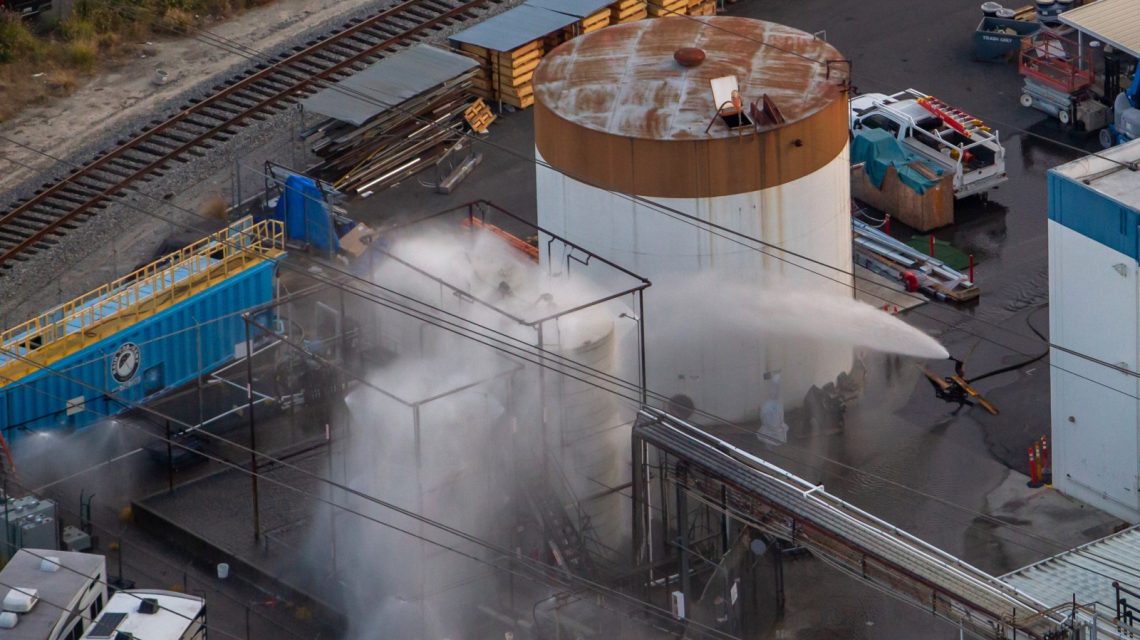
A massive chemical tank in Southern California has become a significant concern as its temperature reached 100 degrees Fahrenheit, raising fears of a potentially catastrophic explosion. Efforts are underway to stabilize the situation, with two key developments offering hope in reducing the risk.
Efforts to Stabilize Overheating Chemical Tank
Fire crews in Garden Grove are working to manage a tank filled with thousands of gallons of methyl methacrylate. This volatile chemical is used in the production of plastics and aerospace materials. The temperature reached a critical point of at least 100 degrees on Sunday, prompting fears of a thermal runaway reaction that could lead to an explosion. The tank’s instability has forced the evacuation of over 40,000 people from Garden Grove and nearby areas as officials warn of a potential explosion or a significant chemical spill.
Crack in Chemical Tank Offers Temporary Relief
A structural crack discovered by the Orange County Fire Authority (OCFA) may provide a temporary pressure release for the tank. This crack acts like a pressure-release valve, possibly allowing gases to escape and reducing the built-up pressure inside, thereby preventing a violent rupture. “With this new information, it could change our trajectory and our strategy to this event,” said T.J. McGovern, OCFA’s interim fire chief. Despite rumors, the OCFA clarified there is only one known crack, ensuring the public that continuous monitoring confirms no chemicals are leaking.
Weather Conditions Play a Crucial Role
The local weather in Garden Grove is another factor helping to mitigate the risk. According to the National Weather Service, mild temperatures and limited wind activity are expected to continue, slowing the rate of heat buildup inside the tank. Highs in the low 70s and lows in the 50s offer ideal conditions for cooling operations. Additionally, light winds limit the spread of potentially hazardous vapors.
Community Response and Government Involvement
The emergency began on May 21 when overheating caused vapor release from the tank at a GKN Aerospace facility. A faulty valve has compounded the issue, making direct intervention difficult. The situation remains one of the most complex hazardous materials emergencies in California’s recent history, involving coordinated efforts across multiple agencies. Residents affected by the evacuation have expressed concerns over the sudden disruption to their lives.
The situation has garnered federal attention, with the White House and the Environmental Protection Agency (EPA) involved. Temporary air monitoring systems have been deployed across the area by the EPA. The federal response, coupled with Governor Gavin Newsom’s declaration of a state of emergency, aims to provide additional resources and support for affected residents.
Ongoing Monitoring and Uncertainty
Despite measures to mitigate risk, officials warn that danger persists. The tank remains unstable, and authorities have not confirmed a decrease in internal reactions. Monitoring equipment has limitations, resulting in uncertainty about the tank’s internal condition. Evacuation orders remain in effect as crews work continuously to monitor and prepare for all possible outcomes.
 Flash Flood Emergency in Muncie, Indiana
  Far-Left Streamer Predicts Challenges for Socialist Left After Primary Defeat
  Europe Witnesses a Total Solar Eclipse
  Karoline Leavitt Resigns as White House Press Secretary
  White House Press Secretary Karoline Leavitt to Step Down
  CTA Introduces Crisis Intervention Teams on Rail Lines