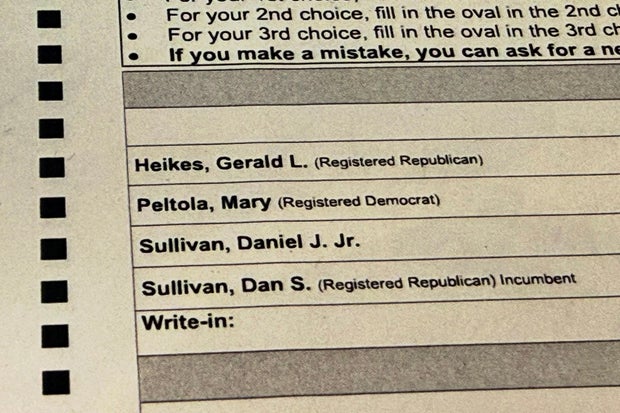
Alaska voters head to the polls for significant races, including a Senate election attracting attention due to two candidates with nearly identical names. This election highlights Alaska’s unique election system.
Understanding Alaska’s Voting System
Alaska uses a top-four nonpartisan primary system and ranked choice voting for its general elections. This system has been under the spotlight since its introduction. Here’s how it works.
Ranked Choice Voting Explained
Ranked choice voting allows you to rank candidates in order of preference instead of choosing just one. This system, first used in 2022, aims to reduce polarization by moving away from party primaries.
If a candidate receives more than 50% as the top choice, they win. If no candidate achieves this, the candidate with the fewest votes is eliminated. Votes for the eliminated candidate are then redistributed based on the voters’ next choice. This process repeats until a candidate secures a majority.
Example: If 100 people voted, with Candidate A as the top choice for 50, Candidate B for 40, Candidate C for 7, and Candidate D for 3, no candidate wins outright. Candidate D is removed, and those 3 votes shift to the second preferences of those voters. A candidate reaches a majority if someone garners more than 50 votes after redistribution.
In a previous special election under this system, Democrat Mary Peltola won after a ranked choice tabulation that lasted 15 days.
Candidates in the Alaska Senate Race
This Senate race may influence control of the upper chamber. Voters will choose from four candidates: incumbent GOP Sen. Dan S. Sullivan, Daniel J. Sullivan, Gerald Heikes, and Peltola.
Sen. Sullivan, a Marine veteran, has a significant contender, Peltola, who marked history as the first Democrat in decades to represent Alaska in the House. The entry of Daniel J. Sullivan, a former teacher, complicates the race.
The Controversy Over Two Dan Sullivans
Daniel J. Sullivan’s candidacy led to a legal battle regarding his place on the ballot. Despite efforts to remove him, a court ruling maintained his eligibility, causing concerns about voter confusion. Peltola had a strong showing in the open Senate primary, while the teacher received limited support.
The ballot distinguishes the two with the incumbent listed as “Sullivan, Dan S. (Registered Republican) Incumbent” and the teacher as “Daniel J. Sullivan.” The latter’s campaign faced scrutiny for potentially fragmenting the vote.
Legal Challenges and Election Results
The Trump administration attempted to prevent certification of the election should incumbent Sullivan lose, but a federal judge dismissed the lawsuit. The Justice Department plans to appeal.
Political operatives aligned with Peltola allegedly tried to involve Daniel J. Sullivan as a strategy; however, Peltola denies participation.
Timeframe for Election Results
Counting votes in Alaska can take time due to its large size, remote areas, and mail-in ballots, with mail ballots counted up to 15 days post-election. Ranked choice tabulation begins only after all votes, potentially delaying results by weeks.
Officials aim to certify results by Nov. 25, based on past timings. Peltola’s previous full-term win occurred on Nov. 30.
 James Talarico and Frederick Haynes III Address Immigration and Racial Issues
 Justice Department Seeks Supreme Court’s Intervention on California Mail-In Ballots
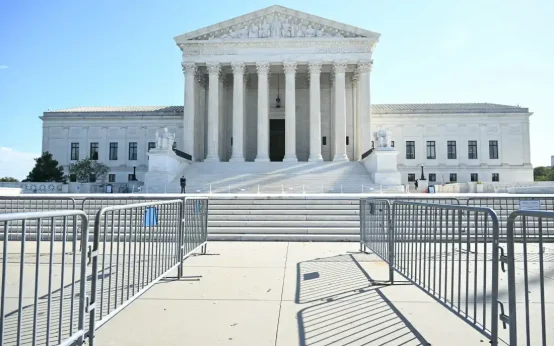 DOJ Appeals to Supreme Court Over California Voter Roll Dispute
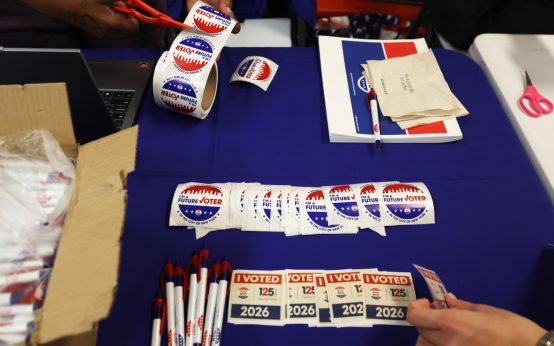 Potential Shifts in Power for Upcoming Elections
 Ballot Controversy in Alaska Senate Race Mirrors Florida Case
 Trump’s Shift on Canada Trade Talks Amid Economic Tensions